
An HMRC “nudge letter” lands roughly the same way a parking ticket does: badly designed envelope, opening line in passive voice, and an alarmingly short response window. The letter isn’t an investigation. It’s HMRC’s signal that they have data suggesting you’ve under-declared something — usually one specific income source — and they’re inviting you to come forward voluntarily before they escalate. Get the next 30 days right and you’ll save tens of thousands. Get them wrong and the same cost-of-living-crisis HMRC will turn into the most expensive professional services bill of your life.
What a nudge letter actually is
HMRC’s Connect system pulls data from 30+ sources — bank account interest, Land Registry, Companies House, Airbnb, eBay, Vinted, Spotlight, OnlyFans, Twitch, AdSense, foreign tax authorities under CRS reporting, and many more. When the data flags an anomaly (e.g. £80k of YouTube income vs zero declared self-employment), Connect generates a candidate. A human officer reviews and either:
- Issues a nudge letter (you’ve still got control of the narrative)
- Opens a formal enquiry under Section 9A TMA 1970 (you’ve lost it)
The nudge letter has a 30-day deadline by convention. If you respond — even just with “I’m engaging professional advice and will revert” — they’ll usually wait. If you ignore it, HMRC opens the formal enquiry and the discount on penalties drops sharply.
The 30-day playbook
Days 1–3: Don’t panic, don’t reply yet.
- Read the letter twice. What income source are they asking about? Is it a single year, a range, or unspecified?
- Check the section reference. Common ones:
- Letting income (LFC1)
- Foreign income / capital gains (CRS)
- Online platform income (DAC7)
- Property disposals (Land Registry)
- Crypto disposals
- Dividend income from certain sources
- Note the deadline. Calendar it.
- Stop posting publicly about anything that might be relevant on social media. HMRC officers do read.
Days 4–10: Build the timeline.
- Pull every bank statement (all UK accounts + Wise + PayPal + Stripe + foreign accounts) for the years in question.
- Pull platform statements (YouTube/Twitch/OnlyFans/Patreon/Airbnb/eBay/Vinted/Spotlight/Etsy) for the years.
- If you’ve sold property: Land Registry records of the sale + completion statement.
- If foreign income: foreign tax authority statements + bank records.
- Build a rough year-by-year reconciliation. Where’s the gap between what you declared and what HMRC plausibly knows?
Days 11–15: Engage a specialist accountant.
- The disclosure document is a legal-quality narrative, not a spreadsheet. Penalties hinge on how it’s framed.
- Look for an accountant who specialises in HMRC investigations and disclosures. £150–£300/hour, typically £2k–£5k for a straightforward case, more for complex ones.
- Brief them with the bank statements + platform statements + your year-by-year reconciliation. Don’t sanitise — they need the full picture.
Days 16–25: Choose the disclosure route.
- Digital Disclosure Service (DDS) — for most undeclared-income cases. Online registration, 90 days from registration to file, calculates tax + interest + penalty.
- Worldwide Disclosure Facility (WDF) — specifically for foreign income/gains.
- Code of Practice 9 (COP9) / Contractual Disclosure Facility — if HMRC suspects deliberate fraud. Higher penalty cap (100%) but immunity from criminal prosecution if accepted. Specialist territory.
- Reply to the original nudge letter explaining which route you’ve chosen.
Days 26–30: File the notification, prepare the calculation.
- Notify HMRC via the chosen disclosure route within the 30 days.
- You then have 90 more days to file the actual disclosure (calculations + narrative + evidence).
- Use that time properly — don’t rush.
The 7 things NOT to say
- “I didn’t know I had to declare it.” Ignorance isn’t a defence. It also escalates the penalty rating from “non-deliberate” to potentially “deliberate concealment” if HMRC believes you should have known.
- “My accountant should have told me.” Doesn’t reduce your liability. Pursue your accountant separately if needed; don’t lead with it to HMRC.
- “I’ll just pay what I owe; I don’t need to disclose properly.” Without formal disclosure, you don’t get the reduced penalty rates. Paying without disclosing leaves you exposed to investigation and full penalties.
- “It was only a small amount.” HMRC’s penalty banding is by behaviour and disclosure quality, not amount. Don’t minimise.
- “It’s not really income because [reason].” If you’re disputing whether the income is taxable at all, you need a different process — but don’t argue it informally in a nudge response. Get advice first.
- Anything about other income sources that aren’t covered by their letter. If you have other undeclared sources, deal with them in the disclosure — but don’t volunteer them to the original letter without thinking through the disclosure scope.
- “I’ll get back to you.” …and then don’t. Silence after a nudge letter is the single biggest predictor of a full enquiry.
Penalty bands
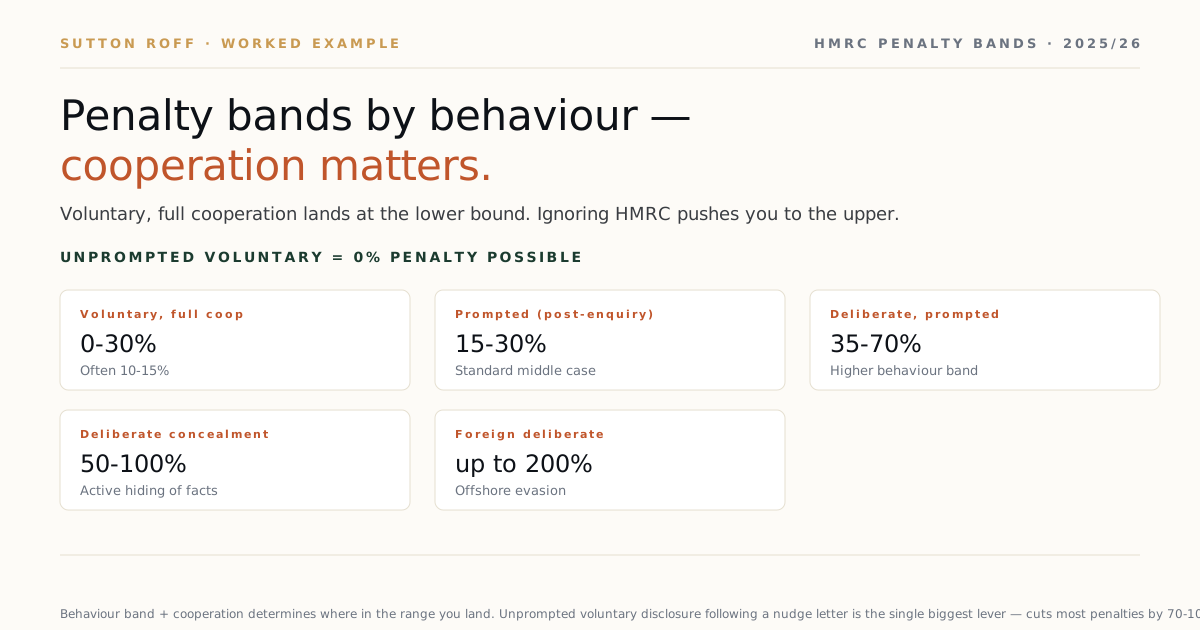
For non-deliberate, prompted disclosure, the penalty bandings are roughly:
| Behaviour + cooperation | Penalty range | Typical landing point |
|---|---|---|
| Voluntary, full cooperation | 0%–30% | 10–15% |
| Prompted (after enquiry) | 15%–30% | 20–25% |
| Deliberate, prompted | 35%–70% | 50% |
| Deliberate concealment | 50%–100% | 70% |
| Foreign income deliberate | up to 200% | varies |
Behaviour and cooperation determine where in the band you land. Voluntary disclosure following a nudge letter is the single biggest lever you have.
Behaviour and cooperation determine where in the band you land. Voluntary disclosure following a nudge letter is the single biggest lever you have.
How long does it take to close?
For a clean case where you cooperate fully:
- Disclosure filed: ~3 months from nudge letter
- HMRC review: 3–6 months
- Settlement letter and final demand: ~9–12 months total
- Payment terms can usually be agreed in instalments if needed
For complex cases or those that escalate to formal enquiry: 18 months to 3+ years.
Key takeaways
- A nudge letter isn’t an investigation — it’s a 30-day window to come forward voluntarily.
- Voluntary, prompted disclosure typically lands a 0–15% penalty. Ignoring it pushes that to 30%+.
- Don’t reply substantively until you’ve engaged a specialist and built a clean timeline.
- The Digital Disclosure Service is the standard route. Notify within 30 days, file within 90.
- Don’t volunteer information beyond the scope of the letter without specialist advice.
FAQ
Can I extend the 30-day deadline?
Yes — HMRC will usually accept an extension if you respond promptly explaining you’re engaging professional advice. A short letter on day 5 saying “I’m engaging an accountant; will respond within X days” protects the relationship.
What if I genuinely don’t owe anything?
Reply briefly explaining the position — ideally with a specialist’s help to make sure your wording doesn’t accidentally widen scope. A “nothing to declare” reply still needs careful framing because of how penalty regimes interact.
Should I tell my accountant about this?
Yes — ideally a specialist accountant who handles HMRC enquiries, not necessarily your everyday compliance accountant. Disclosure work and standard year-end accountancy are different specialties.
If a nudge letter has landed — or you suspect one might — the worst thing to do is wait. Book a confidential 20-min call within the 30-day window. We’ll review the letter, scope the likely exposure, and agree the next steps. Specialist HMRC defence accountants.