
HMRC has data-sharing agreements with Coinbase, Binance, Kraken and most major UK-accessible exchanges. We see clients arrive thinking 2018-2022 trades were “untraceable” and discover via a one-to-many letter that HMRC has known about the activity for years. Crypto disposals attract 18%/24% CGT (post-October 2024 rates), with a £3,000 annual exemption as the only protection.
What HMRC treats as crypto disposals
A “disposal” of crypto is any of these — each one is a CGT event:
- Selling crypto for GBP or any other currency
- Exchanging one crypto for another (BTC → ETH is a disposal of BTC and acquisition of ETH)
- Using crypto to pay for goods or services
- Gifting crypto to anyone other than your spouse/civil partner
The capital gain is the difference between disposal value and acquisition cost (in GBP at the time of each transaction). Each transaction needs to be tracked individually for tax purposes.
Section 104 pooling for crypto
HMRC’s Section 104 pooling rules apply to crypto: each token type (BTC, ETH, SOL etc.) is treated as a single asset pool. Buys add to the pool at average cost; sells dispose of pool tokens at the average cost basis.
So if you bought 1 BTC at £20,000 and 1 BTC at £40,000, your average cost basis per BTC is £30,000. Selling one BTC at £50,000 = £20,000 capital gain.
The 30-day rule applies: selling and rebuying the same token within 30 days matches the rebuy against the sale (rather than going into the pool). This is HMRC anti-avoidance for “wash sale” trades intended to crystallise gains within the annual allowance.
Annual exempt amount and rates
£3,000 of gains per tax year are exempt (down from £12,300 in 2022/23). Above that, gains are taxed at 18% in your basic-rate band and 24% in your higher-rate band — the post-October 2024 rates that brought crypto in line with residential property and shares (covered in our CGT on shares piece).
Nathan’s £20,000 crypto gain — three timing strategies
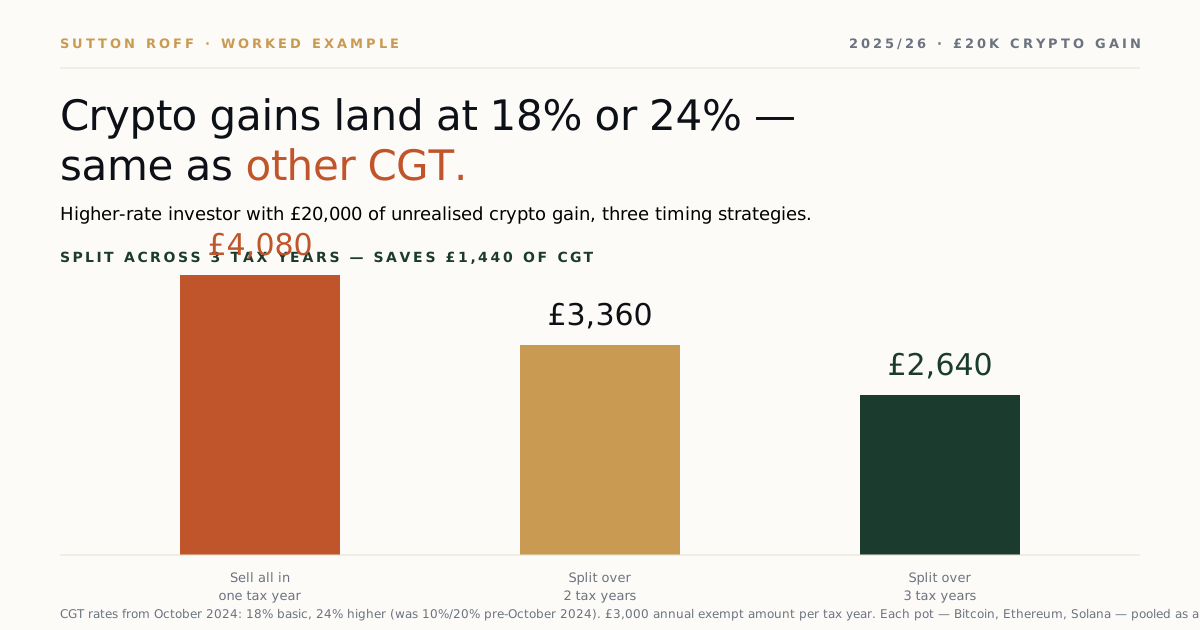
Nathan, a higher-rate-taxpayer investor, has £20,000 of unrealised gain across BTC and ETH.
Strategy A — sell all in one tax year:
- Gain: £20,000 less £3,000 = £17,000 taxable
- Higher rate: 24% × £17,000 = £4,080 tax
Strategy B — split over 2 tax years:
- Each year: £10,000 gain less £3,000 = £7,000 × 24% = £1,680
- Across 2 years: £3,360 tax
- Saves £720
Strategy C — split over 3 tax years:
- Each year: £6,667 gain less £3,000 = £3,667 × 24% = £880
- Across 3 years: £2,640 tax
- Saves £1,440
Sequencing crypto disposals across tax years is the simplest planning lever — and most platforms now support partial sells without forcing all-or-nothing decisions.
Crypto income vs gains
Some crypto activities are taxed as income, not gains:
| Crypto activity | Tax treatment | When taxed |
|---|---|---|
| Mining rewards | Income | At market value when received |
| Staking rewards | Income | At market value when received |
| DeFi yield / liquidity mining | Income (mostly) | At receipt; some treated as gain |
| Airdrops (no service obligation) | Capital | At eventual disposal |
| Airdrops (in exchange for action) | Income | At market value when received |
| Hard fork tokens | Capital | Cost basis split with original |
| Sale / swap / spend / gift | Capital gain | At disposal (CGT) |
| Spouse transfer | No-gain-no-loss | — |
Income from these activities is added to your other income and taxed at marginal rate (20%/40%/45%). For higher-rate-taxpayer crypto miners earning £25,000 of mining rewards: £10,000 of tax.
Both gains and income may eventually be disposed of for further gains/losses, with cost basis being the GBP value at the income-recognition point.
The bed-and-spouse trick
Inter-spouse transfers are no-gain-no-loss. So a higher-rate-taxpayer crypto holder can transfer half their holdings to a basic-rate-taxpayer spouse before sale — same logic as the share-gift mechanic in our gift-shares-to-spouse CGT piece. Cuts the bill by getting half the gain at 18% basic rather than 24% higher.
What about losses?
Crypto losses (whether through bad trades, exchanges going bust, or scam victimisation) are allowable capital losses. They offset gains in the same tax year first; net unused losses carry forward indefinitely.
Critical: losses must be reported to HMRC to be available for future offset. Many crypto holders with losses from 2018-2022 collapses haven’t recorded them and are sitting on £10k+ of unused loss potential.
“Negligible value” claims — for tokens that have effectively become worthless — let you claim the loss without a formal disposal. Useful for shitcoins or rugged projects where you can’t actually sell.
The reporting mechanics
Crypto gains report on the SA Capital Gains supplementary page, due 31 January following the tax year end. Crypto income reports on the standard SA self-employment or other-income pages.
You’re expected to report each disposal separately (per token type, per disposal date), with cost basis, proceeds, and any allowable costs. Platforms like Koinly, CoinTracking, Recap convert exchange and wallet data into HMRC-format reports.
Records to keep
- Every transaction date, token type, GBP value at time
- Wallet addresses involved
- Exchange CSVs
- DeFi transaction hashes for income recognition events
- Mining/staking reward records
HMRC can request crypto records going back 6 years (careless behaviour) or 20 years (deliberate non-disclosure) — covered in our HMRC investigation timeline piece.
What about NFTs?
NFTs are treated as crypto for tax purposes — same CGT rates and rules. Each NFT is its own asset (not pooled like fungible tokens). Sale of an NFT for a gain follows standard CGT rules.
NFT-creator income (selling primary NFTs of your own art) is trading income, not capital. Same as any artist selling their work — income tax and Class 4 NIC apply if it’s a trade rather than occasional sale.
When this is a bad idea
Don’t ignore crypto tax thinking it’s “untraceable”. HMRC has data-sharing agreements with major exchanges (Coinbase UK, Binance, Kraken, etc.) and increasingly receives KYC information on UK customers.
Don’t try to dodge the 30-day rule with rapid sell/rebuy across exchanges — HMRC’s matching rules apply across all exchanges and wallets you control.
Don’t forget to report losses. The unused loss bank from 2018-22 collapses is enormous and underreported.
Key takeaways
- Crypto disposals (sell, swap, spend, gift) are CGT events at 18%/24% rates.
- £3,000 annual exempt amount; sequencing across tax years saves real tax.
- Mining, staking, most DeFi yield = income tax on receipt.
- Section 104 pooling and 30-day rule apply to crypto.
- Inter-spouse transfers no-gain-no-loss — useful pre-sale move.
- Losses must be reported to be carried forward.
FAQ
How do I value crypto in GBP at the time of disposal?
Use the GBP price at the time of the disposal — from a major exchange (Coinbase, Binance, Kraken). Daily close price is acceptable; intraday for high-frequency traders. Document the source and conversion.
Does borrowing against crypto count as a disposal?
No — using crypto as collateral for a loan isn’t a disposal. The loan itself isn’t taxable. But if the position is liquidated by the lender, that liquidation is a disposal triggering CGT.
What about NFTs and DeFi positions?
NFTs are crypto for tax (CGT on disposal). Each NFT is its own asset (not pooled like fungible tokens). DeFi positions (yield farming, liquidity provision) are mostly treated as income with HMRC’s 2022 guidance — some specific exceptions.
Held crypto across exchanges and never filed the gains? Book a free 20-min review — confidential. We’ll reconstruct historical trades from CSVs, identify unregistered losses, and structure a voluntary disclosure if there’s back-period exposure. Specialist UK crypto tax and disclosure accountants.