
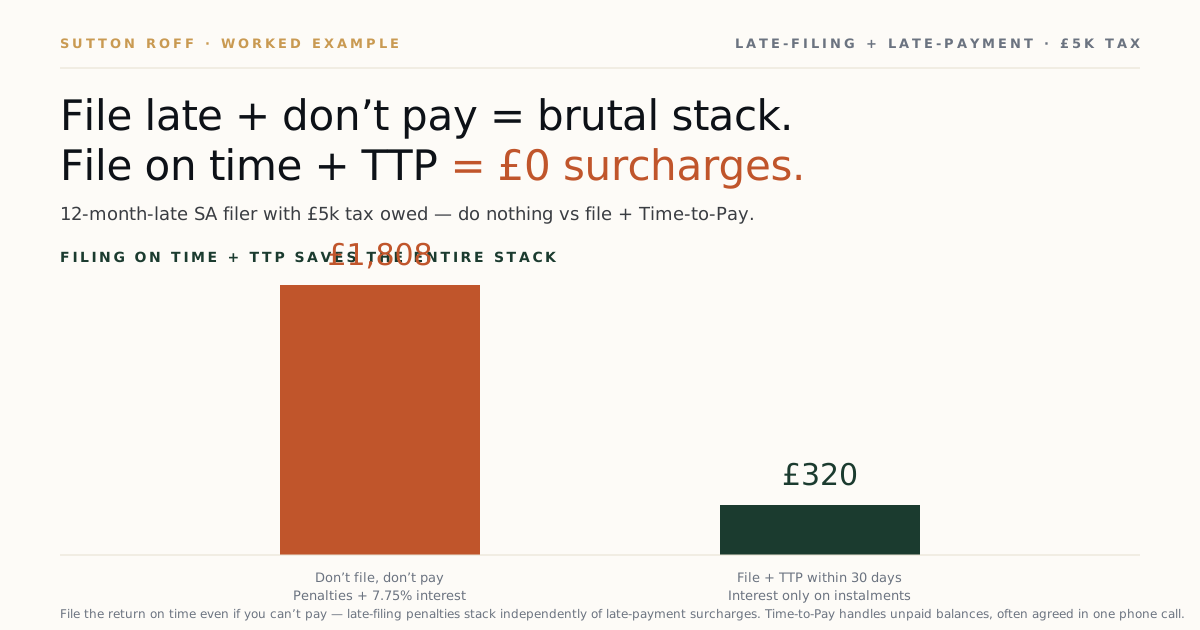
The most expensive mistake people make with a tax bill they can’t pay is not filing the return. Late-filing penalties stack independently of late-payment penalties, and skipping the return creates the second cost without solving the first. We see clients pile up £1,500 of avoidable penalties before they call HMRC — when a single Time-to-Pay phone call would have killed the entire stack on day one.
The first rule — file the return regardless
Late-filing penalties stack independently of late-payment penalties. Filing late costs:
- £100 day-one fixed penalty
- £10/day from month 3, capped at £900
- 5% of tax owed (or £300) at 6 months
- Another 5% (or £300) at 12 months
Detailed escalation in our late filing penalty piece. Critically: filing is free; not filing because you can’t pay creates the second cost without solving the first.
So whatever the cash situation, file the SA return on or before 31 January.
Time-to-Pay — usually agreed in one phone call
Once filed, you can apply for a Time-to-Pay arrangement via:
- Online self-service at gov.uk (for SA debts under £30,000)
- Calling HMRC’s Self-Assessment Payment Helpline: 0300 200 3835
- Through your accountant if HMRC has authorisation
For SA debts under £30,000 with no other tax debts and no recent Time-to-Pay history, HMRC typically agrees to:
- 12-month repayment plan
- Equal monthly direct-debit instalments
- Interest at the published rate (7.75% currently) on the outstanding balance
- No late-payment penalty if the agreement is set up before 30 days late
For larger debts or repeat customers, HMRC needs more financial information — proof of income, expenses, why you can’t pay, what assets you have.
What you’ll be asked
The standard Time-to-Pay conversation covers:
- How much you owe (HMRC already knows)
- Why you can’t pay it now
- Your monthly take-home income
- Essential monthly expenses
- Any other debts or commitments
- The longest you’d need to repay
- The largest monthly instalment you can manage
HMRC typically lands on a 12-month plan for routine cases. For genuine hardship they extend to 18-24 months; for very high-debt cases they may want a security or shorter timeline.
What HMRC won’t agree to — set expectations honestly
- Wave away the tax (only forgiveness via tax refund or amendment)
- Wave away the late-payment interest (statutory)
- Agree to no instalments — they always want a structured payment
- Negotiate when you’ve ignored prior letters or defaulted on previous plans
Late-payment penalty stack (separate from late-filing)
For taxpayers who’ve migrated to Making Tax Digital for Income Tax (£50k+ from April 2026, £30k+ from April 2027), HMRC’s newer points-based regime applies:
| How late on payment | MTD ITSA regime (post-migration) | Pre-MTD SA regime |
|---|---|---|
| 1–15 days late | No penalty (interest only) | No penalty (interest only) |
| 16 days late | 3% surcharge on outstanding tax | — |
| 31 days late | +3% surcharge (6% total) + 4%/yr daily interest | 5% surcharge |
| 6 months late | — | +5% surcharge |
| 12 months late | — | +5% surcharge |
| Statutory interest on top | 7.75% (current) | 7.75% (current) |
Setting up a Time-to-Pay agreement before the relevant deadline eliminates the surcharge entirely. After it, surcharges apply even with TTP — though HMRC sometimes waives them for first-time arrangements made promptly.
Paying via direct debit
Time-to-Pay agreements typically run through HMRC’s direct debit. Once set up:
- Monthly instalment amount fixed at agreement
- First payment usually 7-10 days after agreement
- Interest accrues daily on outstanding balance
- Final payment may be slightly larger to cover accrued interest
You can pay off early with no penalty — interest stops the day the balance clears. Some taxpayers set up Time-to-Pay then settle early when cash flow improves; HMRC has no objection.
If Time-to-Pay isn’t enough
For tax debts above £30,000 or where you genuinely can’t make even a 12-month plan work, the conversation moves to:
1. Extended Time-to-Pay (24+ months). Possible but needs more detailed financial review.
2. Asset-based settlement. If you have assets but no cash flow, HMRC may agree to staged payments tied to asset realisation timing.
3. Insolvency-related settlement. If genuinely insolvent, the formal insolvency processes (IVA, bankruptcy) include HMRC as a creditor with rules for prioritising the debt. Tax debts in personal insolvency are treated like other unsecured debts.
4. Hardship discharge. Rare and difficult but possible — HMRC can write off tax debt where there’s genuine inability to pay and no prospect of future ability. Written-off tax shows on the taxpayer’s record and may affect future credit.
The mistake we see clients make — robbing HMRC to pay other creditors
Don’t pay one creditor by not paying HMRC. The instinct to pay credit cards, suppliers or landlords first feels rational but creates the worst outcome. HMRC is one of the more lenient creditors (with TTP) but the most aggressive enforcer once cooperation breaks down.
Don’t take out high-interest debt to pay HMRC. The 7.75% interest on TTP is much cheaper than typical credit-card or short-term loan interest. Keep the cheap debt with HMRC; clear the expensive debt elsewhere.
Don’t ignore the letters. HMRC’s enforcement escalates from polite reminders to debt collection agency referral to enforcement action (bank account orders, bailiff visits, charges on property). The window from first letter to enforcement is 4-12 weeks; communicating early stops the escalation.
What if you’ve already missed the deadline?
Late filing means the £100 fixed penalty has already applied. If you also miss payment:
- File the return immediately (stops further filing penalties)
- Call HMRC about Time-to-Pay (will negotiate even after-the-fact)
- Pay the £100 fixed penalty if you can
- Set up direct debit for the agreed instalments
- Appeal the late-filing penalty if you have a “reasonable excuse” — bereavement, hospitalisation, IT failure on HMRC’s side. Bar is high but real.
What about HMRC enforcement?
If you ignore the debt entirely, HMRC’s enforcement options include:
- Distraint (bailiff visit to seize goods)
- Charging Order on property
- Direct Recovery (bank account access for tax debts above £1,000 — requires court agreement post-2014)
- Bankruptcy petition for personal debt
- Wind-up petition for company debt
- Driving licence suspension (rarely used; possible for very large unpaid debts)
None of these happen quickly — typically 6-12 months from missed deadline to enforcement, with multiple opportunities to engage and arrange Time-to-Pay along the way.
Key takeaways
- File the return on time even if you can’t pay — late-filing and late-payment penalties stack separately.
- Call HMRC’s TTP line — automatic 12-month plan for SA debts under £30k.
- Set up TTP before day 30 to avoid late-payment penalties.
- Interest at 7.75% on outstanding balance — cheaper than most other debt.
- Direct debit instalments — early settlement free of penalty.
- Don’t take expensive debt to clear cheap HMRC debt.
FAQ
What if I miss a Time-to-Pay instalment?
HMRC may cancel the agreement. The full balance becomes immediately due with all the original surcharges and interest. Contact them before the next missed payment if you see a problem coming.
Does TTP affect my credit score?
No — HMRC TTP arrangements aren’t reported to credit reference agencies. Your formal credit history isn’t affected. Some lenders ask about HMRC arrears in mortgage applications, so disclose where required.
Can I get TTP for a payment over £30k?
Yes, but the process is more involved. HMRC requires detailed financial information, asset disclosure, and may want security. Larger debts often need 24-month or longer plans agreed individually rather than via the standard online flow.
Got a tax bill you can’t pay or about to miss the 31 January deadline? Book a free 20-min review — we’ll get the return filed today, call HMRC’s Time-to-Pay line on your behalf, and lock in the instalment plan before the late-payment surcharges kick in. Specialist UK self-assessment and HMRC negotiation accountants.