
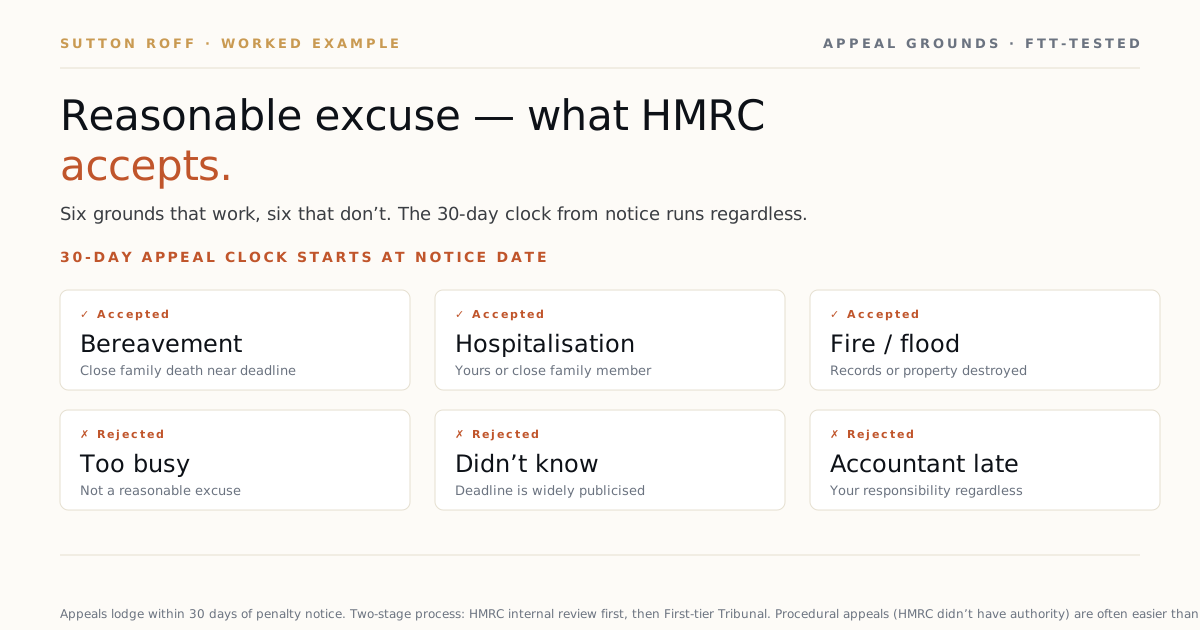
HMRC penalties carry a 30-day appeal clock from the notice date. The “reasonable excuse” defence is real but narrow — bereavement, hospitalisation, fire, HMRC system failure. “Too busy”, “didn’t know”, and “my accountant filed late” don’t qualify. We see strong appeals fail at internal review because the letter didn’t anchor the right grounds, and weak ones succeed because they did.
The 30-day clock starts from the penalty notice
HMRC issues penalty notices for late filing, late payment, inaccurate returns, and various compliance failures. Each notice includes the right to appeal. The window: 30 days from the date of the notice.
Miss the 30-day window and you can request a “late appeal” — but HMRC’s discretion to accept narrows considerably after 30 days, and your appeal grounds need to address the lateness as well as the underlying penalty.
The two-stage appeal process
Stage 1: Internal review. Submit the appeal in writing to HMRC. They allocate it to a different officer (not the one who issued the penalty) for an independent review. Decision typically arrives within 45 days.
Stage 2: First-tier Tribunal. If the internal review upholds the penalty and you still disagree, you can appeal to the First-tier Tax Tribunal within 30 days of the review decision. The tribunal hears evidence from both sides and reaches an independent ruling.
Most appeals settle at stage 1 — either HMRC concedes or the taxpayer accepts the outcome. Tribunals are uncommon for routine SA penalties.
“Reasonable excuse” — narrow but real
HMRC accepts these as reasonable excuse grounds:
- Bereavement — close family member’s death around the deadline
- Hospitalisation or serious illness — your own or that of a close family member
- Fire, flood, theft — destruction of records or property near deadline
- HMRC system failure — when the failure is on HMRC’s side, not yours
- Being unexpectedly out of UK with no internet — narrow, but real
- Postal disruption — for paper-filed returns where post is provably delayed
What HMRC does not accept as reasonable excuse:
- Being too busy
- Not understanding the rules
- Forgetting the deadline
- Your accountant didn’t file on time
- Pressure of work
- Computer/software failure on your side
- Not receiving the reminder
The bar is “circumstances that prevented compliance despite reasonable efforts” — not “circumstances that made compliance inconvenient”.
Tribunal-tested cases
Cases that have succeeded at tribunal:
- Taxpayer hospitalised with serious illness in November-January, return due 31 Jan
- House fire destroyed accounting records and computer in early January
- Postman provably delivered penalty notice late, taxpayer responded within 30 days of receipt
Cases that have failed at tribunal:
- Accountant filed late (taxpayer responsible for choosing accountant)
- “I didn’t know about the deadline” (deadline is widely publicised)
- Software couldn’t connect to HMRC at 11:55pm on 31 January (taxpayer should have started earlier)
- “My business was struggling so I couldn’t afford to file” (financial struggle isn’t reasonable excuse for filing)
How to write the appeal
The appeal letter should:
- Reference the penalty notice (date, amount, reason)
- State the grounds of appeal — reasonable excuse, factual error, or procedural failure
- Provide specific evidence supporting your grounds
- Attach supporting documents (medical notes, death certificates, proof of disruption)
- Confirm the date when the underlying obligation (filing or payment) was finally met
- Request the penalty be cancelled
HMRC’s online services let you submit appeals digitally for many penalty types. Otherwise written submission to the address on the penalty notice.
Helen appeals a £100 late-filing penalty — bereavement grounds
Helen’s SA return was due 31 January. Penalty notice issued 5 February for £100.
Helen’s mother died unexpectedly on 15 January. Funeral 24 January. Taxpayer was helping organise affairs and missed the 31 January deadline. Filed return 12 February.
Appeal letter:
- References the £100 fixed penalty
- Grounds: reasonable excuse — bereavement of mother on 15 January
- Evidence: death certificate, funeral attendance evidence, statement of duties
- Confirms return filed 12 February (within reasonable time after returning to normal affairs)
- Requests cancellation
This appeal would normally succeed at internal review stage. The penalty would be cancelled and any payment refunded.
Procedural appeals — sometimes easier than reasonable-excuse
Some penalties can be challenged on procedural grounds even without reasonable excuse:
- HMRC didn’t have authority to issue the penalty — e.g. penalty issued for a year you weren’t required to file
- The underlying tax wasn’t actually due — penalty contingent on tax that was incorrectly calculated
- You weren’t legally obliged — e.g. your income was below SA registration thresholds (covered in our SA registration piece)
- HMRC issued duplicate penalties — same offence penalised twice
- Notice not properly issued — wrong address, missing required elements
Procedural appeals are often easier to win because they don’t rely on subjective judgement of “reasonable excuse” — they’re factual challenges to HMRC’s authority or accuracy.
Penalty-specific appeal grounds
Late-filing penalty: reasonable excuse, return wasn’t due, return was filed within time but not received
Late-payment penalty: reasonable excuse, payment was made on time, payment wasn’t due (e.g. underlying tax incorrectly assessed)
Inaccuracy penalty: the inaccuracy was carelessness rather than deliberate (lower penalty rate), or there was no inaccuracy at all
Failure to notify penalty: you weren’t required to notify, or you did notify within the relevant time
What if you’re partly at fault?
HMRC sometimes reduces penalties rather than cancelling them. For example, a £900 penalty for filing 4 months late might be reduced to £100 if you can show 3 of those months were due to genuine excuse and 1 month was your delay.
Partial wins are common at internal review stage. Tribunals tend to be more binary (uphold or cancel) but can also adjust amounts in some categories.
The “Special Circumstances” reduction
Beyond reasonable excuse, HMRC has discretion under “special circumstances” to reduce penalties. This applies in rare cases where the strict application of the rules would be disproportionate or unfair given specific facts.
Special circumstances reduction is rarely granted — but it’s worth requesting alongside a reasonable excuse appeal as a fallback.
What about interest?
Interest on unpaid tax is statutory and not subject to appeal. You can appeal a penalty but not the underlying interest charge.
If your appeal succeeds and the underlying tax was wrong (so no interest should have been charged), the interest is automatically refunded. If the appeal succeeds only on the penalty (with the tax still due), interest still applies.
When to involve a specialist
For routine £100 fixed penalties, DIY appeal is usually fine. For:
- Penalties above £1,000
- Discovery assessment penalties
- Behaviour-categorisation challenges (careless vs deliberate)
- Code of Practice 8/9 outcomes
- Tribunal-level appeals
…the cost of professional help is usually a fraction of the difference in outcome.
When this is a bad idea
Don’t appeal frivolously. Frivolous appeals can attract additional penalties for “tribunal abuse” — rare but possible.
Don’t ignore the penalty hoping it goes away. After 30 days the appeal route narrows; after 6 months HMRC moves to enforcement.
Don’t admit fault prematurely. Sometimes a penalty issued for “deliberate behaviour” can be reduced to “careless” with the right framing — admitting deliberate up-front locks in the higher penalty.
Key takeaways
- 30-day window from penalty notice to appeal.
- Two-stage process: internal review then First-tier Tribunal.
- “Reasonable excuse” is narrow — bereavement, illness, disasters, HMRC system failure.
- “Too busy” or “didn’t know” don’t qualify.
- Procedural appeals often easier than reasonable excuse — challenges HMRC’s authority not your conduct.
- Specialist help worth considering for penalties above £1,000 or behaviour-categorisation appeals.
FAQ
Can I appeal multiple penalties at once?
Yes — one appeal letter can cover multiple penalty notices. Reference each penalty separately and apply your reasonable-excuse or procedural argument to each. Saves admin and presents a coherent case.
Does an appeal pause the late-payment surcharges?
No — appealing a penalty doesn’t pause the underlying payment due. Interest and additional surcharges continue accruing on unpaid tax. Pay the tax (or set up Time-to-Pay) while appealing the penalty.
What’s the cost of going to tribunal?
First-tier Tax Tribunal hearings are free (no court fees). Your costs are mainly accountant or barrister representation if you choose to use them. Self-representation is allowed; some appellants do go alone successfully on simpler cases.
Penalty notice landed and the 30-day clock is running? Book a free 20-min review — we’ll assess whether reasonable-excuse, procedural-failure, or special-circumstances grounds apply, and draft the appeal letter to maximise the chance of cancellation. Specialist UK HMRC penalty appeal accountants.