
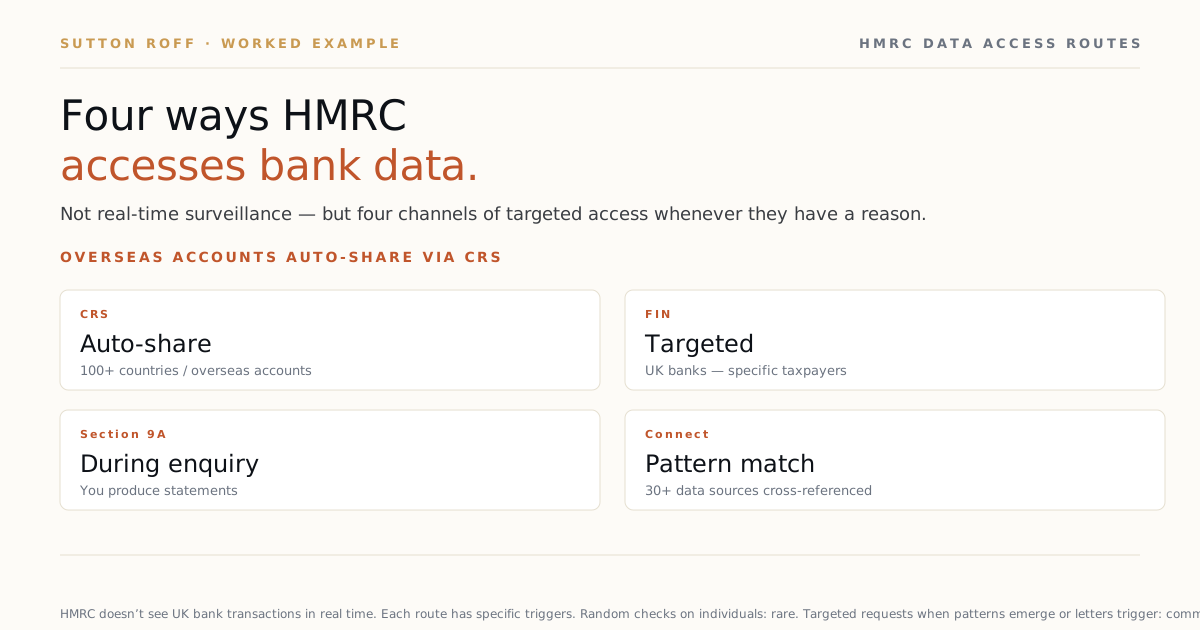
HMRC doesn’t watch your transactions in real time — but their Connect system cross-references 30+ data sources, and the Common Reporting Standard automatically shares overseas account data from 100+ countries. The “they’ll never notice” assumption was already obsolete in 2018; in 2026 it’s actively expensive. We see clients arrive after a one-to-many letter wondering how HMRC found out — often the answer is bank data shared via CRS five years ago.
Four routes — none of them are real-time surveillance
1. Common Reporting Standard (CRS) — automatic. Every year, UK and 100+ other countries automatically exchange bank account data on each other’s tax residents. So if you’re a UK resident with a Spanish, German or US bank account, HMRC receives summary data on your balance, interest earned, and dividends from those accounts every year.
UK domestic accounts don’t flow through CRS — they don’t need to, since UK banks already provide tax-relevant information (interest reporting, ISA tracking) directly to HMRC.
2. Financial Institution Notices (FINs) — targeted. HMRC can issue a Financial Institution Notice to a UK bank to provide data on a specific taxpayer. No court order needed — this was created specifically for HMRC investigations and can compel banks to provide transaction history.
FINs target specific people HMRC is investigating. They aren’t a sweep — but if HMRC is enquiring into your tax affairs, they can compel your bank to share records.
3. Information notices — under enquiry. When HMRC has opened a Section 9A enquiry into your tax return, they can issue you a formal request for bank statements covering the relevant period. Failure to comply triggers daily penalties.
4. Connect database — pattern matching. HMRC’s Connect system cross-references 30+ data sources. It doesn’t directly see bank transactions, but it pieces together visible patterns — Land Registry purchases, DVLA car registrations, online platform earnings, social media spending — to identify cases where declared income doesn’t match observed lifestyle.
What HMRC doesn’t have — and why the surveillance myth misleads
- Real-time transaction monitoring — HMRC can’t see your spending or transfers as they happen
- Account-level visibility on UK current accounts without a specific notice or enquiry
- Automatic spending pattern analysis — they have data sources but not real-time AI surveillance
The myth that HMRC sees every transaction is false. The reality is they have substantial data and powerful targeting — but they need a reason to look at any specific person.
Triggers that prompt HMRC to look
Most bank data requests follow specific triggers:
- Discrepancy between declared income and visible lifestyle
- Untaxed income from offshore (CRS data flagging)
- Platform-reporting from Vinted/eBay/Uber showing undeclared activity
- Tip-offs from members of public, ex-spouses, business partners
- Pattern matching across data sources (e.g. property purchase but no declared rental income, expensive car registration but modest declared income)
- Random selection for compliance audit (rare but happens)
For someone who’s filed accurately and consistently, the chance of HMRC requesting bank data is low. For someone with patterns suggesting undeclared income, the chance climbs.
What overseas account data HMRC sees automatically
CRS reporting from overseas banks typically includes:
- Account holder’s name, date of birth, address
- Account number and balance at year-end
- Total interest, dividends, gross proceeds from sales
- Type of account (savings, investment, custody)
What CRS doesn’t include: detailed transaction history, individual transfers, daily spending patterns. So HMRC sees the year-end balance and total income, not the day-to-day flow.
If you have an overseas account with £80,000 of unreported interest income, CRS reporting tells HMRC about it. They then issue a FIN to the same bank for transaction-level history if they investigate.
Connect — HMRC’s 30-source pattern-matching engine
HMRC’s Connect cross-references:
- Land Registry property purchases
- DVLA car registrations
- Companies House director appointments
- Land Registry rental tenancies
- Local authority short-term let licensing
- Foreign exchange records
- Social media (publicly visible)
- News articles, court records, planning applications
The system flags inconsistencies — e.g. someone who declared £25,000 of income but bought a £600,000 house. Doesn’t prove anything, but triggers manual review and potentially an enquiry letter.
What about cash transactions?
Cash gets significant attention from HMRC because it’s harder to track. Banks report large cash deposits (above £10,000) under anti-money-laundering rules. Cash purchases of high-value items (cars, property deposits) attract scrutiny.
For routine cash from declared sources (e.g. cash tips paid to a waiter), the issue is just getting it onto the tax return. For undeclared cash income, the longer it accumulates the more visible it becomes via lifestyle pattern matching.
Joint accounts
Joint accounts don’t change the visibility — both account holders’ data flows through CRS or FIN requests. Married couples don’t get any privacy advantage from joint accounts versus individual accounts.
What you should do if you’re worried
If you have undeclared income (even from years ago):
- Don’t move money around to “hide” it — anti-money-laundering reporting flags transfers
- Don’t continue undeclared activities — current-period non-disclosure compounds the problem
- Consider voluntary disclosure — penalties dramatically lower than HMRC-discovered (covered in our HMRC investigation timeline piece)
- Engage a specialist before contacting HMRC — opening letters frame the case
What you don’t need to worry about
If you’re filing accurate returns and your visible activity matches declared income:
- HMRC doesn’t watch your daily transactions
- Routine transfers between your own accounts don’t trigger reviews
- Normal living expenses don’t get flagged
- Standard PAYE employees with no extra income basically never get audited
The privacy question
UK financial privacy isn’t absolute. HMRC has substantial powers to compel data when they have grounds. But they don’t have unfettered surveillance — every request needs a reason within their legal framework.
For most taxpayers most of the time, this is fine. For people with complicated affairs (multiple income sources, offshore accounts, undeclared activity), the data infrastructure has changed substantially in the past decade and continues to expand.
Key takeaways
- HMRC accesses bank data via CRS (overseas auto-share), FINs (UK targeted), enquiry notices, and Connect pattern matching.
- No real-time transaction monitoring of UK current accounts.
- Overseas accounts visible through CRS data exchange with 100+ countries.
- Connect database flags lifestyle-vs-declared-income inconsistencies.
- Specific data requests require specific triggers — rarely random.
- Voluntary disclosure dramatically cheaper than HMRC discovery.
FAQ
Can HMRC see my crypto wallet?
Centralised exchange accounts: yes via DAC7 / data-sharing agreements with major exchanges. Self-custody wallet: not directly, but transactions to/from monitored exchanges create data trails HMRC can follow.
What about cash deposits?
Cash deposits over £10,000 are reported by banks to HMRC under anti-money-laundering rules. Multiple smaller deposits in patterns get flagged for review. Cash isn’t invisible to HMRC’s monitoring systems.
Does HMRC see PayPal or Wise transactions?
PayPal and Wise file information reports under DAC7 for users above platform reporting thresholds. Personal use up to small thresholds may not be reported, but business activity above £1,740/30 transactions is.
Have undeclared income or an overseas account that hasn’t been on a return? Book a free 20-min review — confidential. We’ll size the exposure, explain how HMRC likely already knows, and structure a voluntary disclosure before a prompted letter arrives. Specialist UK voluntary disclosure accountants.