
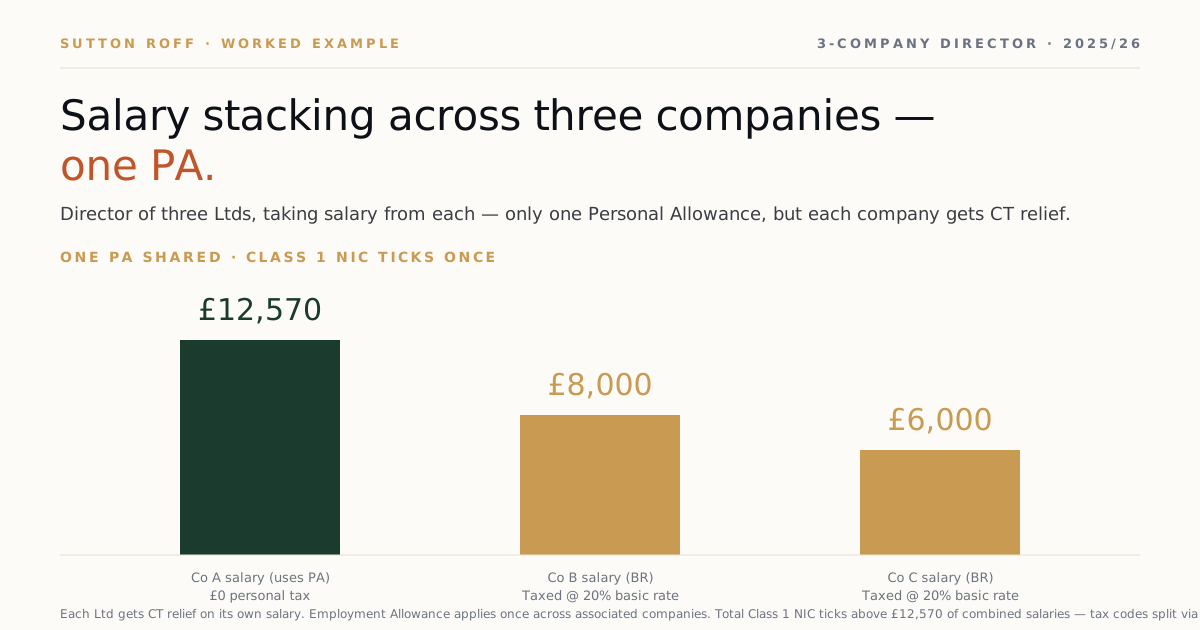
If you genuinely own and run two or more separate companies, you can draw a salary from each — and the NIC secondary threshold applies independently to each employment. Done correctly, this can extract several thousand pounds a year from your companies more efficiently than dividends. The April 2025 NIC changes (secondary threshold dropped from £9,100 to £5,000, employer NIC up to 15%) tightened the maths considerably. Here’s the 2025/26 reality.
The principle — NIC stops applying separately per employer
National Insurance Contributions are calculated separately by each employer (unlike income tax, which aggregates across all sources). So if you draw £8,000 of salary from Company A and £8,000 from Company B, neither hits the £5,000 secondary threshold by enough to create a meaningful NIC bill — even though combined you’ve earned £16,000.
Income tax does aggregate, so you’ll pay tax across the total — but salaries are corporation-tax-deductible at 19–25%, while dividends aren’t. The net cost of an extra salary is therefore lower than an extra dividend in many scenarios.
The maths — extra salary vs extra dividend
For a basic-rate-band-filling director (income up to £50,270), a £10,000 extra salary vs £10,000 extra dividend:
Extra salary:
- Personal income tax: 20% on £10,000 = £2,000
- Employer NIC: 15% on (£10,000 − £5,000) = £750 (CT-deductible)
- CT relief on salary + NIC: 19% × £10,750 = £2,043 saving
- Net cost to company + director: £2,000 + £750 − £2,043 = £707
Extra dividend (same £10,000 to director):
- CT already paid on £10,000 of profit at 19%: £1,900
- Distributable: £8,100 net dividend (after CT)
- To get £10,000 of dividend, need pre-CT profit of £12,346, costing £2,346 of CT
- Plus dividend tax at 8.75%: £851
- Net cost: £2,346 + £851 = £3,197
Salary wins by ~£2,500 per £10,000 of extraction in the basic-rate band. Dividends pull ahead at higher tax rates — the picture flips above the higher-rate threshold.
The “associated companies” rule
The catch: if your two companies are associated, NIC has to be aggregated across them. HMRC’s definition of associated isn’t crisp but generally captures:
- Companies under common control (you own 50%+ of both)
- Companies sharing premises
- Companies sharing employees, equipment or staff
- Companies financially dependent on each other
If your two businesses are operationally distinct — different sectors, different premises, different staff — they’re typically not associated. If they’re a group, sister companies, or share offices, they likely are. HMRC will look at the substance, not the legal structure.
The Employment Allowance complication
From April 2025, the Employment Allowance is £10,500/year of employer NIC relief — but it’s only available to companies that aren’t sole-director companies (i.e. you need at least one other paid employee who isn’t a director). Sister/group companies that share owners may also share the Employment Allowance — they can’t both claim £10,500 if they’re connected.
If you have two genuinely independent companies, each with employees beyond just you, each can claim £10,500 of Employment Allowance — meaningful additional relief on the employer NIC bill.
Worked example — independent companies
You own two genuinely independent companies: a digital agency (Co A) and a property-management business (Co B). Different premises, different staff, different sectors. You’re a director of both. Each has at least one other employee, so each can claim Employment Allowance.
You take a £12,570 salary from Company A (full personal allowance) and a £12,570 salary from Company B. Total salary: £25,140.
- Personal income tax: 20% on (£25,140 − £12,570) = £2,514 (PA only applies once across all earnings)
- Employer NIC per company: 15% × (£12,570 − £5,000) = £1,135 — but Employment Allowance covers this in each company. Net employer NIC: ~£0.
- CT relief on £12,570 salary in each company: 19% × £12,570 = £2,388 per company × 2 = £4,776
- Net cost: £2,514 personal tax − £4,776 CT relief = £2,262 net SAVING across the group
Compare to taking the same £25,140 of cash purely as dividend from one company: you’d pay ~£2,200 of dividend tax (at 8.75%) on top of CT already paid, with no offsetting CT deduction.
Saving from the dual-salary structure: ~£4,400/year on this profile.
When this stops working
- Your companies are genuinely associated — NIC aggregates, Employment Allowance is shared.
- You’re already over the higher-rate threshold from one company’s earnings — additional salary is taxed at 40%, dividends at 33.75%, and dividends start to win.
- Sole-director status in either company — Employment Allowance unavailable, employer NIC applies in full.
- The “second” company has no real trade, just exists for tax extraction — HMRC’s GAAR + IR35-equivalent rules can apply.
Key takeaways
- NIC applies separately per employer if companies are genuinely not associated.
- For basic-rate band extraction (covered in detail in our salary vs dividends guide), an extra salary typically costs ~£700 net per £10k vs ~£3,200 for an extra dividend.
- Companies need at least one non-director employee each to claim Employment Allowance (£10,500/yr).
- Sister/group companies share the Employment Allowance — only one £10,500.
- Above the higher-rate threshold, dividends overtake salaries — different planning needed.
FAQ
Do I need separate PAYE schemes for each company?
Yes — each company runs its own PAYE scheme and reports separately to HMRC. Tax codes are split across employments via your tax code (typically BR or D0 on the secondary employer). Year-end reconciliation handles any over- or under-payment.
What if I’m sole director of all the companies?
You can still draw salary from each, but Employment Allowance only applies once per group of associated companies. HMRC’s definition of “associated” catches most director-controlled multi-company structures.
Does Employment Allowance work if I have no other employees?
No — sole-director companies with no other staff don’t qualify for Employment Allowance. Adding a spouse or co-director on payroll unlocks it (£10,500/year of employer NIC waived).
Got two or more companies and not sure if you’re extracting tax-efficiently? Book a free 20-min review and we’ll model your specific structure across both. Specialist UK accountants for owner-managed groups.