
If you own a successful Ltd company that’s accumulating retained profit, there’s a structural decision worth thinking about long before you sell: the holding-company architecture. Done correctly, it ring-fences cash from operating risk, keeps options open for future reinvestment, and — through the Substantial Shareholding Exemption — can let the holding company sell the trading company tax-free. It’s a few hours of professional work for what often becomes the single most valuable structural decision of an owner’s career.
The basic structure
Today, you own 100% of TradingCo Ltd directly. After the restructuring:
- You own 100% of HoldingCo Ltd.
- HoldingCo owns 100% of TradingCo.
- You and HoldingCo are connected via your shareholding; HoldingCo and TradingCo are connected via HoldingCo’s shareholding in TradingCo.
The transfer typically happens via a share-for-share exchange under section 135 TCGA 1992. You hand over your TradingCo shares to HoldingCo and receive new HoldingCo shares of equivalent value. No cash changes hands. No CGT crystallises (provided the exchange satisfies bona fide commercial purpose tests). HMRC clearance is available in advance to confirm the arrangement.
Why bother — three real benefits
1. Profit ring-fencing.
Surplus retained profit can flow up from TradingCo to HoldingCo as inter-company dividends, which are completely tax-free in the UK. Once at HoldingCo, the cash is ring-fenced from TradingCo’s operating risk: a customer dispute, a supplier failure, an HMRC enquiry against TradingCo, anything that creates a creditor claim against TradingCo can’t reach the cash sitting in HoldingCo.
For service businesses with episodic legal risk (consultancies, agencies, hospitality), this alone often justifies the structure.
2. Tax-free trading-company sale via SSE.
The Substantial Shareholding Exemption (SSE) in Schedule 7AC TCGA 1992 says that if a company sells shares in another company in which it holds at least 10% for at least 12 of the previous 6 years, the gain is completely exempt from corporation tax. Provided the trading-company test is met (TradingCo is genuinely trading, not investment), HoldingCo can sell TradingCo for any uplift and pay zero corporation tax on the gain.
This is genuinely 0% tax on the gain inside HoldingCo. The cash from the sale is now in HoldingCo, ready to deploy.
3. Reinvestment optionality.
If you sell TradingCo and the proceeds end up personally — even with BADR at 14% (2025/26) or 18% (April 2026 onwards) — you’d pay tax on the gain. Reinvesting personally then means investing the post-tax amount.
If the proceeds end up at HoldingCo via SSE, you’ve paid no tax on the gain. You can then deploy the full proceeds into a new venture, a buy-to-let portfolio, an EIS portfolio, or another acquisition. No tax leakage between exiting one business and starting the next.
When holding companies don’t help — the simple-exit case
If your plan is: “sell TradingCo, take the cash personally, retire on the proceeds” — the holding company structure adds friction without saving tax.
Reason: SSE gets the proceeds tax-free into HoldingCo. But you then need to extract them personally. Liquidating HoldingCo to access the funds as capital triggers CGT, with BADR available at 14% (2025/26). That’s the same rate you’d have paid on direct sale of TradingCo without the holding company.
Plus, the HoldingCo liquidation has its own admin (Members’ Voluntary Liquidation typically £4,000–£8,000 in fees). So in the simple-exit-and-retire case, you’d be slightly worse off going through the holding company.
The math flips when you reinvest — that’s the scenario where SSE plus reinvestment-without-personal-tax beats personal-sale-then-reinvest.
A worked example — sell, then reinvest
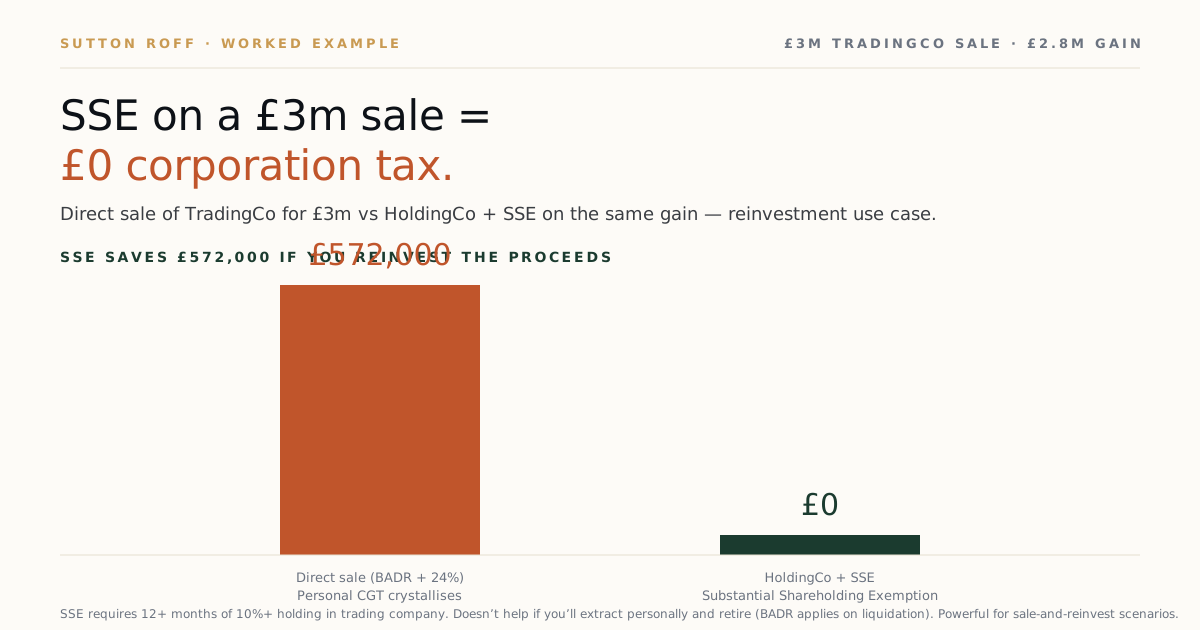
You own TradingCo, valued today at £2 million, on a £200k cost base. You expect to sell it in 4 years for £3 million, and want to reinvest the proceeds into a new venture (or property portfolio) without retiring.
| Step | Direct sale | Via HoldingCo + SSE |
|---|---|---|
| Sale price | £3,000,000 | £3,000,000 |
| Gain | £2,800,000 | £2,800,000 |
| BADR up to £1m @ 14% | £140,000 | — |
| Excess gain @ 24% | £432,000 | — |
| SSE on company gain | — | 0% CT |
| Total tax | £572,000 | £0 |
| Available to reinvest | £2,428,000 | £3,000,000 |
The £572k difference compounds for years. At 6% real return for 15 years: personal-sale route ends with £5.8m, HoldingCo route ends with £7.2m — a £1.4m gap.
The £572k difference compounds for years. If invested at 6% real return for 15 years, the personal-sale route ends with £5.8m, the HoldingCo route ends with £7.2m — a £1.4m gap.
The set-up — what it actually involves
- HMRC clearance application — confirming the share-for-share exchange qualifies under s.135. Free, takes 4–6 weeks.
- Independent valuation of TradingCo at the date of the share exchange.
- Legal documentation — share-for-share exchange agreement, new HoldingCo articles, share certificates.
- Companies House filings — incorporation of HoldingCo, change of TradingCo’s shareholding records.
Typical professional cost: £4,000–£8,000 first-time setup. Ongoing: HoldingCo needs annual accounts and a corporation-tax return — typically £1,500–£3,000/year extra accountancy.
Watch-outs
- SSE requires TradingCo to be a trading company, not an investment company. Substantial non-trading activities (typically >20%) can break the trading test.
- The 12-month minimum holding period for SSE means you need to plan ahead — restructuring 3 months before sale doesn’t qualify.
- HMRC clearance is strongly recommended for the share exchange.
- If you ever want to live off the proceeds personally rather than reinvest, you’re back to standard CGT rates on liquidation. The structure helps reinvestment, not retirement spending.
- Adding a holding company changes inter-company loan structures, group VAT registration, and other practicalities — needs proper modelling.
Key takeaways
- Share-for-share exchange to a holding company is tax-neutral (no immediate CGT) under s.135 TCGA.
- Inter-company dividends from TradingCo to HoldingCo are tax-free, ring-fencing cash.
- Sale of TradingCo by HoldingCo qualifies for SSE — 0% CT on the gain (12-month holding + trading-company tests required).
- Best fit: owner who plans to reinvest sale proceeds, not retire on them. Otherwise the structure adds admin without tax saving.
- Setup cost £4k–£8k. Ongoing extra £1.5k–£3k/year. Worth it on any business worth £500k+ with a likely future sale + reinvestment plan.
FAQ
How long after setting up HoldingCo can I sell TradingCo?
You need a 12-month minimum holding period for SSE. So if you set up the structure today, the earliest tax-free sale via SSE is 12 months from now. Restructuring 3 months before sale doesn’t qualify.
Does SSE apply if my company has investment activity?
SSE requires TradingCo to be “wholly or mainly trading” — substantial non-trading activities (typically >20%) can break the trading test. Excess cash piles, investment property and dormant subsidiaries all need careful management.
What if I want to extract the cash personally later?
Liquidating HoldingCo to access funds personally triggers CGT (BADR at 14% in 2025/26 or 18% from April 2026). You’ve still benefited from tax-free internal accumulation, but the final personal extraction has its own cost.
Owner-managed business worth £500k+ with a future exit on the horizon? Book a free 20-min review and we’ll model the holding-company structure with your specific numbers and exit plans. Specialist UK tax planners for owner-managed businesses.