
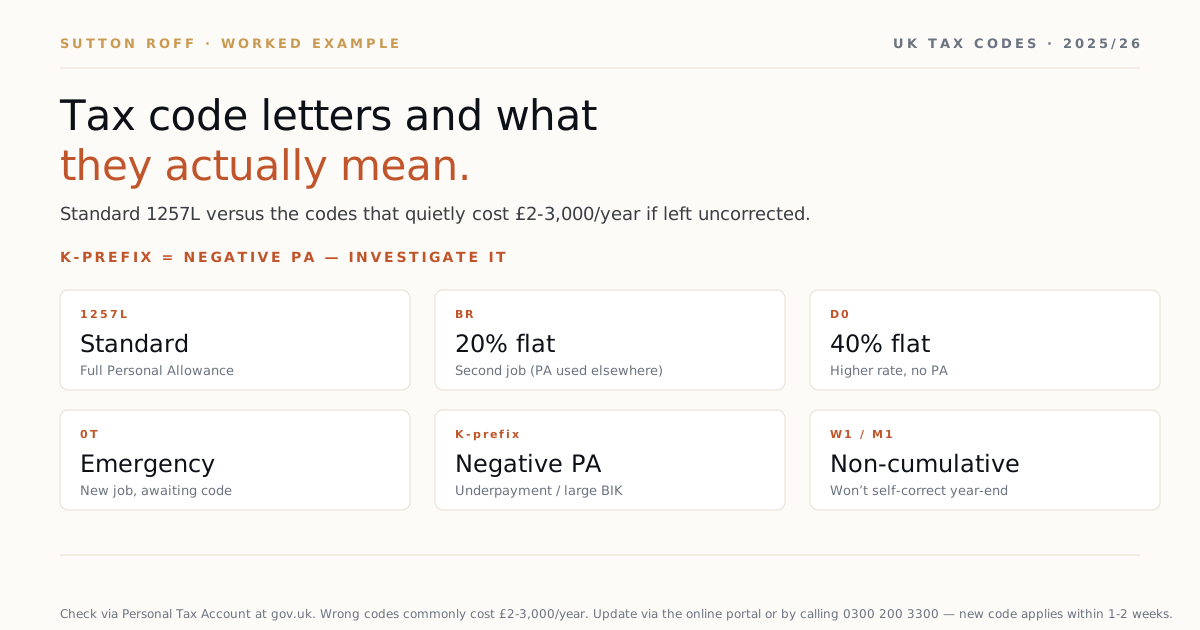
A wrong tax code costs the average affected employee £2,000-£3,000 over a year — and most never spot it because the deduction looks normal-ish on the payslip and self-corrects only at year-end (or never, if it’s an emergency code). We see new-job starters lose £400/month for six months because they never gave the employer a P45.
What a normal tax code looks like
The standard 2025/26 tax code for someone with a single job and no benefits-in-kind is 1257L. The “1257” represents your £12,570 Personal Allowance (divided by 10), and “L” means you’re entitled to the standard PA.
So 1257L on your payslip = no other complications. PAYE deducts the right amount monthly across the year.
Common letters and what they mean
| Code | What it means | When you see it |
|---|---|---|
| 1257L | Standard — full Personal Allowance | Default for one job, no benefits |
| BR | All income at 20%; no PA | Usually a second job (PA used elsewhere) |
| D0 | All income at 40%; no PA | Second job pushing you into higher rate |
| D1 | All income at 45%; no PA | Second income source for additional-rate |
| 0T | Emergency — no PA, banded rates | New job before HMRC issues a real code |
| K-prefix (e.g. K500) | Negative PA — adds K×10 to taxable income | Accumulated underpayments / large BIK |
| M / N | Marriage Allowance — M receives, N transfers 10% PA | Couple electing into Marriage Allowance |
| W1 / M1 / X | Non-cumulative — each pay cycle in isolation | Won’t self-correct year-end — check it |
| NT | No tax | Non-residents on UK income outside scope |
Five reasons your tax code might be wrong
1. New job, no P45. Started a job without giving the new employer a P45. They use emergency code (often 1257L W1/M1) until HMRC issues a real code based on your full picture. You’re often over-taxed initially because the employer doesn’t know your prior earnings.
2. Multiple jobs. Your PA is split across two or more employers. If the split doesn’t match your actual income from each, you under- or over-pay tax. Common scenario: PA fully assigned to Job 1, all of Job 2’s income at BR — but Job 2 actually pays more than Job 1.
3. Benefits-in-kind. Company car, medical insurance, gym membership through PAYE — all these are taxable benefits. HMRC adjusts your tax code mid-year as employers report P11D forms (the deadline is 6 July for the prior tax year). So a benefit started in October might not affect your code until the following August.
4. Underpayment from a prior year. If you owed tax for last year (e.g. due to dividend income that wasn’t covered by PAYE), HMRC sometimes recovers it through your tax code this year — usually via a K-code. The amount is added to your taxable income each pay cycle until the underpayment is cleared.
5. Pension contributions or Gift Aid recently changed. Increased pension contributions or major Gift Aid donations can change your effective Personal Allowance entitlement and trigger code adjustments.
How to check your tax code is right
The fastest path: log into your HMRC Personal Tax Account at gov.uk/personal-tax-account. The dashboard shows your current tax code, the breakdown of how it’s calculated (PA + adjustments – underpayments), and a year-to-date earnings/tax summary.
If the breakdown shows a benefit you no longer have, an overstated PA reduction, or an old underpayment that’s already been settled, you can update it directly through the online service or call HMRC.
How a returned company car cost Eva £5,760 in over-deducted tax
Eva, a Ltd director, was provided with a £45,000 BMW with 32% BIK rate. Tax code adjustment: -£14,400 (£45,000 × 32%). New tax code: 1257L − 1440 = becomes effectively a smaller PA.
Director returned the car in November. The BIK should reduce pro-rata. But HMRC’s code might not update automatically — they wait for the next P11D filing.
If the director keeps the original code: by April they’ve over-paid roughly £5,760 of tax (5 months of BIK adjustment × 40% × £14,400/12). HMRC will eventually refund this — usually 12+ months later when the P11D adjustment flows through. Faster path: update the tax code through the Personal Tax Account immediately.
K-codes — what they mean and what to do
A K-code is an alarm signal. It means your taxable income is being increased by the K-number × 10. So K500 adds £5,000 to your taxable income for PAYE purposes — typically because of accumulated benefits or back-tax.
K-codes can produce surprisingly large monthly deductions. Check the breakdown on your tax account. Sometimes the K-code is justified (genuine BIK or underpayment); often it’s stale and can be removed by phoning HMRC and explaining the basis.
When to ignore the difference
Tax codes self-correct at the end of each tax year via P60 reconciliation. So a wrong code that over-taxes you in months 1-6 will get refunded in months 7-12 (cumulative tax codes recalculate each pay cycle). For most cases of “my code looks wrong” the year-end position is right.
The exception: emergency codes (W1/M1/X) which are non-cumulative — they tax each month standalone. So an emergency code lasting all year will systematically over-tax you with no auto-correction.
How to actually fix it
- Log into your Personal Tax Account — see the breakdown
- Check what’s wrong — wrong benefits, wrong allowances, stale underpayments
- Update online if possible — most BIK and personal-detail updates can be done directly
- Phone HMRC if not — 0300 200 3300, have UTR/NI number ready
- Wait for new code — HMRC issues a new code within 2-4 weeks
- Check next payslip — confirm the new code applied
What if PAYE has under-taxed you?
If your code is wrong in the other direction — under-taxing you all year — HMRC catches up via either (a) a code adjustment in the following year (K-code) or (b) a self-assessment liability if you cross into the SA registration thresholds covered in our SA registration piece.
Either way, you’ll eventually owe the tax. Better to spot the under-deduction in real-time and ask HMRC to update — voluntary correction avoids interest charges that build on under-deductions discovered late.
When this is a bad idea
Don’t just ignore a weird tax code “until P60 sorts it out”. For under-deductions, the build-up costs you interest. For over-deductions in non-cumulative codes, you’re gifting HMRC an interest-free loan you’ll only get back later.
Don’t change jobs without giving your new employer the P45 from your old job. Without it, the emergency code applies and you’ll over-pay tax for the first few months.
Don’t ignore a K-code without checking what’s behind it. A genuine underpayment that grows untouched can become unmanageable.
Key takeaways
- Standard tax code for 2025/26: 1257L (full Personal Allowance, no complications).
- BR/D0/D1: tax-rate-only codes for second jobs or pensions.
- K-codes: negative allowance — usually accumulated BIK or underpayment.
- W1/M1/X: emergency codes — non-cumulative, won’t self-correct year-end.
- HMRC Personal Tax Account is the fastest place to check and adjust.
- Five common causes: new job, multiple jobs, BIK, prior-year underpayment, pension/Gift Aid.
FAQ
How do I check my tax code is correct?
Log into your Personal Tax Account at gov.uk/personal-tax-account. The dashboard shows current tax code, breakdown of allowances and adjustments, and year-to-date earnings/tax. Compare to your payslip.
What does “BR Cumul” mean?
BR (Basic Rate, no PA) applied cumulatively — tax recalculates each pay period as if it’s a fresh start, using year-to-date totals. Most second-job tax codes use this. Different from W1/M1 which is non-cumulative.
How fast does HMRC update a code change?
Online updates via Personal Tax Account: typically 1-2 weeks for the new code to flow to your employer’s payroll. Phone updates: 2-4 weeks. The next pay date after update applies the new code automatically.
Tax code looking weird this year and you’re not sure why? Book a free 20-min review — we’ll log into your Personal Tax Account with you, decode the breakdown, and update HMRC for whatever’s stale. Specialist UK personal tax accountants.