
First freelance invoice today; first HMRC payment due 31 January in roughly 20 months. The catch most new freelancers miss: the January bill isn’t just last year’s tax — it’s last year’s tax PLUS 50% of next year’s expected bill via payment-on-account. We see first-year self-employed people genuinely shocked by the 1.5× hit, with no cash reserved for it.
The 5 October deadline — and why everyone misses it
For each tax year you’re self-employed, you must register for self-assessment by 5 October following the tax year end.
The UK tax year runs 6 April to 5 April. So for the 2025/26 tax year (which ends 5 April 2026), you have until 5 October 2026 to register. Miss it and HMRC charges a “failure to notify” penalty separate from the eventual late-filing penalty.
Critically, the deadline is the same whether you started freelancing in May 2025 or in March 2026. As long as your activity falls inside the tax year, the same 5 October cut-off applies.
Sarah’s timeline — first invoice June 2025, first tax bill January 2027
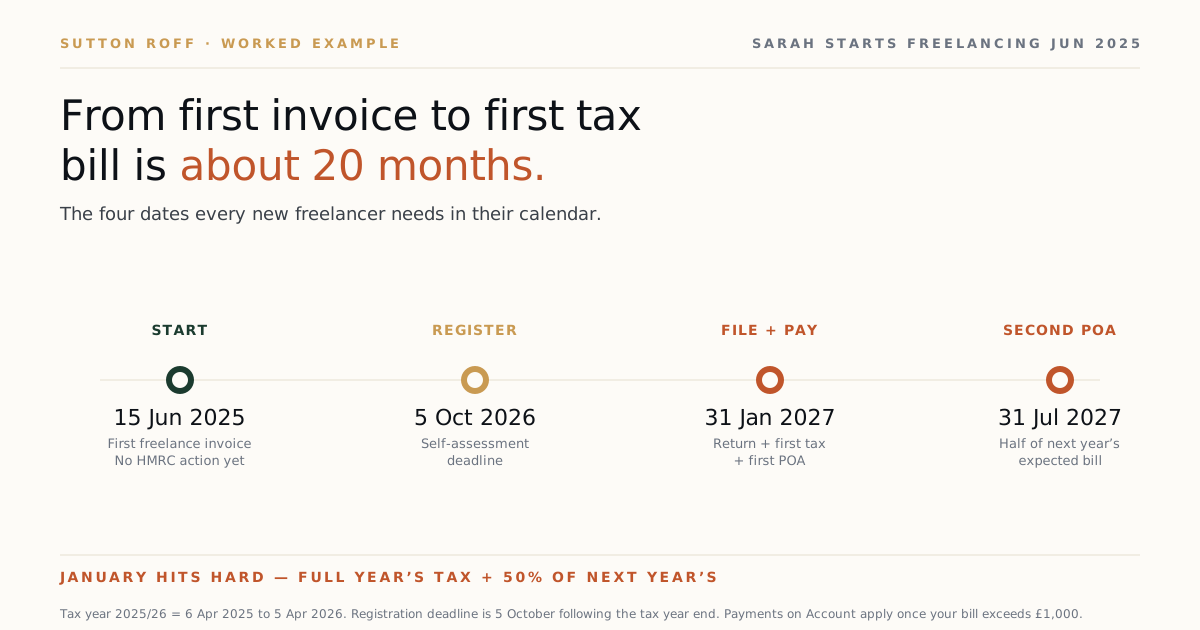
Sarah quits her day job and sends her first freelance invoice on 15 June 2025. Her four key dates:
15 June 2025 — first invoice. No HMRC action yet, but record-keeping starts now. Open a separate business bank account, save copies of every invoice and expense receipt.
5 October 2026 — registration deadline. She registers online via gov.uk for self-assessment, gets a 10-digit UTR (Unique Taxpayer Reference) within 10 working days, and sets up her Government Gateway login.
31 January 2027 — first tax return + first tax payment + first payment-on-account. Sarah files her 2025/26 return online (covering income from 15 June 2025 to 5 April 2026), pays her tax bill in full, and — if her tax bill is over £1,000 — also pays a 50% “payment on account” for next year’s expected bill.
31 July 2027 — second payment-on-account. The other 50% of next year’s expected bill.
If Sarah’s first-year bill is, say, £4,800, her January 2027 outflow is £4,800 + £2,400 = £7,200. The full-year tax plus 50% of next year. New freelancers regularly underestimate this.
Class 2 abolished, Class 4 unchanged — what you actually pay
Class 2 NIC (the £3.45/week flat rate) was abolished from 6 April 2024. You no longer pay it. Self-employed earners now pay only:
- Class 4 NIC at 6% on profits between £12,570 and £50,270, then 2% on profits above £50,270.
- Income tax at the standard rates on profits above the Personal Allowance.
You still get the state-pension qualifying year credit if your profits are above £6,725 — even though you’re not paying Class 2.
How to register, in five steps
- Go to gov.uk/register-for-self-assessment and choose “self-employed”.
- Enter your personal details, NI number, and the date you started trading.
- HMRC posts your UTR within 10 working days (digital activation also possible).
- Set up a Government Gateway account using the UTR.
- You’re now in self-assessment. Each January you’ll log in to file the previous tax year’s return.
Don’t forget you might need separate registrations
VAT — required if your taxable turnover exceeds £90,000 in any rolling 12-month period. Voluntary registration is also possible below the threshold; we cover the trade-offs in our voluntary VAT registration guide.
PAYE — required if you take on employees. Sole-director Ltds run their own payroll; sole traders only need PAYE if they hire someone.
When this is a bad idea
Don’t try to delay registration “until next year” thinking nobody will notice. Banks now share account information with HMRC under the Common Reporting Standard, and platform-reporting from Vinted, Etsy, eBay, Airbnb and Uber means your activity is visible to HMRC even before you file. The cost of registering on time is zero; the cost of being late is penalties plus interest.
Don’t ignore payment-on-account in your first January. The mechanic catches new freelancers off-guard every year — budget for 1.5x your expected first-year tax bill at the January 2027 deadline.
Key takeaways
- Register by 5 October following the tax year you started — same date regardless of when in the year you began.
- First tax return + first payment due 31 January after the tax year ends.
- Payments-on-account in January and July split next year’s expected bill into two halves.
- Class 2 NIC abolished from April 2024 — you only pay Class 4 (6%/2%) plus income tax now.
- You still earn state-pension qualifying years if profits exceed £6,725.
- Don’t underestimate January — full year + 50% next year hits at once.
FAQ
What if I started freelancing late in the tax year?
The 5 October deadline still applies regardless of when in the year you started. Started 1 March 2026? Register by 5 October 2026 for the 2025/26 year. The single-month income reports on the 2025/26 SA return.
Do I need to tell my employer if I’m also employed?
No legal requirement — but check your employment contract. Many have moonlighting clauses or require disclosure. HMRC is informed via SA registration, not via your employer.
Can I backdate registration?
Yes — you can register and date the start of trade earlier. Useful if you’ve been trading for months without realising. But back-period sole-trader profits also need declaring, with potential failure-to-notify penalties for late registration.
Just sent your first invoice or planning to soon? Book a free 20-min review — we’ll register you for SA, structure Class 4 NIC properly, and budget the four key dates so January doesn’t surprise you. Specialist freelancer and self-employed accountants.