
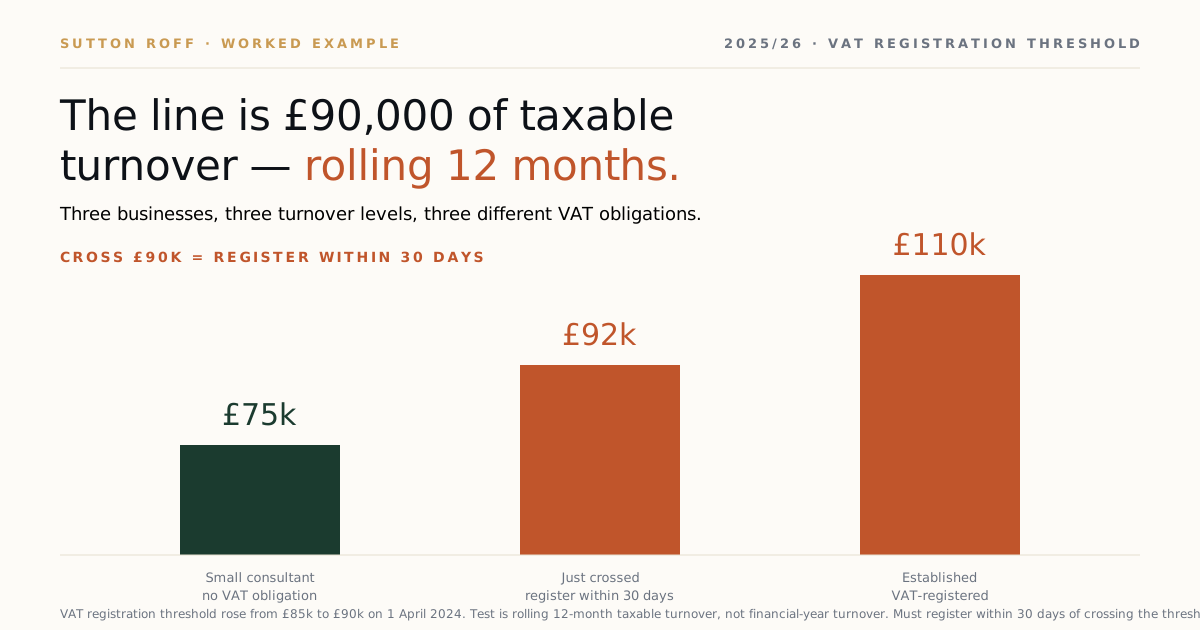
The £90,000 VAT threshold is rolling, not annual — and the “expecting to exceed in next 30 days” forward-looking test catches more businesses than the actual hit-the-line moment. We see consultants register late after a single big invoice pushed them over, and HMRC backdate registration to the contract date — creating a retrospective VAT bill the consultant has to absorb because clients have already been invoiced.
The £90k line — rolling 12 months, not financial year
The threshold for compulsory VAT registration in 2025/26 is £90,000 of taxable turnover. “Taxable turnover” excludes VAT-exempt supplies (insurance, financial services, education) but includes zero-rated supplies (most food, books, children’s clothing).
The test is rolling — you check, every month, whether your taxable turnover for the preceding 12 months exceeds £90,000. So if you crossed £90,000 in the year ending 30 June 2026, you must register by 30 July 2026 (within 30 days of the month in which you crossed).
There’s also a forward-looking test: you must register if you reasonably expect to exceed £90,000 in the next 30 days. So a one-off large contract that pushes you over needs to trigger registration on the date the expectation arises — not after delivery.
What happens once you’re registered
- You must charge VAT on all taxable supplies — typically 20% on services and most goods
- You can reclaim input VAT on business purchases
- You file VAT returns (usually quarterly) showing output VAT minus input VAT
- You pay HMRC the difference (or claim a refund if input exceeded output)
- You issue VAT invoices with VAT number, supply date, VAT amount
Registration applies from the date HMRC’s “effective date of registration” — usually the start of the month after you crossed the threshold. From that date, every taxable invoice must include VAT.
Diana’s solo consultancy — month-by-month across the threshold
Diana, a solo strategy consultant, invoices month-by-month. Year-1 total: £75,000 (well below). Year-2 starts strong:
- Apr-Mar 2024/25: £75,000 ✓ no obligation
- May 2025: rolling 12-month total reaches £88,500
- June 2025: invoice £4,000. Rolling 12-month total: £92,500. Threshold crossed.
- Must register by 30 July 2025 (within 30 days of the month-end where the threshold was crossed)
- Effective date of registration: 1 August 2025
- From 1 August onwards, all invoices include 20% VAT
If the consultant fails to register by the deadline, HMRC will register them retrospectively from the effective date. They’ll owe VAT on all sales since 1 August even though VAT wasn’t charged to clients — typically meaning the consultant has to absorb 20% of those revenues unless they can negotiate the VAT separately with each client. Penalties for late registration also apply, scaling with how late.
The month-end trick that catches people
The 30-day window for forward-looking registration triggers when the expectation arises, not when the deal is delivered. So if a consultant signs a £40,000 contract on 5 January expected to deliver in March, but their 12-month rolling income is currently £75,000:
- The £40,000 was foreseeable on 5 January
- Adding £40,000 to £75,000 = £115,000 expected over the rolling 12 months
- Registration is due 30 days from 5 January (the day the expectation arose) — not from invoice date
The “we’ll register when we deliver” approach is a registration deadline failure. Practically: register the moment a contract pushes your forward 12-month income above £90k, regardless of delivery dates.
Three options for managing the moment of crossing
1. Register and absorb. You cross the threshold, register, and your existing customers continue to pay the same prices but now £83.33 of every £100 invoice is your revenue and £16.67 is VAT to HMRC. Your effective margin drops 16.67%.
2. Register and pass on. You raise prices by 20% on existing customers when registration kicks in. B2B customers usually accept (they reclaim the VAT). B2C customers usually don’t.
3. Hold turnover under £90,000. Decline work that would push you over. Many small B2C businesses (cleaners, mobile services, takeaways) deliberately cap turnover for this reason. The growth ceiling is real and the decision is rarely about the £90k turnover itself — it’s about the consumer-facing pricing impact.
Voluntary registration as an alternative
If you’re under the threshold but suspect you’ll cross it within the next year, voluntary registration can sometimes pre-empt the cliff edge — particularly for B2B service businesses where customers can reclaim. We covered the voluntary registration trade-offs in our voluntary VAT guide.
Deregistration threshold
If your taxable turnover drops below £88,000, you can apply to deregister. HMRC will require evidence that turnover has genuinely fallen — typically 12+ months of declining revenue rather than a temporary blip.
The £2,000 gap between £90k registration and £88k deregistration prevents a “register/deregister/register” yo-yo for businesses hovering at the threshold.
What about non-UK customers?
VAT is a UK tax on UK supplies. Sales to overseas customers are typically outside the scope of UK VAT, but they still count toward your turnover for registration purposes if they’re UK-based supplies. Cross-border services follow place-of-supply rules — covered in our VAT to overseas clients guide.
Critically, exports of goods are typically zero-rated rather than outside scope — meaning they count toward the £90k threshold. So an Etsy seller exporting £80k of UK-located stock to US customers is still over the threshold and must register.
When this is a bad idea
Don’t try to “split your business” into multiple sole-trader or Ltd entities to stay under £90k each. HMRC’s anti-avoidance rules treat closely-related supplies between connected parties as one business for VAT purposes. The disaggregation challenge is well-rehearsed and usually fails.
Don’t ignore the rolling 12-month test in favour of a financial-year mental model. Crossing £90k in any rolling period — even mid-year — triggers registration.
Key takeaways
- VAT registration mandatory above £90,000 taxable turnover (rolling 12 months) since April 2024.
- Register within 30 days of the month-end in which the threshold was crossed.
- Forward-looking test: register if expecting to cross £90k in next 30 days.
- Deregistration threshold: £88,000 (the £2k gap prevents yo-yo registration).
- Late registration leads to back-VAT plus penalties — registration date is HMRC’s choice.
- Disaggregation across multiple entities doesn’t work.
FAQ
Does turnover include zero-rated sales?
Yes — zero-rated supplies (e.g. food exports, children’s clothing) count toward the £90k registration threshold. Only VAT-exempt supplies (insurance, financial services) are excluded.
Can I deregister voluntarily?
Yes once your turnover drops below the £88,000 deregistration threshold (sustained reduction, not a temporary blip). HMRC requires evidence of the genuine drop — typically 12 months of declining figures.
What about exempt supplies (e.g. property)?
Don’t count toward the £90k registration threshold. So a property landlord with £150k of residential rent + £30k of taxable consultancy doesn’t trigger registration just from the rental.
Approaching £90k of taxable turnover or just crossed it? Book a free 20-min review — we’ll calculate your effective registration date, set up the right VAT scheme (standard, FRS or cash accounting), and clean up the back period if registration was delayed. Specialist UK VAT registration accountants.