
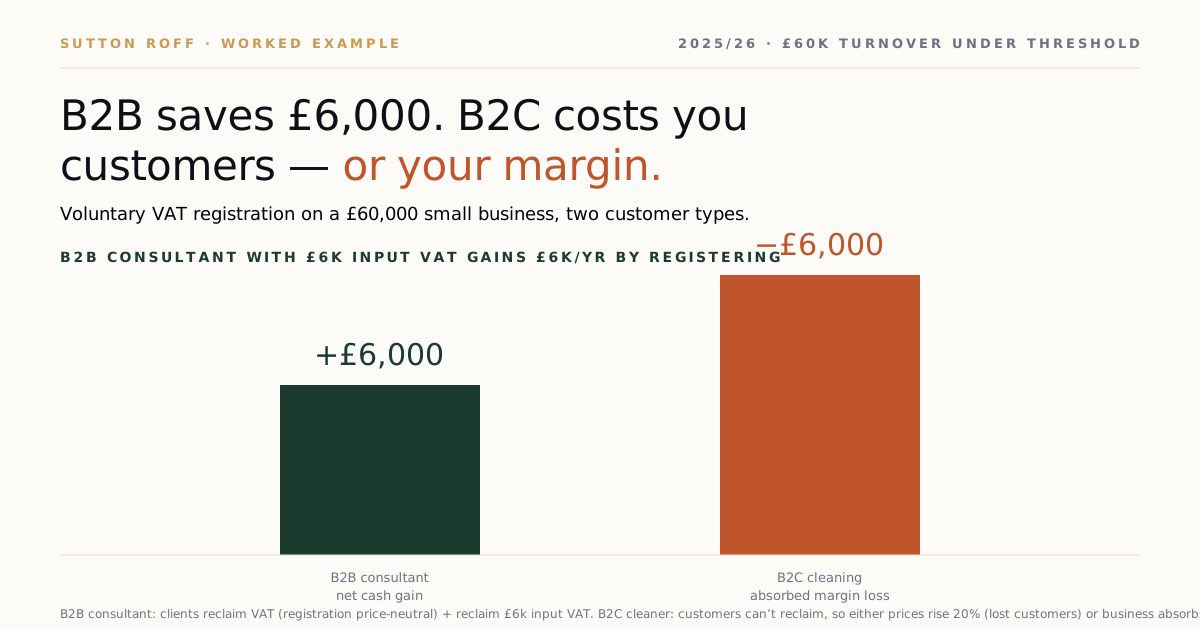
B2B consultants typically gain £6,000/year by voluntarily registering for VAT — they reclaim input VAT and their clients reclaim the 20% they pay. B2C cleaners typically lose £6,000/year by doing the same — their customers can’t reclaim and either prices rise (lost customers) or margin gets absorbed. The decision turns on customer mix, and the break-even sits around 50:50.
Why voluntary registration ever makes sense
Two reasons:
- Reclaim input VAT. A non-VAT-registered business pays full VAT on every purchase and can’t recover any of it. Once registered, you reclaim 100% of input VAT on legitimate business purchases.
- Look established. A VAT registration number on the website signals “real business” to corporate procurement teams. Some larger B2B clients won’t engage with non-registered suppliers.
The cost is the obligation to charge 20% on your sales — and whether that 20% costs your business depends entirely on whether your customers can reclaim it.
The B2B vs B2C decision
| Decision factor | B2B customer base | B2C customer base |
|---|---|---|
| Customer can reclaim VAT? | Yes | No |
| Effective price to customer | Same as before | +20% (or you absorb) |
| You reclaim input VAT? | Yes | Yes |
| Net annual impact on £60k turnover | +£6,000 | −£6,000 |
| Verdict | Clear gain | Usually a loss |
Tom the B2B consultant — gains £6,000/year by registering
Tom is a solo strategy consultant invoicing UK businesses — £60,000 annual revenue, £6,000 of input VAT on costs (laptop, software, travel, office services).
Not registered:
- Revenue: £60,000 received
- Input VAT paid (unable to reclaim): -£6,000 trapped in costs
- Net effective revenue: £54,000
Voluntarily registered:
- Charge clients £60,000 + £12,000 VAT
- Pay HMRC: £12,000 output – £6,000 input = £6,000
- Net revenue retained: £60,000
- Net effective revenue: £60,000 (clients don’t care — they reclaim the £12,000)
Voluntary registration adds £6,000/year for this consultant. The reclaim alone makes it worth doing.
Karen the B2C cleaner — loses £6,000/year by doing the same
Karen runs a solo home-cleaning business — £60,000 annual revenue from individual customers, £2,000 of input VAT on costs (cleaning products, equipment, fuel).
Not registered:
- Revenue: £60,000 received
- Input VAT paid (unable to reclaim): -£2,000
- Net effective revenue: £58,000
Voluntarily registered, prices raised by 20%:
- Charge customers £60,000 + £12,000 VAT = £72,000 total
- But — many price-sensitive customers leave; revenue shrinks to perhaps £52,000 + VAT
- Pay HMRC: net £8,000 of VAT
- Net effective revenue: £52,000 – £8,000 (revenue lost) – £8,000 (VAT to HMRC) + £2,000 (input reclaim) = £36,000… actually let me redo this cleanly
Voluntarily registered, prices absorbed (kept at £60k inclusive of VAT):
- Customer pays £60,000 (no change)
- Of that, £10,000 is VAT to HMRC; £50,000 is revenue
- Less input VAT reclaim: +£2,000
- Net effective revenue: £52,000
- Loss vs not registered: -£6,000/year
So either route — pass on or absorb — costs the B2C business roughly £6,000 a year. Voluntary registration almost always loses money for B2C below the threshold.
The mixed B2B/B2C business
Many small businesses are mixed — say, 70% B2B and 30% consumer customers. The voluntary registration math depends on the mix:
- Above ~70% B2B: voluntary registration usually wins
- Below ~30% B2B: voluntary registration usually loses
- In between: depends on input VAT proportion and price sensitivity
Run the numbers properly with both customer types modelled. The break-even point is usually around 50/50 mix for businesses with moderate input VAT.
The Flat Rate Scheme question
Voluntarily registered businesses can opt into the Flat Rate Scheme — paying a fixed % of gross turnover to HMRC instead of tracking output and input VAT separately. We covered the Flat Rate Scheme in detail in our FRS guide; for most service businesses post-2017, FRS no longer wins versus standard VAT, but for some — particularly retail and hospitality — it can simplify admin and save modest amounts.
Cash accounting scheme
If you’re voluntarily registered and your turnover is under £1.35m, you can use cash accounting — paying VAT only when customers pay you (rather than when you invoice). This dramatically helps cash flow for businesses with long payment terms or bad debts.
The catch: you can’t reclaim input VAT on supplier invoices until you’ve actually paid the supplier. So cash accounting tightens both sides of the VAT timing.
Backdating registration
You can request voluntary registration to be backdated up to 4 years, allowing you to reclaim input VAT on purchases made before registration (subject to time limits — capital items 4 years, services 6 months). Useful when significant purchases preceded the decision to register, but no help with output VAT — you still owe HMRC VAT on sales from the backdated date forward.
When this is a bad idea
Don’t voluntarily register if your customer base is predominantly consumer or non-registered small business. The 20% increase in pricing or absorbed cost will dwarf any input VAT reclaim.
Don’t backdate voluntary registration to a year of low input VAT and high sales — you’ll owe output VAT on the back-period sales without much input recovery.
Don’t voluntarily register before you understand quarterly compliance obligations. Late VAT returns trigger penalty points (4 = first £200 penalty, escalating from there) under the Making Tax Digital VAT regime.
Key takeaways
- Voluntary VAT registration reclaims input VAT on business purchases.
- B2B: voluntary registration almost always wins by the input-VAT amount.
- B2C: voluntary registration almost always loses (clients can’t reclaim, you absorb 20%).
- Mixed: depends on B2B proportion — break-even typically around 50% of customer mix.
- Backdating up to 4 years possible but reclaims output VAT on past sales too.
- Compliance obligations include quarterly returns under Making Tax Digital.
FAQ
Can I register and deregister flexibly?
Yes within the rules — register voluntarily, deregister once below £88k. But repeated yo-yo isn’t allowed. Most businesses register voluntarily and stay registered as turnover grows past the mandatory threshold.
Does FRS apply to voluntary registrants?
Yes — voluntary registrants can join FRS provided turnover stays under £150k (excluding VAT) and exit at £230k. The same Limited Cost Trader rules apply.
How long before registration is approved?
Online registration: typically 30 days for HMRC to issue the VAT number. Backdating to an earlier effective date is possible but creates back-VAT obligations on intervening sales.
Sub-£90k and unsure whether voluntary VAT registration helps or hurts? Book a free 20-min review — we’ll model both directions against your customer mix, input VAT pattern, and growth trajectory before you commit. Specialist UK VAT advisors.