
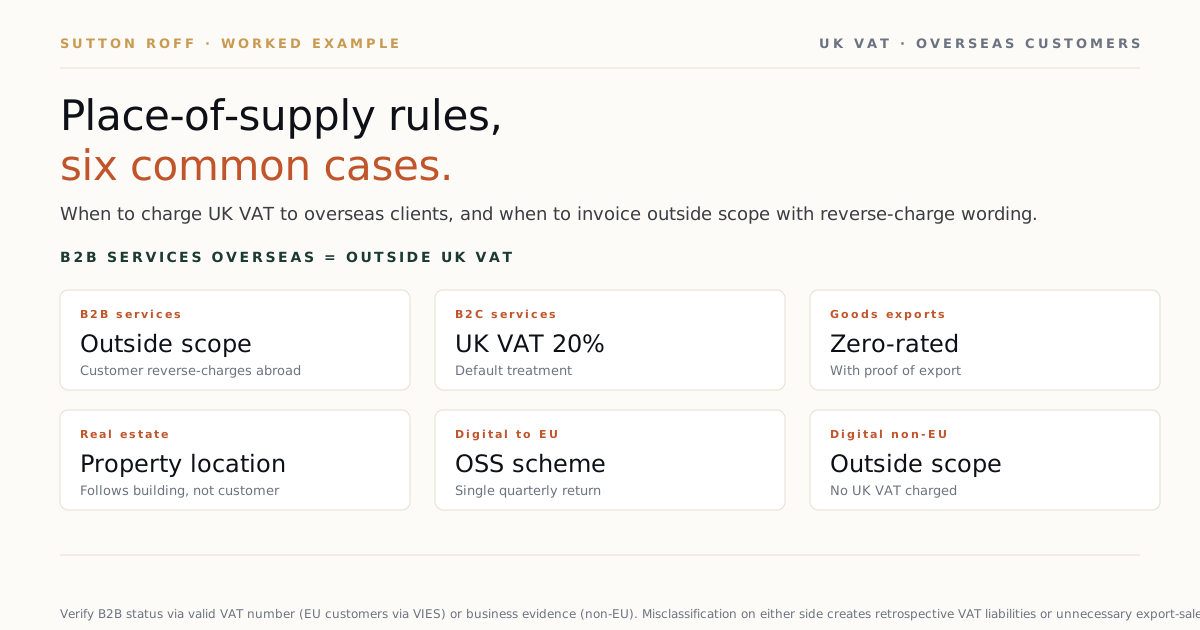
B2B services to overseas clients are typically outside the scope of UK VAT — the customer reverse-charges in their own country and you charge nothing. Get this wrong by adding 20% to a US client’s invoice and you’ve effectively gifted HMRC 20% of an export sale, since the overseas client can’t reclaim. We see consultants over-charge VAT to overseas clients for years before realising.
Place-of-supply rules — who you’re selling to decides where the VAT lives
VAT is charged where the supply happens, not where the supplier is based. For services, the “place of supply” is determined by who the customer is and what kind of service:
B2B services — the place of supply is where the customer belongs (their business address). So a UK consultant invoicing a US business client: place of supply is the US, no UK VAT.
B2C services — the place of supply is generally where the supplier belongs. So a UK designer invoicing a US individual: place of supply is the UK, charge UK VAT at 20%.
Specific exceptions — digital services, telecoms, broadcasting, real estate, restaurant and entertainment services have their own rules and often follow the customer regardless of B2B/B2C.
The reverse charge — your overseas customer accounts for VAT, not you
When a UK supplier provides B2B services to an EU or non-EU business customer, the customer (not the supplier) accounts for VAT in their own country under the “reverse charge” mechanism. The UK supplier:
- Doesn’t charge UK VAT on the invoice
- Includes the customer’s VAT number on the invoice (where applicable)
- Adds a clear note: “Reverse charge: customer to account for VAT” or similar
- Records the sale on their own VAT return as outside-scope (Box 6 only, no VAT in Box 1)
The customer in their country reports it as a reverse-charge purchase, paying VAT to their tax authority and reclaiming it (if eligible) — net cost zero in most B2B cases.
Goods exports vs services
For physical goods exported outside the UK:
- Sales to EU customers are now exports (post-Brexit) — zero-rated for UK VAT, with import VAT and customs handled at destination
- Sales to non-EU customers: zero-rated for UK VAT, customs duties paid by recipient
- You need export evidence (bill of lading, courier proof, customs declaration) within 3 months
- Without export evidence, HMRC re-categorises the sale as a UK supply and charges 20% VAT
Zero-rated exports still count toward the £90,000 VAT registration threshold — so an Etsy seller exporting £80k to US customers must register if they cross the threshold even though no UK VAT is collected.
Maria invoices her US client — outside scope of UK VAT
Maria, a solo UK strategy consultant, VAT-registered, invoices a US software company £50,000 for a strategy project. The client has no UK presence.
Invoice treatment:
- Service is “consultancy” — falls under general B2B place-of-supply rule
- Customer is a business outside UK
- Place of supply: US (customer’s country)
- UK VAT: not chargeable
- Invoice line: “£50,000 — outside the scope of UK VAT — customer to account under local rules”
VAT return:
- Box 6 (total sales): include the £50,000
- Box 1 (output VAT): no VAT charged
- No US tax registration required for the UK consultant (unless they create US sales tax nexus through other means)
Clean and simple. The same applies for invoicing EU business clients with valid VAT numbers.
The “customer is a business” test
For B2B reverse charge to apply, the customer must genuinely be a business. Two tests:
- For EU customers: provide a valid EU VAT number that matches their company name. Verify via VIES (the EU’s VAT number checker)
- For non-EU customers: take reasonable evidence of business status — company name, business address, website, contractual paperwork
If the customer turns out to be a consumer pretending to be a business, HMRC may retrospectively add UK VAT to the historical invoices. The “reasonable evidence” defence requires meaningful checks, not just taking their word for it.
Digital services to consumers — the OSS scheme
Selling digital services (apps, downloads, software-as-a-service, online courses) to consumers in the EU triggers VAT in the consumer’s country, not the UK. To handle this efficiently, UK businesses can register for the EU’s One Stop Shop (OSS) scheme — paying a single VAT return covering all EU consumer sales rather than registering in each country separately.
For Amazon sellers shipping physical goods across borders, the related Import One Stop Shop (IOSS) scheme covers consignments under €150 imported into the EU. We covered the OSS/IOSS framework in detail in our UK Amazon sellers VAT piece.
Real estate exception
VAT on services connected with land or buildings always follows the location of the property — regardless of customer status. So a UK architect designing a project in Spain charges Spanish VAT (and may need to register in Spain). UK VAT does not apply.
Conversely, an architect designing UK projects from anywhere charges UK VAT to UK clients — even if the client is a US business or the architect is based in Italy.
What needs to be on the invoice
For zero-VAT overseas B2B invoices, include:
- Your UK VAT number
- Customer’s name, address, and VAT number where applicable
- Service description and total amount
- Note that VAT is not charged: “Outside scope of UK VAT — reverse charge applies”
- Currency (can be foreign currency, but record sterling equivalent on VAT return)
Cross-border invoicing software setup
Most accounting software (Xero, QuickBooks, FreeAgent) handles overseas invoices natively — set the customer as “outside UK”, set the invoice line as “outside scope of VAT” or similar. The software adjusts the VAT return accordingly.
Misconfigured software is a common source of incorrect VAT returns. Run a sample invoice through, check the resulting VAT return preview, and confirm Box 6 includes the value while Box 1 doesn’t. If the maths doesn’t add up, the customer or invoice settings are wrong.
When this is a bad idea
Don’t apply UK VAT to all overseas invoices “to be safe” — the customer can’t reclaim it (they’re outside UK), so you’re effectively gifting HMRC 20% of an export sale.
Don’t claim a sale as outside-scope without verifying the customer is a business. The cost of getting it wrong is back-VAT plus penalties.
Don’t ignore EU customer VAT numbers for B2B sales — VIES verification is a one-minute check that prevents headaches if HMRC investigates.
Key takeaways
- B2B services to overseas clients: typically outside scope of UK VAT, customer reverse-charges.
- B2C services: generally UK VAT applies (with digital-services exceptions).
- Goods exports: zero-rated UK VAT, with proof-of-export within 3 months required.
- Real estate services follow property location.
- Digital services to EU consumers can use OSS scheme.
- Verify customer is a business via VAT number / business evidence.
FAQ
What about Northern Ireland sales?
NI is treated as part of the UK for goods, but applies EU VAT rules for some movements. Generally: B2B services to NI businesses follow UK reverse-charge rules; goods to NI consumers follow special protocol rules.
Do digital services follow different rules?
Yes — digital services to EU consumers follow the customer’s country VAT, reportable via OSS. Digital services to non-EU consumers are typically outside scope of UK VAT. Each region has its own digital-services treatment.
How do I prove the customer is a business?
EU customer: valid VAT number verified via VIES. Non-EU customer: business address, company registration evidence, trade documentation. “They told me they’re a business” isn’t enough — reasonable evidence is the standard.
Invoicing overseas clients and unsure whether to add VAT? Book a free 20-min review — we’ll review your invoicing, apply the place-of-supply rules correctly, and clean up any historical over-charging you’ve been absorbing. Specialist UK cross-border VAT accountants.