
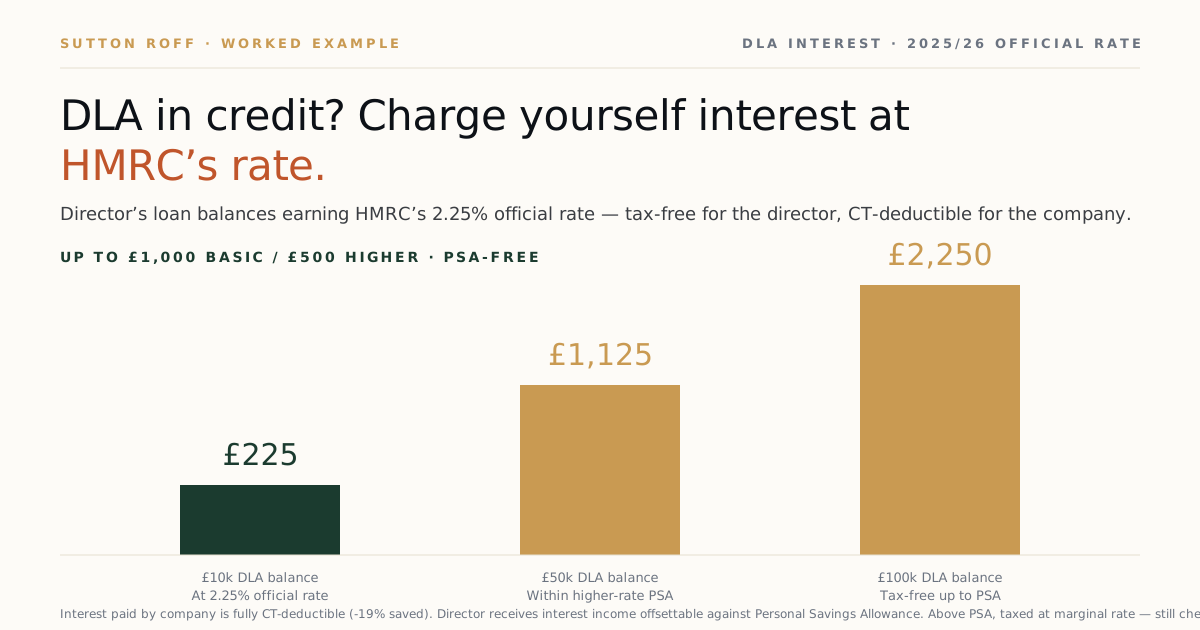
Most directors take dividends and a low salary, sit on a credit balance in their Director’s Loan Account, and never charge their company a penny of interest on it. That’s a missed tax planning opportunity. Set up correctly, several thousand pounds of interest can flow out of the company tax-free, while the company gets the corporation-tax deduction. Here’s how it works in 2025/26.
The two allowances doing the work
Two reliefs make this possible:
- Starting rate for savings — £5,000 at 0%. Available where non-savings income is below £17,570. The lower your salary/pension/rental income, the more of this band is available against savings interest.
- Personal Savings Allowance — £1,000 basic-rate, £500 higher-rate, £0 additional-rate. Stacks on top.
For a director on a typical low salary of £12,570 (the 2025/26 personal allowance), there’s headroom of £5,000 in non-savings income before the £17,570 threshold bites. Push above £17,570 and the starting-rate band starts shrinking pound-for-pound.
A worked example
Sarah runs her own consultancy through a limited company. Profits are £85,000 a year. She has no other employees, so the £10,500 Employment Allowance isn’t available (sole-director companies are excluded). She pays herself:
- Salary: £12,570 (full personal allowance; minimal NIC for company)
- Dividends: she takes enough to land just under the higher-rate threshold of £50,270
Sarah has lent her company £80,000 over the years from personal savings. Until now she’s charged it 0% interest. Let’s change that.
Her non-savings income is £12,570 — comfortably below £17,570. So she has the full £5,000 starting-rate band plus £1,000 Personal Savings Allowance available against interest. That’s £6,000 of interest she can receive at 0% income tax.
Set the loan rate at a commercially-defensible 7.5% per annum (an unsecured director loan justifies a healthy rate). Interest = £80,000 × 7.5% = £6,000. Sarah receives £6,000 of interest, taxed at 0%.
The company gets a corporation-tax deduction of £6,000 at 25% (or 26.5% in the marginal-rate band) = £1,500–£1,590 saved in CT. Sarah reduces her dividends by £6,000 to keep her total income flat, saving the personal dividend tax that would have applied on that slice.
Net annual benefit: typically £2,000–£2,500 for a director with this profile. Repeat year after year.
What rate can the company pay?
HMRC requires the rate to be commercially justifiable. There’s no statutory ceiling. We recommend benchmarking against unsecured business-loan rates, currently in the 7–9% range for SMEs. Anywhere up to 8% pa is comfortably defensible. Above that, document the commercial reasoning (no security, subordinated to other creditors, long-term loan, etc.).
The CT61 admin — and why it might still be worth it
One genuine downside: when a UK company pays interest to an individual, it must deduct 20% basic-rate tax at source and pay it to HMRC quarterly via form CT61. The director then reclaims it through their self-assessment return. Over a year there’s no net tax cost — but the paperwork is real.
Typical accountancy fee: around £45–£60 +VAT per CT61 return. Four a year = £200 +VAT. So if your potential annual saving is £2,000+, comfortably worth doing. If you’re scraping £400 of saving, the admin overhead might equal the benefit — skip it.
When this is a bad idea
- You don’t have a credit balance on your Director’s Loan Account (you owe the company, not the other way around).
- Your non-savings income is well above £17,570 (the starting-rate band has tapered to nothing).
- Loan balance is small (under ~£20k) — the saving doesn’t cover the CT61 admin cost.
- Your company is loss-making for the year — no CT deduction to capture.
Key takeaways
- Up to £6,000 of director-loan interest can be tax-free in 2025/26 (£5,000 starting-rate band + £1,000 PSA), if non-savings income is under £17,570.
- The company gets a corporation-tax deduction at 19–26.5%, worth £1,140–£1,590 a year on £6,000 of interest.
- The interest rate must be commercially justifiable — up to 8% pa is normal for an unsecured director loan.
- Quarterly CT61 returns are required. Plan for ~£200/year in extra admin.
- Net win for most directors with a meaningful loan balance: £2,000+ a year.
FAQ
Does the company need to pay the interest annually?
Best practice is annually, in line with the company’s accounting period. The interest charge can accrue and be paid in arrears, but document the rate, the calculation period, and the payment in board minutes.
What about the £500 dividend allowance interaction?
Director’s loan interest is interest income, not dividend income — it uses the Personal Savings Allowance (£1,000 basic-rate, £500 higher-rate, £0 additional-rate), not the dividend allowance.
Is the interest income taxable for the company?
No — the company is paying interest, not receiving it. The director receives interest income personally. The company gets full corporation-tax deduction on the interest paid.
Got a credit balance on your Director’s Loan Account? Book a free 20-min review and we’ll model exactly what you’d save with current salary, dividends and CT rates. Helpful for any Ltd company with a director who’s funded the business.