
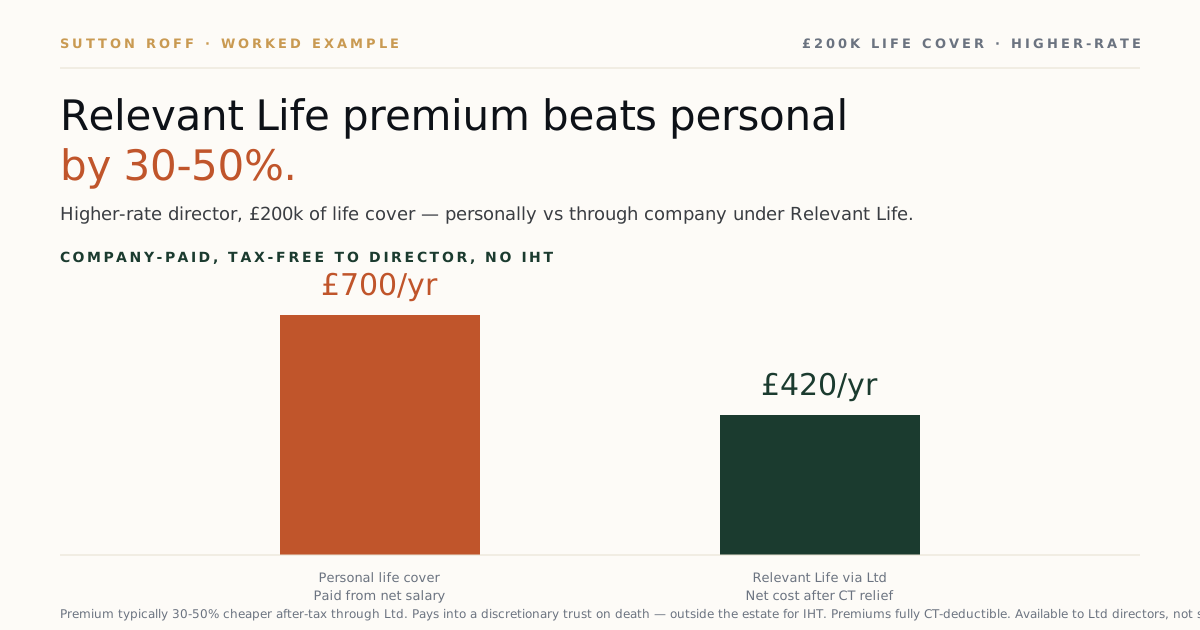
Most UK company directors with a family handle life insurance one of two ways. Either they buy personal life insurance from after-tax income (no tax efficiency) or they have “keyman” cover where the company is the beneficiary (tax-deductible but the payout gets caught by Inheritance Tax and other complications). Relevant Life policies sit in the middle — and they’re the right answer for almost every director with a partner or kids.
The three ways company directors typically arrange life cover
Personal life insurance: you pay premiums from your post-tax income. Cover is in your name. Death benefit goes to your family tax-free (assuming policy in trust). Cost: full marginal-rate tax to fund the premiums. For a higher-rate director paying £200/month in premiums, that’s £400+ of pre-tax income to fund.
Keyman insurance: the company is the policyholder and beneficiary. Premiums are corporation-tax-deductible. But the death benefit goes to the company, not your family — which means it goes through the company’s accounts (potentially affecting goodwill at sale), and ends up in IHT territory if extracted as a dividend or salary post-event. Useful for protecting the business, not for protecting your family.
Relevant Life: the company is the policyholder, but the policy is set up in trust for your family from day one. Premiums are corporation-tax-deductible. No P11D entry — it’s not a benefit in kind for the director. The death benefit goes to your family tax-free, outside your estate for IHT.
Why Relevant Life is the best of all worlds
- Premiums are CT-deductible for the company (assuming “wholly and exclusively” for the trade — easy to demonstrate).
- No income tax or NIC on the director — relevant life is specifically excluded from benefit-in-kind treatment.
- Death benefit paid tax-free to beneficiaries, written into trust at policy inception.
- Outside your estate for IHT — the policy proceeds skip the 40% IHT band entirely.
- No employer NIC on the premiums (unlike pension contributions, which are also exempt).
The maths — Relevant Life vs personal life cover
You need £500,000 of life cover. Quote: £80/month (£960/year) for a 40-year-old non-smoker.
Personal cover, paid from post-tax income (higher-rate director):
- Need £960/year of post-tax income to pay premiums
- To get £960 net, need to extract ~£1,449 of dividend (after 33.75% dividend tax)
- To distribute £1,449 of dividend, need ~£1,932 of pre-CT profit (after 25% CT)
- Total pre-tax cost to the business: £1,932/year
Relevant Life policy, paid by the company:
- Company pays £960/year, deductible against CT
- CT saving at 25%: £240
- Net cost to the business: £720/year
Net annual saving: £1,212 for the same £500k of cover. Over a 20-year policy, that’s £24,240 of saving — for the same product.
The IHT angle
If your personal life insurance isn’t written into trust (a surprisingly common oversight), the proceeds form part of your estate at death and can be subject to 40% IHT above the nil-rate band. On a £500k payout, that’s potentially £200k lost to IHT.
Relevant Life policies are always written into trust as a structural requirement of the regime. The proceeds skip your estate entirely — guaranteed.
Eligibility and rules
- The policy must be on the life of an employee (you, in your director-employee capacity).
- The death benefit must be paid to the employee’s family or charity — not to the employer or shareholders.
- Policy term must end before the employee turns 75.
- Single-life policies only (no joint cover — you’d need a separate Relevant Life policy for your spouse if they’re also a director-employee).
- Critical illness, terminal illness, or income-protection riders are not allowed in a Relevant Life policy. (For those, you’d need a separate executive income-protection policy.)
Setting it up — what’s involved
- Choose a provider — most UK life insurers offer Relevant Life policies (Aviva, Vitality, Royal London, Legal & General, Zurich, AIG).
- Apply through a specialist broker — they ensure the trust is set up correctly at outset (not retroactively, which can fail).
- Trust deed signed alongside the policy. Names beneficiaries (typically spouse and children).
- Premiums paid from the company bank account.
- Document board minutes recording the decision to provide Relevant Life as a director benefit.
Cost of a typical Relevant Life policy: similar to personal life cover. The “saving” comes from how it’s paid for, not the cover itself.
When Relevant Life isn’t right
- You’re a sole trader (no Ltd company) — you need personal life cover.
- You want to add critical illness or income protection — these riders aren’t allowed in Relevant Life. Use separate policies.
- You’re already over 70 — short remaining policy window before the age 75 cap.
- You want joint-life cover (with a spouse) — Relevant Life is single-life only.
Key takeaways
- Relevant Life premiums are corporation-tax-deductible, with no income tax or NIC on the director.
- Death benefit is paid tax-free, into trust, outside the IHT estate.
- Vs personal life cover: typical saving of £1,000+/year on £500k of cover for a higher-rate director.
- Always set up the trust at policy inception. Retroactive trust setup can fail.
- Doesn’t replace personal critical-illness or income-protection cover — those need separate policies.
FAQ
How much can the company contribute to Relevant Life premiums?
Premiums must be commercially reasonable for the cover provided — HMRC’s standard test. Most policies are 10-15× the director’s salary; premiums under £100/month are typically uncontroversial for higher-rate directors.
Is the payout subject to inheritance tax?
Generally no — payouts go into a discretionary trust set up at policy inception, sitting outside the director’s estate for IHT purposes. The trust then distributes to nominated beneficiaries.
Can sole traders use Relevant Life?
No — it’s an employer-paid policy, requiring an employer-employee relationship. Sole traders need standard personal life insurance instead. Ltd directors qualify because the company is the legal employer.
If you’re a Ltd company director with personal life insurance, you’re almost certainly overpaying. Book a free 20-min review and we’ll show you the Relevant Life setup with your specific cover requirement and cost. Specialist UK accountants for owner-managed companies.