
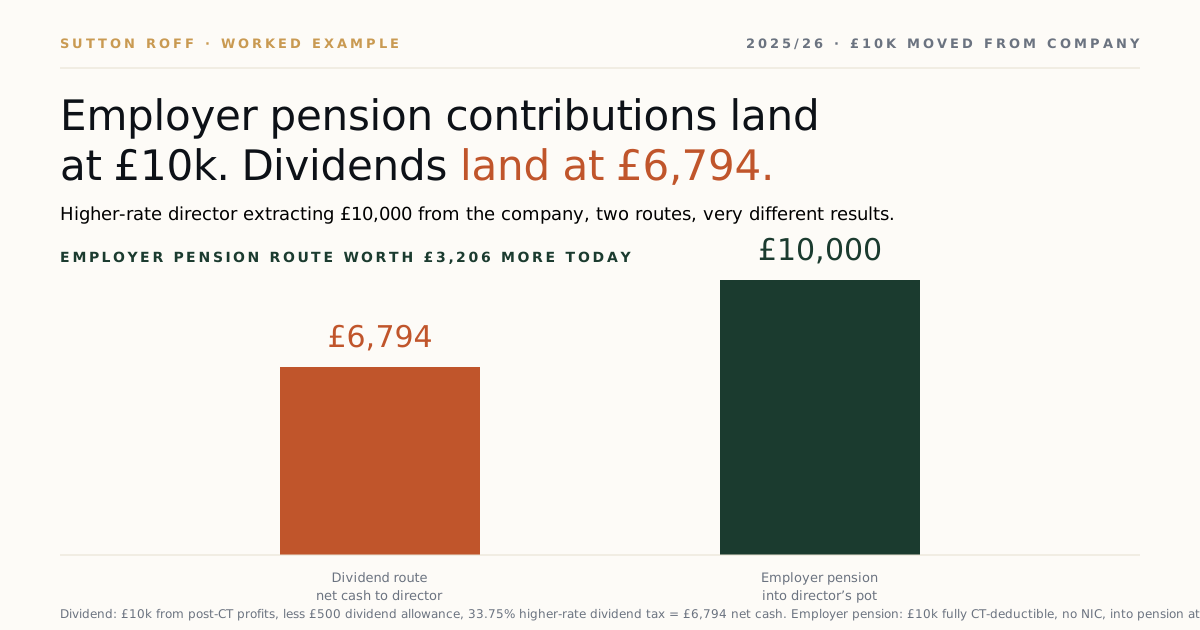
A Ltd director’s most efficient extraction route isn’t a dividend — it’s an employer pension contribution. £10,000 from company profits lands at £10,000 of pension wealth. The same £10,000 as a higher-rate dividend nets £6,794. We see director clients still extracting via dividends because their previous accountant never modelled the pension route at year-end.
Why employer pension contributions are so efficient
Three things stack to make employer-paid pension contributions the cleanest extraction route:
- Corporation tax relief. The contribution is fully deductible against company profits. At the 19% small profits rate, every £100 contributed saves £19 of corporation tax.
- No employee NIC. Pension contributions paid by the employer aren’t taxable income for the director.
- No employer NIC. Unlike salary or bonus payments, employer pension contributions don’t trigger employer NIC at 15%.
- Doesn’t count toward your £60k personal annual allowance for tax-relief calculation purposes — the AA still applies, but the contribution isn’t capped by your earnings the way personal contributions are.
The result: every pound of company profit that goes into pension lands as a pound of pension. No tax is taken on the way in.
Three ways Vikram extracts £10,000 from his Ltd
Vikram is a higher-rate-taxpayer sole director (no Employment Allowance) wanting to extract £10,000 from his Ltd’s profits.
Route A — Dividend.
- Company pays corporation tax on profits (assume 19% small profits rate has already been paid)
- Dividend declared: £10,000 from post-CT profits
- Director’s dividend allowance: £500 covered
- Remaining £9,500 at 33.75% higher-rate dividend tax: £3,206
- Net cash to director: £6,794
Route B — Salary or bonus.
- Company gross salary: £10,000 (CT-deductible: -£1,900 saved)
- Employer NIC at 15%: £1,500 (also CT-deductible: -£285 net)
- Director’s income tax at 40%: £4,000
- Director’s employee NIC at 2%: £200
- Net cash to director: £5,800
- Net cost to company: £10,000 + £1,500 − £1,900 − £285 = £9,315
- For each £9,315 of company spend, director gets £5,800 cash.
Route C — Employer pension contribution.
- Company pension contribution: £10,000 (CT-deductible: -£1,900 saved)
- No employer NIC, no employee NIC
- No income tax for director
- £10,000 lands in director’s pension. 25% (£2,500) tax-free at 55+; 75% (£7,500) taxable on drawdown
- If drawn at basic rate later: £7,500 × 20% = £1,500 future tax
- Net wealth to director (now plus future): £10,000 − £1,500 = £8,500
Across the three routes: dividend nets £6,794 of cash, salary nets £5,800 of cash, employer pension contribution becomes £8,500 of net retirement wealth. The pension route wins by 25% over dividends and 47% over salary.
The size of contribution your company can pay
Personal contributions are capped at 100% of relevant UK earnings. Employer contributions aren’t subject to that cap — your Ltd can pay any amount that’s commercially reasonable and supported by company profits.
HMRC’s “wholly and exclusively” rule still applies: the contribution must be reasonable remuneration for the director’s role. A £200,000 contribution for a director generating £400,000 of company profit is comfortable. The same £200,000 for a director generating £80,000 of company profit could be challenged as “not wholly for the trade”.
The standard practical test: would you pay this level of contribution to a non-related employee in the same role? If the answer is “yes, subject to retention bonus norms in your industry”, the contribution is defensible.
Annual Allowance still applies
The £60,000 annual allowance applies to all your pension contributions combined — personal, employer, salary-sacrifice. Going above the AA (after carry-forward — covered in our AA + carry-forward guide) triggers an annual allowance charge that adds the excess to your taxable income.
So a director getting their company to pay £100,000 into pension this year, having no carry-forward and an AA of £60,000, gets an AA charge on the £40,000 excess. The charge is at marginal rate, so for a higher-rate director the £40,000 excess effectively gets taxed at 40% — wiping out the company’s CT relief on that portion.
Carry-forward usually solves this. With three years of unused AA available (covered separately), most directors have £100k+ of headroom for a one-off catch-up.
The Tapered AA trap for high earners
Adjusted income above £260,000 tapers your AA from £60,000 down to a minimum of £10,000. Adjusted income includes employer contributions — so a director taking £150,000 dividend plus £80,000 employer pension contribution has adjusted income of £230,000. Below the threshold; AA stays at £60,000.
But a director on £210,000 of dividends with a £100,000 employer pension contribution has adjusted income of £310,000. AA tapers down to £35,000, and the £100,000 contribution is well over — triggering a substantial charge.
For this reason, very-high-earning directors often need to plan contributions over 2-3 years rather than one big lump.
What about salary sacrifice as well?
If you’re a director taking some salary, you can also sacrifice salary into the same pension on top of the employer contribution. This is sometimes called “doubling up”. Total contribution = employer contribution + sacrificed salary, both fully tax-efficient.
The sacrifice mechanics are the same as for any employee — covered in detail in our bonus salary sacrifice piece.
When this is a bad idea
Don’t pay an employer pension contribution if your company doesn’t have the profits to support it. CT-deductibility helps, but you can’t pay £100,000 from a company with £30,000 of distributable reserves.
Don’t pay a six-figure contribution if your relevant earnings are under £20,000 and there’s no good business reason — HMRC can challenge as not “wholly for the trade”.
Don’t ignore liquidity. Pension money is locked until 55 (57 from April 2028). If your company might need the cash back as working capital in 6 months, paying it into your personal pension is a one-way move.
Key takeaways
- Employer pension contributions are CT-deductible, with no employee or employer NIC.
- £10k extracted as employer pension nets ~£8,500 of long-run wealth versus £6,794 as dividend.
- No 100%-of-earnings cap on employer contributions (unlike personal contributions).
- Wholly-and-exclusively rule still applies — must be reasonable remuneration.
- Standard £60k AA still applies (with 3-year carry-forward); tapered AA bites above £260k adjusted income.
- Pension money is locked until 55 (57 from April 2028).
FAQ
How much can the company contribute?
Limited only by company cash + the “wholly and exclusively” rule. A reasonable benchmark: total comp (salary + employer pension) shouldn’t exceed market rate for the director’s role and the company’s profitability.
Does the contribution need to match my salary?
No — employer contributions don’t have the “100% of relevant earnings” cap that personal contributions do. A director on £12,570 salary can take £60,000 employer contribution.
When should the contribution be made?
Before the company year-end to fall in the right CT period for that year. Personal AA limits are based on tax year (6 April to 5 April), so timing across the two cycles needs care.
Ltd director taking dividends and never structured an employer pension contribution? Book a free 20-min review — we’ll size the contribution against AA headroom, check the wholly-and-exclusively defensibility, and time it correctly for current-year CT relief. Specialist UK director-extraction accountants.