
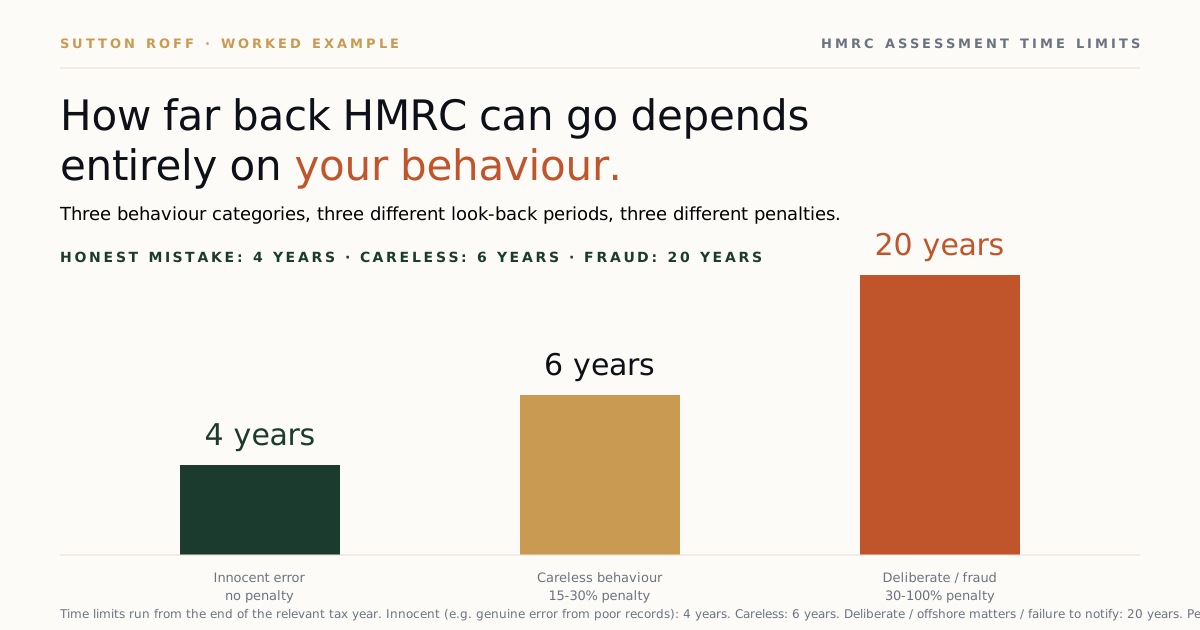
HMRC’s look-back window depends entirely on what they think you did: 4 years for honest mistakes, 6 for careless behaviour, 20 for deliberate or offshore matters. The taxpayer doesn’t decide which category applies — HMRC does, and the burden of proof effectively shifts to you to demonstrate “reasonable care”. We see disclosed errors land at 0% penalty when handled properly and 50%+ when handled badly — same underlying facts.
Three categories — and HMRC decides which applies
| Behaviour category | Look-back window | Penalty range | Examples |
|---|---|---|---|
| Innocent error | 4 years | None | Genuine mistake despite reasonable care |
| Careless behaviour | 6 years | 0-30% | Sloppy bookkeeping, wrong advice unchecked |
| Deliberate or offshore | 20 years | 30-100% | Concealment, false statements, undisclosed offshore |
The clock runs from the end of the relevant tax year. So in 2026/27, HMRC could potentially open a 20-year-back enquiry covering the 2007/08 tax year (and earlier, if the actions were deliberate).
Who decides which category applies?
HMRC. They evaluate behaviour based on:
- What evidence shows about your actions and intent
- Quality of records you kept
- Advice you took (or didn’t)
- Whether you knew or should have known about the error
- Whether you actively concealed information
You can dispute their categorisation at tribunal — but the burden of proof effectively shifts to you to demonstrate you took “reasonable care”. Many disputes turn on documentary evidence of advice received, records kept, and decisions made at the time.
The “failure to notify” trap — Sophie’s 5-year side-hustle
Sophie starts a side-hustle in 2020, doesn’t register for self-assessment, and continues for 5 years. HMRC eventually issues a registration nudge.
The taxpayer’s view: “I didn’t know I had to register.” HMRC’s view: failure to notify HMRC of liability to tax = either careless (6 years) or deliberate (20 years), depending on circumstances.
For a side-hustle generating £15k/year of profit over 5 years: £75k of unreported income. At higher rate, ~£30k of income tax + Class 4 NIC + interest at 7.75% per year + penalties at 30-50% of the tax. Total exposure: £40-50k on top of the unpaid tax.
For someone who reasonably-genuinely didn’t know (e.g. assumed the platform handled tax), the lower 6-year window and 0-30% penalty scale apply. Voluntary disclosure before HMRC writes can drop penalties further toward 0%.
What unprompted voluntary disclosure does
If you spot an error or oversight and disclose it to HMRC before they ask, the penalty regime drops dramatically:
- Careless behaviour: penalty starts at 0% (vs 15% on prompted disclosure)
- Deliberate behaviour: penalty starts at 20% (vs 35% on prompted)
- Deliberate concealment: penalty starts at 30% (vs 50% on prompted)
The “unprompted” requirement: you disclosed before HMRC had any reason to enquire. If they’re already asking, your disclosure is “prompted” and the discount is smaller.
For someone who knows they have a back-period issue, voluntary disclosure now is dramatically cheaper than waiting for the letter. The penalty saving alone often exceeds the back-tax owed.
HMRC’s data sources
HMRC’s data network for spotting errors has expanded substantially:
- Connect database — cross-references 30+ data sources including bank accounts, Land Registry, DVLA, social media, online platforms
- CRS (Common Reporting Standard) — automatic exchange of bank account data with 100+ countries
- Platform reporting — Airbnb, Uber, Vinted, eBay, Etsy, OnlyFans report seller earnings from January 2024
- FATCA — US data sharing for UK residents with US accounts
- OECD pillars — multinational tax data sharing for cross-border income
Activities that were “invisible” to HMRC in 2010 are now systematically visible. The 20-year window combined with this data network means historical non-disclosure carries real risk.
What if HMRC enquires into the wrong year?
HMRC can only open formal enquiries within 12 months of the filing deadline for that year (the “enquiry window”). After that, they need a “discovery” trigger to reopen — typically:
- Information they didn’t have when the return was filed
- Behaviour that involved careless or deliberate conduct
So a return filed by 31 January 2026 (for 2024/25) has an enquiry window until 31 January 2027. Beyond that, HMRC needs a discovery basis — and the burden shifts to them to show the discovery requirement is met.
What about interest?
HMRC charges interest on overdue tax at the published rate (currently 7.75% for 2025/26). Interest accrues from the original due date until payment.
For 5-year-back tax of £25,000, interest alone can reach £8,000-£10,000 by the time HMRC discovers and assesses. This is on top of penalties.
Interest is not negotiable — it’s a statutory calculation. Penalties can be negotiated based on cooperation; interest cannot.
The Common Reporting Standard catch
UK residents with overseas bank accounts have automatic data flow back to HMRC via CRS. Account opened with a foreign bank in 2018 and never disclosed: HMRC has known about it since 2019 via CRS reporting.
Many “I forgot about that account” disclosures are actually just catching up to information HMRC already has. The “Worldwide Disclosure Facility” — HMRC’s offshore disclosure scheme — is the formal route for cleaning up these situations, with penalties scaling based on how cooperative and timely the disclosure is.
What to do if you’re worried about a past error
- Don’t ignore it — discoveries by HMRC are dramatically more expensive than self-disclosed
- Gather records — bank statements, P60s, dividend receipts, foreign account info — for the relevant years
- Calculate the under-declared tax with reasonable accuracy
- Consult a tax-disputes specialist (DIY voluntary disclosure can compromise the unprompted-discount eligibility)
- Submit the disclosure via the appropriate route (Worldwide Disclosure Facility, Code of Practice 9, or standard amendment depending on facts)
- Pay the tax + interest immediately on agreement; negotiate penalties based on cooperation
When this is a bad idea
Don’t try to outlast the 20-year clock by hoping HMRC won’t notice. Data systems are improving every year, and discovery now reaches back further than ever.
Don’t make partial disclosures hoping HMRC won’t dig further. Incomplete disclosures can recharacterise behaviour from “careless” to “deliberate” — pushing into the 20-year window with much higher penalties.
Don’t DIY a voluntary disclosure for anything serious without specialist help. The opening letter you write becomes the file’s frame — getting it wrong can lock in worse penalties than necessary.
Key takeaways
- Time limits: 4 years (innocent), 6 years (careless), 20 years (deliberate or offshore).
- HMRC categorises the behaviour, not you.
- Unprompted voluntary disclosure can reduce penalties to 0% on careless behaviour.
- Connect database and platform reporting make historical non-disclosure increasingly visible.
- CRS automatic data sharing with 100+ countries on offshore accounts.
- Interest at 7.75% on top of penalties — non-negotiable.
FAQ
What if HMRC uses extended time limits unfairly?
You can challenge HMRC’s behaviour categorisation at tribunal. The First-tier Tax Tribunal hears these. Burden of proof effectively shifts to you to show “reasonable care” against careless categorisation.
Can I see what HMRC has on me?
Yes — submit a Subject Access Request under GDPR. HMRC provides what they hold within 1 month. Useful before disclosing — lets you scope what HMRC already knows vs what you’re about to reveal.
How does criminal investigation timing differ?
Criminal investigations don’t have the same statutory time limits as civil enquiries. They’re bounded by the limitation periods of the offence (typically 6+ years for tax evasion, 7+ years for fraud). Different track entirely.
Worried about a back-period error and considering voluntary disclosure? Book a free 20-min review — confidential, no commitment. We’ll size the exposure, recommend the right disclosure route (WDF, COP9 or standard amendment), and structure the opening letter so penalties land in the lowest tier available. Specialist UK HMRC investigations and voluntary disclosure accountants.