
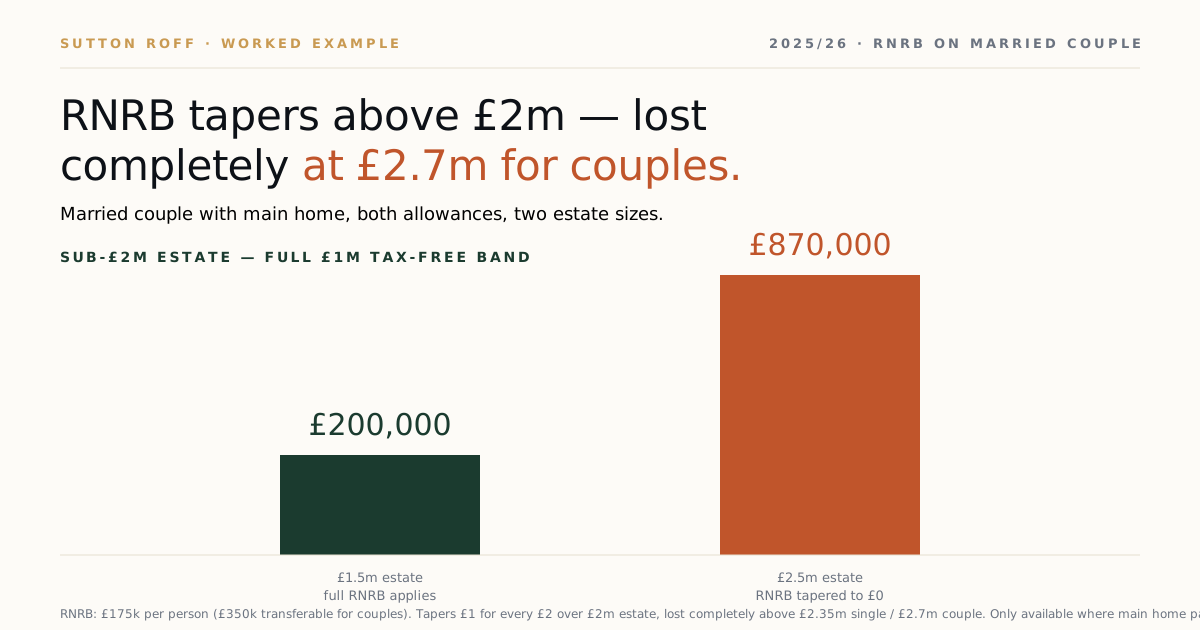
The Residence Nil-Rate Band gives a married couple £350,000 of IHT-free allowance on top of the £650,000 standard NRB — provided their estate stays below £2 million. Cross £2.35 million (single) or £2.7 million (couple) and the RNRB is gone entirely. We see estates land at £2.1m and pay £140,000 more IHT than they would have if a single round of lifetime gifting had pulled the estate back below £2m.
What the RNRB is
The Residence Nil-Rate Band (RNRB) gives an additional £175,000 of IHT-free allowance per person — on top of the standard £325,000 nil-rate band — provided three conditions are met:
- Your estate includes a “qualifying residential interest” — broadly your main home or a property you’ve lived in
- The home (or its value) passes to direct descendants — children, grandchildren, stepchildren, foster children, adopted children
- Your estate is below £2 million (above this it tapers)
For a married couple meeting all three conditions, the combined allowances are £325k NRB × 2 + £175k RNRB × 2 = £1,000,000 tax-free.
The £2m taper — where the cliff edge is
For estates above £2m, the RNRB tapers by £1 for every £2 over the threshold:
- £2.0m estate: full RNRB
- £2.175m estate: half RNRB (£87,500 per person)
- £2.35m estate: zero RNRB for an individual
- £2.7m estate: zero RNRB even for a couple (each loses theirs at the £2.35m mark, but combined they’ve also lost the transfer)
The taper creates an “effective marginal rate” on the slice between £2m and £2.35m of around 60% — every £1 of estate above £2m costs you 40% IHT plus another 50p of lost RNRB allowance × 40% = 20p more IHT. Familiar territory if you’ve read our 60% trap piece — the same income-tax mechanic but for IHT.
The £1.5m estate versus the £2.5m estate — same couple, RNRB taper
Both married couples leave their main home (£500k) to children, with savings/investments making up the rest of the estate.
£1.5m estate (below £2m threshold):
- NRB × 2: £650,000
- RNRB × 2 (full): £350,000
- Total tax-free: £1,000,000
- Taxable: £500,000
- IHT at 40%: £200,000
£2.5m estate (taper applies):
- NRB × 2: £650,000
- RNRB × 2: tapered to £0 (estate exceeds £2.35m per person)
- Total tax-free: £650,000
- Taxable: £1,850,000
- IHT at 40%: £740,000
The £2.5m estate pays £540,000 more IHT than the £1.5m estate — but only £200,000 of that is “expected” 40% on the £500k extra. The other £340,000 comes from losing the RNRB (and the punishing taper around the £2m line).
Direct descendants — what counts
For RNRB to apply, the home must pass to a direct descendant. HMRC’s definition includes:
- Children, including adopted, fostered, stepchildren
- Grandchildren, great-grandchildren, etc.
- Spouses or civil partners of any of the above
- Widows/widowers of pre-deceased descendants
What doesn’t count:
- Siblings (brothers, sisters)
- Parents
- Nieces and nephews (unless adopted)
- Charity (uses the charity exemption instead, which still works)
So a childless person leaving their home to a niece doesn’t get RNRB. Single people without descendants similarly miss out — only the £325k NRB applies.
The “home” test
The home doesn’t need to be the home you live in at death. Two important variants:
Downsizing addition. If you sold your main home before death (e.g. moved into a smaller flat, sheltered accommodation, or a care home), the RNRB you would have used on the bigger home is preserved — provided you sold after 7 July 2015 and the value passes to descendants. So a couple selling a £900k home and moving into a £300k flat doesn’t lose RNRB because they downsized.
Multiple home owners. Where there are multiple properties, only one qualifies as the residence for RNRB purposes — typically the one you’ve actually lived in.
If the deceased never owned a main home (e.g. lifelong renter), no RNRB applies regardless of estate size.
Transferring unused RNRB between spouses
If the first spouse to die doesn’t use any RNRB (e.g. left everything to surviving spouse), 100% of their RNRB transfers to the survivor. So the surviving spouse can use their own £175k plus 100% of the deceased’s £175k = £350k total RNRB.
This works the same way as transferable NRB. The mechanic gives married couples meaningful estate-planning flexibility — leave everything to spouse first, all allowances transfer.
What happens for very large estates
Above £2.35m (single) or £2.7m (couple), the RNRB is lost entirely. The estate effectively faces 40% IHT above the £325k or £650k standard NRB. For very large estates (£5m+), the RNRB loss is a relatively small proportion of total IHT exposure — the bulk of planning energy needs to go into other reliefs (BPR, lifetime gifting, charitable bequests, FICs).
The “freeze” until April 2030
Both NRB (£325k) and RNRB (£175k) have been frozen since 2017 and confirmed frozen until April 2030. As property values and estate sizes naturally rise with inflation, more estates fall into IHT territory each year — fiscal drag pushing more of the population into IHT exposure.
By 2030, RNRB will have been £175k for 13 years while average property values may have risen 30-40%. The relief becomes proportionally less effective.
Planning around the £2m taper
For estates close to £2m:
- Lifetime gifting — outright gifts surviving 7 years reduce the estate, often pulling it below £2m
- Charitable bequests at 10%+ of the net estate reduce the IHT rate on the rest from 40% to 36%
- Pension contributions during lifetime reduce other estate components (cash, investments) — until April 2027 the pension itself was outside the estate; from then it counts
- Spouse exemption — leaving everything to spouse first defers the IHT calculation to second death
For a couple with £2.2m estate, gifting £200k between them across 5 years (using annual exemptions and PETs) brings the survivor’s estate back below £2m and recovers the full £175k RNRB.
When this is a bad idea
Don’t assume RNRB applies just because you own a home. Verify the “passes to direct descendants” condition is met — childless owners leaving to siblings or charities still don’t get RNRB.
Don’t ignore the £2m taper. An estate at £2.1m vs £1.9m has dramatically different IHT positions — small reductions in the estate via lifetime gifting can recover £140k of allowances.
Don’t over-commit to “passing to children” structures that conflict with other planning. Sometimes leaving to a discretionary trust for descendants makes more sense even if it costs the RNRB.
Key takeaways
- RNRB: £175k per person; £350k transferable for couples.
- Conditions: home passing to direct descendants, estate below £2m.
- Taper £1 per £2 over £2m; lost completely at £2.35m (single) / £2.7m (couple).
- Effective marginal IHT rate around the threshold approaches 60%.
- Downsizing addition preserves RNRB after selling main home.
- Both NRB and RNRB frozen until April 2030 — fiscal drag pulls more estates in.
FAQ
What if I never owned a home?
RNRB doesn’t apply — it’s specifically tied to passing a home. Lifelong renters get only the £325k standard NRB. The downsizing addition rule preserves RNRB if you sold a home and moved to a smaller property; it doesn’t help if you never owned.
Does RNRB apply to step-children?
Yes — HMRC’s “direct descendants” definition includes stepchildren, fostered children, and adopted children. Spouses or civil partners of any of these also count.
How does the downsizing addition work?
If you sold a home after 7 July 2015 and moved to a smaller home or rented, the RNRB you would have used on the bigger home is preserved — provided the value passes to descendants. Useful for retirees who downsized for cash.
Estate around or above £2m and worried about the RNRB taper? Book a free 20-min review — we’ll size the RNRB taper exposure, identify gifting capacity that recovers the allowance, and structure the will to maximise both spouse allowances. Specialist UK estate planning accountants.