
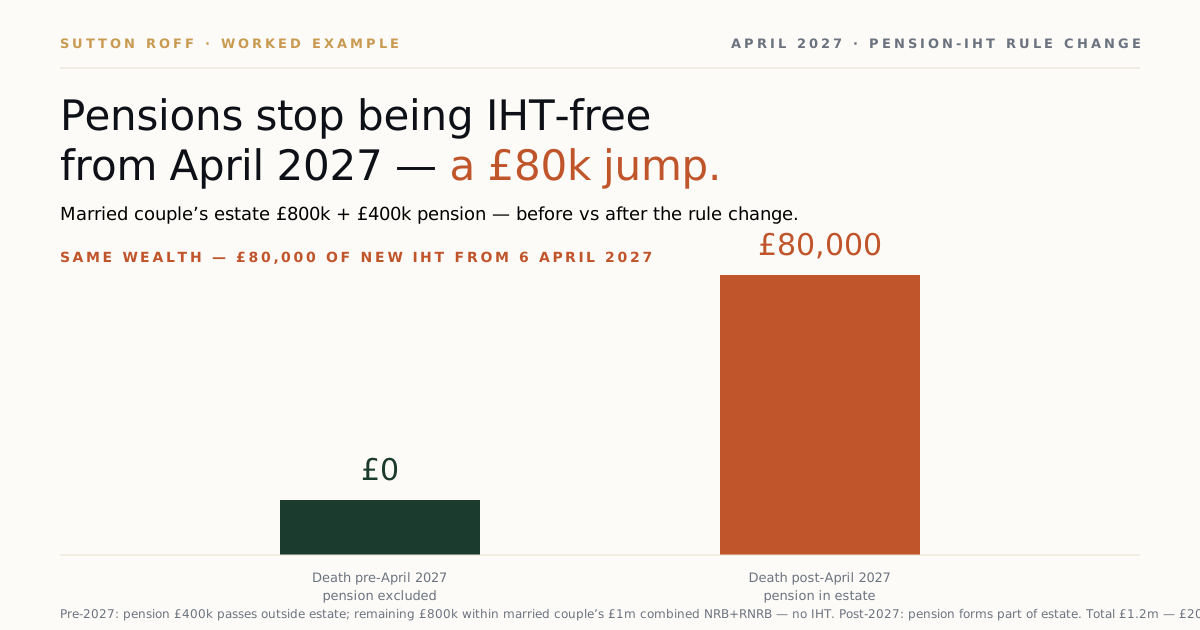
From 6 April 2027, most pension funds become part of your estate for inheritance tax — undoing decades of “pensions are the most efficient asset to leave to children” planning. We see landlord-and-pension households facing £80,000-£200,000 of new IHT post-2027 on the same wealth that paid £0 today. The 18-month window before the change is the only time to restructure the position cleanly.
The current rules — until 5 April 2027
If you die before 75 with a defined-contribution pension:
- Pension passes to nominated beneficiaries outside your estate
- No IHT
- Beneficiaries can draw it as income (taxed at their marginal rate) or take a tax-free lump sum if you died before 75
If you die at 75 or after:
- Pension still passes outside the estate (no IHT)
- Beneficiaries pay income tax at their marginal rate when they draw
This treatment has made pensions the natural place to “park” wealth for inheritance — particularly for landlords and business owners with already-IHT-exposed estates.
What changes from 6 April 2027
The 2024 Autumn Budget announced that most pension funds will become part of the estate for IHT from 6 April 2027. The mechanics:
- Pension funds at death will be added to other estate assets
- IHT calculated on the combined total at standard 40% above NRB+RNRB
- Pension provider will withhold the IHT amount before paying out to beneficiaries
- Beneficiaries still pay income tax on inherited pensions when drawn (creating possible double-tax situations)
The change applies to deaths from 6 April 2027 onwards. Pensions inherited before that date follow the old rules; deaths after follow the new rules.
The Foster estate — £80k of new IHT from April 2027
The Fosters, a married couple, have total wealth of £1.2m: £800k of property and savings + £400k of pension funds. Both die after April 2027 (second death triggers final IHT calculation).
Pre-April 2027 rules:
- Estate at second death: £800k
- Combined NRB + RNRB available: £1m
- Taxable estate: £0 (entire £800k covered by allowances)
- Pension £400k passes outside estate to beneficiaries
- Total IHT: £0
Post-April 2027 rules:
- Estate at second death: £800k + £400k pension = £1.2m
- Combined NRB + RNRB available: £1m
- Taxable estate: £200,000
- IHT at 40%: £80,000
The same wealth, the same household — £80,000 of new IHT created by the rule change. For larger pension-and-property combined estates, the gap is substantially bigger.
Who’s most affected
Pension-rich landlords. Many landlords have accumulated large pensions on top of property portfolios, comfortable that the pension was IHT-protected. Combining a £500k pension with a £1m property portfolio post-2027 creates substantial new IHT exposure.
SIPP/SSAS holders. Self-invested pension holders with seven-figure pots will see major IHT planning changes. Some will accelerate withdrawals before April 2027 to crystallise tax-efficient extraction.
High earners with executive pensions. DB pensions paying out lump sums on death also fall into the new estate calculation — affecting many senior public-sector and corporate pension members.
What planning levers still work after 2027
Drawing the pension during your lifetime. Money drawn out and spent reduces both the pension and the eventual estate. Money drawn out, taxed at marginal rate, then gifted into trust (or as outright PETs) starts the 7-year clock — falling out of the estate completely after 7 years.
The Lump Sum Allowance and PCLS. The 25% tax-free lump sum (covered in our 25% pension tax-free guide) lets you take up to £268,275 tax-free during life. Cash taken now, gifted within allowances, escapes both income tax and IHT.
Spouse exemption is unchanged. Pensions passed to a surviving spouse remain IHT-free between spouses. The IHT calculation is on the second death, not the first. So a married couple has the same first-death position; the change kicks in on the second death.
Charitable bequests. Pension funds gifted to charity at death remain IHT-exempt. Used strategically, this can bring estates back below thresholds.
Family Investment Companies. Moving accumulated wealth into a FIC over time, with shares gifted to children, sits outside the estate after 7 years. Doesn’t directly help with the pension itself but offers an alternative wealth-transfer vehicle.
The pre-2027 strategic window
For anyone with health issues or older age, dying before 6 April 2027 vs after has materially different outcomes. The grim observation: estate planning that accelerates before the cliff edge is rational for some.
For everyone else, the more practical move is using the 18-month window to:
- Take the 25% PCLS now if it makes sense (covered in our 25% piece)
- Crystallise income drawdown plans that move money out of pension during life
- Begin lifetime gifting to children, starting the 7-year clock
- Review nominated beneficiaries — spouse first to defer the IHT issue
What the pension provider will do
From 6 April 2027, when a member dies, the pension provider must:
- Notify HMRC of the pension fund value
- Wait for HMRC’s IHT calculation across the whole estate
- Pay the calculated IHT amount before distributing to beneficiaries
- Distribute the remainder to nominees
This adds processing time to pension distributions — potentially 6-9 months between death and beneficiaries receiving the money. Cash-flow implications for families relying on pension inheritance to cover other estate liabilities.
Will the rules change again?
The 2024 Budget announcement is law as scheduled, but pension-IHT has been politically contested. A change of government could reverse the rule before 2027 implementation. Plan based on current law; flex if changes happen.
When this is a bad idea
Don’t accelerate large pension withdrawals just to “beat” the 2027 deadline without modelling the income-tax cost. Withdrawing £400k in 2026/27 produces a tax bill that often exceeds the IHT saving on the same amount post-2027.
Don’t gift pension proceeds to a spouse “to escape IHT” — spouse gifts are already exempt, so it just adds to their estate which faces the same IHT calculation eventually.
Don’t ignore pension nominations. Out-of-date nominations can result in pension passing to the estate (always IHT-exposed) rather than directly to nominees.
Key takeaways
- Until 5 April 2027: pensions pass outside the estate for IHT (income tax only on draw).
- From 6 April 2027: most pensions form part of the estate, IHT at 40% above allowances.
- Same wealth households face £80k+ of new IHT depending on size.
- Spouse exemption unchanged — IHT calculation triggers on second death.
- Lifetime drawdown + gifting can move wealth out of estate (7-year clock).
- 25% PCLS still tax-free during life.
FAQ
Does this apply to defined benefit pensions too?
Most DB pension lump-sum death benefits will fall into the new IHT regime from April 2027. The detail varies by scheme. Some legacy DB schemes have specific treatment — check with your scheme administrator.
What if my pension is already in drawdown?
In-drawdown funds are still part of your pension wrapper for the new IHT rules. The “outside the estate” treatment ends regardless of crystallisation status. Drawing down faster pre-2027 to crystallise into spendable cash is one strategy.
Will spouse beneficiaries pay tax?
Inter-spouse transfers (alive or on death) remain IHT-exempt. So a spouse beneficiary inherits without IHT, but the asset then sits in their estate — subject to IHT on their eventual death (taxable then).
Substantial pension on top of property or business assets and never modelled IHT exposure? Book a free 20-min review — we’ll size the pre- and post-2027 bills, identify lifetime extraction strategies, and structure gifting timelines around the rule change. Specialist UK estate planning accountants.