
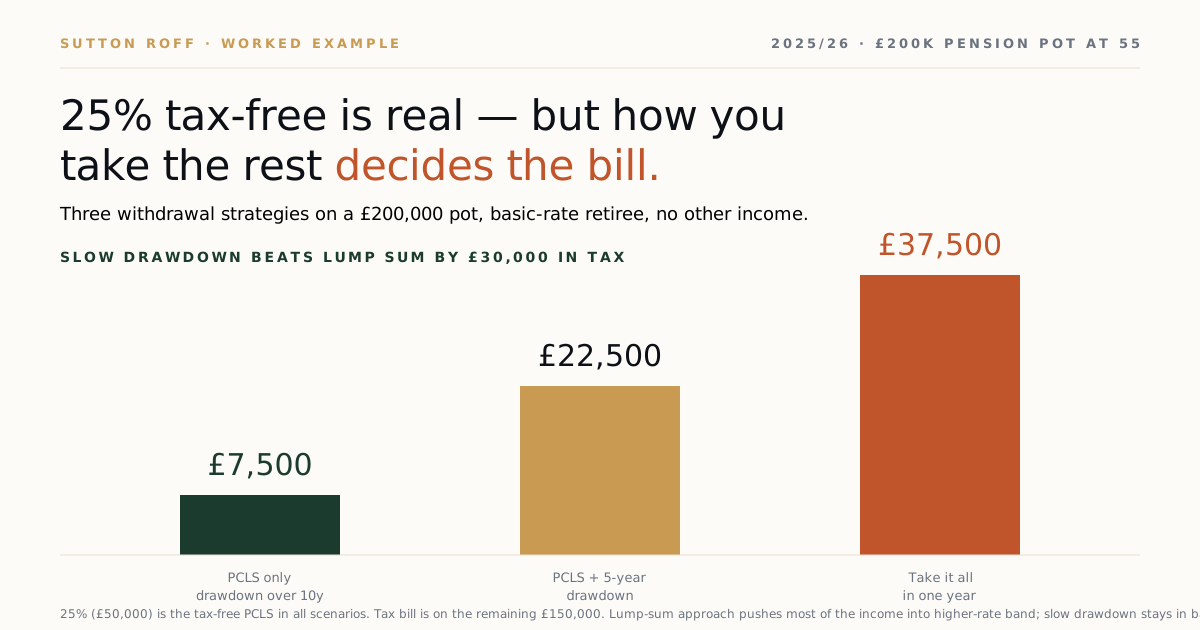
25% of your defined-contribution pension comes out tax-free at 55, capped at the £268,275 Lump Sum Allowance. The bigger decision is what you do with the other 75%. We see £200,000 pots cost their owner £37,500 in tax via single-year withdrawal — when slow drawdown over 10 years would have cost £7,500. Same money, same age, same allowance — three decades of difference.
The basic mechanic
From age 55 (rising to 57 from April 2028), you can access your pension. The first 25% of any defined-contribution pot can be taken as a Pension Commencement Lump Sum (PCLS) — completely tax-free. The remaining 75% is taxable as income at your marginal rate when you take it.
The 25% tax-free amount is capped by the Lump Sum Allowance (LSA) of £268,275. Most savers won’t hit this cap — it kicks in on pots above £1,073,100. For everyone below that, 25% of the pot really is 25% tax-free.
The two main routes once you’ve taken the 25%
Flexi-access drawdown. Take the 25% tax-free lump sum upfront, leave the remaining 75% invested, and draw income from it as needed. Each pound drawn from the 75% is fully taxable as income. You control timing, and good timing means you stay in the basic-rate band each year.
UFPLS (Uncrystallised Funds Pension Lump Sum). Take chunks ad-hoc, with each chunk being 25% tax-free and 75% taxable. So a £40,000 UFPLS is £10,000 tax-free + £30,000 taxable. Useful for people who don’t want to “commit” the full 25% upfront.
We covered the trade-off in detail in our UFPLS vs PCLS guide — for most retirees with mortgage payoff or investment plans for the lump sum, PCLS-then-drawdown wins. For people who want to keep options open, UFPLS is more flexible but rarely cheaper in tax.
Three withdrawal strategies on Lisa’s £200,000 pot
Lisa is a basic-rate retiree at 55 with a £200k pot. No other income until her state pension kicks in at 67.
| Strategy | How Lisa takes it | Total tax | vs Strategy A |
|---|---|---|---|
| A | All £200k in one tax year (£50k tax-free + £150k taxable) | £37,500 | — |
| B | £50k PCLS upfront + £30k/yr drawdown over 5 years | £17,430 | −£20,070 |
| C | £50k PCLS upfront + £15k/yr slow drawdown over 10 years | £7,500 | −£30,000 |
Same pot, same 25% tax-free lump sum — just very different choices about how to take the rest. The lump-sum-everything approach is the worst path for almost everyone with a £200k+ pot.
Same pot, same 25% tax-free lump sum — just very different choices about how to take the rest. The lump-sum-everything approach is the worst path for almost everyone with a £200k+ pot.
What happens to the 75% if you leave it invested?
Inside the pension wrapper, the remaining 75% (or all of it, if you didn’t take PCLS) keeps growing tax-free. No income tax on dividends or interest, no CGT on growth. So leaving funds in pension drawdown often beats moving them to ISA or general investment account.
Plus — until April 2027 — pensions sit outside your estate for IHT. So large drawdown pots are an excellent vehicle to pass to children. From 6 April 2027 most pension funds become part of the estate for IHT, which materially changes this calculus. We’ll cover the 2027 change in detail separately.
The “pension recycling” rule to be aware of
HMRC’s pension recycling rule blocks people from taking the tax-free 25% and immediately re-contributing it to another pension to claim more tax relief. The trigger is broadly: significant new contribution (£7,500+ or 30%+ of the lump sum) within two years of a tax-free lump sum, where the contribution was pre-planned.
Penalties for breaching the recycling rule are 25% of the lump sum back to HMRC. Don’t take the 25%, lump it back into another pension, and expect to be fine — even if it sounds technically clever.
The Money Purchase Annual Allowance trap
Once you’ve drawn taxable income from a pension (anything beyond the 25% tax-free portion), your future annual contribution allowance drops from £60,000 to £10,000 — the Money Purchase Annual Allowance (MPAA). So if you’re 55, want to access pension cash, but also still want to keep contributing meaningfully (e.g. you’re still working), think hard before triggering taxable drawdown.
Taking just the 25% tax-free lump sum (PCLS) does not trigger MPAA. It’s the first taxable drawdown that flips the switch.
When this is a bad idea
Don’t take 25% tax-free and stick it in a low-yield savings account. Inside the pension it would compound tax-free; outside it loses 1-3% to inflation each year. Take the 25% only when you have a specific plan for the cash — debt payoff, business investment, defined retirement spend.
Don’t trigger drawdown before 55 — you’ll trigger an unauthorised payment charge at 55%+ even if it’s an emergency.
Don’t ignore the age change. The minimum pension age rises from 55 to 57 on 6 April 2028. People with pre-2006-protected lower minimum ages keep them; everyone else loses two years of access.
Key takeaways
- 25% of a defined-contribution pension is tax-free from age 55 (rising to 57 from April 2028).
- Lump Sum Allowance caps the 25% at £268,275 (relevant only above £1.07m pot).
- Slow drawdown of the 75% saves tens of thousands in tax versus single-year withdrawal.
- PCLS alone doesn’t trigger the £10k MPAA contribution cap; first taxable drawdown does.
- Pension recycling rules block contributing the tax-free lump sum back into pensions.
- Pensions sit outside the estate for IHT until April 2027 — major change ahead.
FAQ
Can I take 25% from each separate pension?
Yes — each pension pot has its own 25% PCLS, capped at £268,275 in aggregate across all pensions (Lump Sum Allowance). Most savers have multiple pots and combine them strategically.
What if I’m 56 with health issues?
From April 2028 the minimum age rises from 55 to 57 — some pre-2006-protected arrangements keep lower minimums. Health-related early access (severe ill-health) lets you take the full pot tax-free at any age.
Does PCLS count toward the personal allowance?
No — the 25% tax-free portion isn’t income for tax purposes. It doesn’t use any Personal Allowance, doesn’t affect HICBC threshold, doesn’t push you into the 60% trap.
Approaching 55 with a meaningful pot and want to time the withdrawals properly? Book a free 20-min review — we’ll model PCLS-versus-UFPLS, the multi-year drawdown sequence, and the April 2027 pension-IHT impact on your overall plan. Specialist UK retirement planning accountants.