
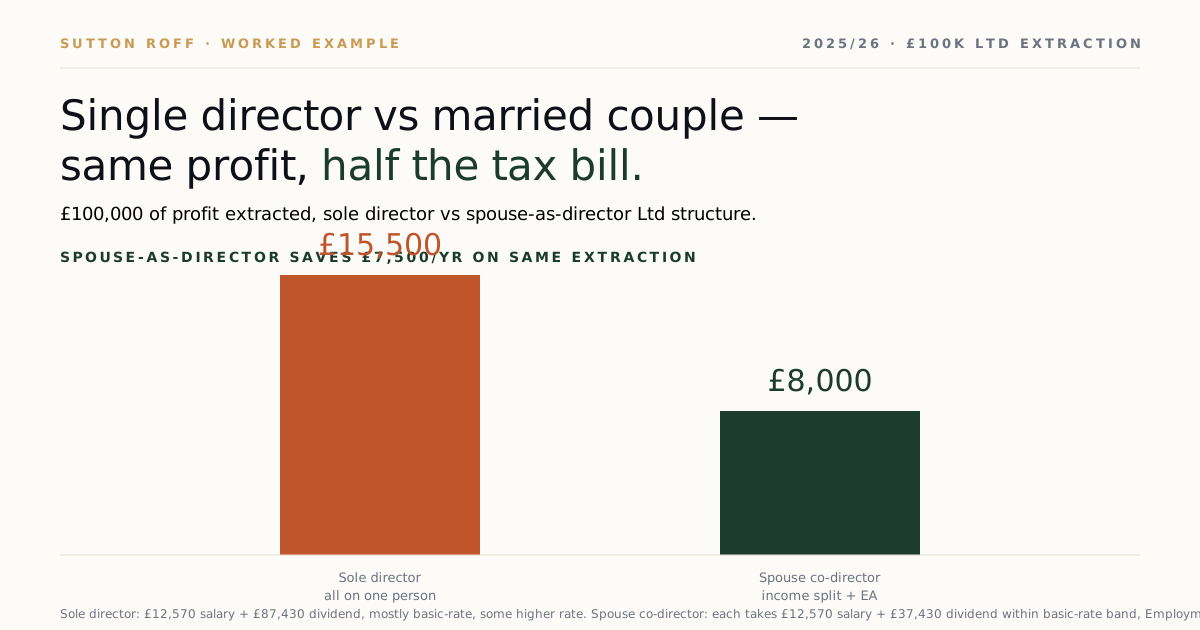
Bringing a spouse into your Ltd as co-director-and-shareholder saves a higher-rate director £4,000-£7,500/year on the same total extraction — £100,000 across a decade. The structure has been court-tested (Arctic Systems, 2007) and survives HMRC scrutiny — provided the salary is commercially defensible and shares carry full economic rights. We see DIY arrangements with stripped voting rights or token salaries fall apart under review.
Three ways to bring a spouse in
1. As an employee. The spouse takes a salary for genuine work. Salary is corporation-tax deductible. They use their own £12,570 Personal Allowance, and the company unlocks the £10,500 Employment Allowance (which sole-director companies can’t claim).
2. As a co-director. The spouse becomes a registered director of the company. Same EA benefit, but with statutory director responsibilities. Often paired with a shareholding too.
3. As a shareholder. The spouse holds shares (usually preference or ordinary), receives dividends. This unlocks their basic-rate dividend band and £500 dividend allowance — typically saves £4-7k/year on £40-50k extracted.
Most spouse-in-business structures combine 2 and 3: spouse becomes co-director with a meaningful shareholding. The combined effect is dramatic.
Sole director versus spouse co-director — £7,500/year on the same £100k
David runs a Ltd consultancy extracting £100,000 of profit. We model two structures:
Sole director route:
- £12,570 salary + £87,430 dividends
- Most of the dividend lands in higher-rate band (above £50,270 total income)
- Personal tax on extraction: roughly £15,500
- No Employment Allowance available (sole director)
With spouse as co-director with 50% shares:
- Each spouse: £12,570 salary + £37,430 dividends = £50,000 each total
- All dividends within basic-rate band (under £50,270 total income)
- Combined personal tax: roughly £8,000
- Plus Employment Allowance = £0 employer NIC on first £10,500 paid
- Saves £7,500/year on the same £100,000 extraction
The settlements legislation — what Arctic Systems settled
HMRC’s settlements legislation (technically S624 ITTOIA 2005) prevents “income shifting” — giving income-producing assets to a spouse purely to shift income at lower marginal rates. It’s the rule that catches sham employee arrangements where the spouse does nothing.
The key case is Arctic Systems (Jones v Garnett, 2007). The Supreme Court held that arranging shares for a spouse who contributes minimally to the business is broadly fine for ordinary spouses with shared finances — provided the shareholding is structured properly. The “spouse exemption” within settlements legislation gives married couples a recognised legitimate route.
What needs to hold for the structure to survive:
- The spouse genuinely owns the shares (not just paper transfer)
- The shares must carry full rights — voting, capital — not be “stripped” of substance
- If the spouse is also an employee/director, their role and pay must be commercially defensible
The reasonable salary test for an employed spouse
If the spouse is paid as an employee, the salary must be commercially reasonable. HMRC’s wholly-and-exclusively rule applies: would you pay this salary to a non-relative for the same role?
Common acceptable arrangements:
- Bookkeeping, admin, scheduling: 5-10 hours/week at £15-25/hour = £4,000-£12,500/year
- Marketing, content, social media: 5-15 hours/week at £25-50/hour = £6,000-£35,000/year
- Operational management, client services: 20-40 hours/week at £20-50/hour = £20,000-£100,000/year
What HMRC challenges:
- “Director’s wife paid £30,000/year for company secretarial work she barely performs”
- “Husband paid £45,000/year as ‘consultant’ with no contemporaneous evidence of work delivered”
- Salaries paid into joint accounts with no spouse-controlled withdrawal pattern
Salaries paid in line with role and time genuinely worked are defensible. Inflated salaries for token roles get reassessed.
Director’s responsibilities a spouse should accept
Becoming a co-director isn’t just a paper title:
- Statutory duties under Companies Act 2006
- Personal liability for certain decisions (e.g. wrongful trading, tax compliance)
- Public listing on Companies House
- Required signature on annual confirmation statements and accounts
For some couples, having both as directors is fine. For others (e.g. where one spouse has a separate professional career and doesn’t want public director status), employee-and-shareholder is cleaner than co-director.
The dividend-only spouse route
If the spouse has no involvement in the business beyond being a shareholder, the structure can still work — but the analysis is more sensitive to the settlements legislation. Key factors:
- Shares must be ordinary or preference, with full economic rights
- Dividend distribution must be consistent across share classes (no “alphabet shares” abuse)
- HMRC has historically flagged structures with stripped voting rights or stripped capital rights
For most owner-managed businesses, a 50:50 shareholding with the spouse holding ordinary shares survives scrutiny. Stripped-rights structures or wildly disproportionate splits (95:5) raise the bar significantly.
Pre- and post-marriage transfers
Transfers between spouses are CGT-exempt (no-gain-no-loss). So a director already running a Ltd can transfer shares to their spouse without triggering CGT — useful for retrofitting the structure to an existing business.
The settlements legislation evaluation looks at the substance of the transfer, not just the legal title. A genuine intent that the spouse benefits long-term is required. Court-tested mechanisms like the Arctic Systems shareholding survive; stripped structures don’t.
Pension contributions for the spouse
Once the spouse is on payroll, the company can also make employer pension contributions for them. This compounds the tax efficiency — extracting money via spouse pension instead of dividend further uses the spouse’s tax-efficient routes (covered in our employer pension contributions guide).
For a spouse with no other employment, the £60,000 annual allowance applies in full, so substantial contributions are possible.
When this is a bad idea
Don’t put a spouse on payroll for a token salary if they’re not genuinely working in the business. HMRC challenges these and the cost of getting it wrong is back-tax plus penalties scaling with how aggressive the arrangement looked.
Don’t transfer shares “the night before the dividend” — anti-avoidance rules look at substance. The transfer needs to reflect a long-term family economic arrangement, not a tactical income-split before a known distribution.
Don’t rely on stripped-rights “alphabet shares” without taking proper advice. The arrangements that survived Arctic Systems are full-rights shareholdings; stripped structures are vulnerable.
Key takeaways
- Spouse as employee + shareholder + director = unlocks tax savings of £4-7k/year on £50k+ extraction.
- Salary must be commercially reasonable for role genuinely performed.
- Shareholding should be ordinary shares with full economic rights.
- Settlements legislation has a spouse exemption — Arctic Systems test confirms structure works.
- Co-directorship adds statutory responsibility — sometimes employee-only is cleaner.
- Spouse pension contributions further compound the efficiency.
FAQ
Does my spouse need to be on payroll?
For the spouse-as-employee route, yes — PAYE registration, RTI returns, payroll software. For shareholder-only structure (no employment), no payroll needed; dividends are sufficient. Most efficient structure combines both.
What’s the Settlements Anti-avoidance test?
HMRC’s rule preventing “income shifting” via spousal arrangements. Arctic Systems (Jones v Garnett, 2007) confirmed ordinary spouse-shareholders survive the test. Stripped voting rights or sham employee arrangements fail it.
Can I retroactively allocate shares?
No — share allocations must reflect economic reality at the time. Backdating share certificates is fraud. The structure must be in place before the income is generated, not after.
Sole director taking £80k+ from your Ltd and never restructured with a spouse? Book a free 20-min review — we’ll size the saving, structure the shareholding properly, and document the role-and-salary case so it stands up to HMRC scrutiny. Specialist UK director-extraction accountants.