
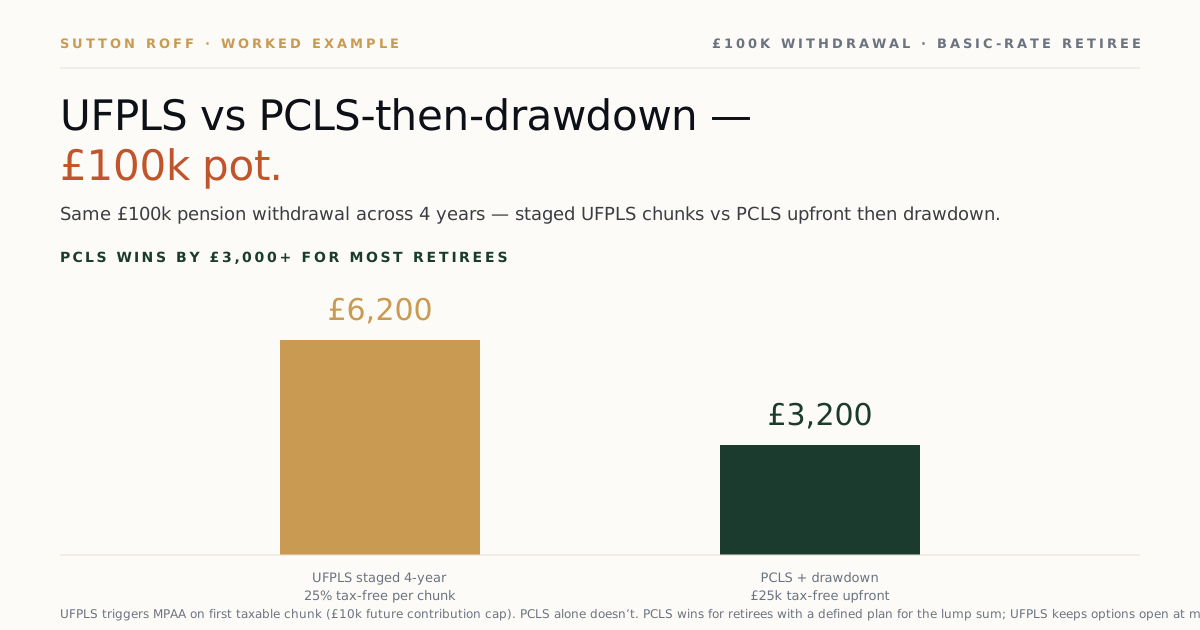
When you reach 55 (rising to 57 from April 2028), you can start accessing your pension. There are two main ways to do it, both of which give you 25% tax-free access — but the timing of when you take that 25% can dramatically change your tax bill, especially if you’re still working or planning a phased retirement. Here’s the 2025/26 framework.
The two options
Option 1 — Pension Commencement Lump Sum (PCLS): the traditional route. You take 25% of your fund as a tax-free lump sum upfront. The remaining 75% goes into “drawdown” and you withdraw from it as needed, with each drawdown taxed as income at your marginal rate.
Option 2 — Uncrystallised Funds Pension Lump Sums (UFPLS): introduced 2015. Each time you withdraw, 25% of that withdrawal is tax-free and 75% is taxable. So instead of taking the 25% all upfront, you spread it across every withdrawal.
Both routes deliver the same total tax-free amount (25% of your fund) over the long run — what changes is the timing and the way it interacts with your other income.
The Lump Sum Allowance
One important 2024 change: the old “Lifetime Allowance” was abolished and replaced with three new allowances. The most relevant here is the Lump Sum Allowance (LSA) of £268,275 — the maximum tax-free lump sum you can take across all your pensions in your lifetime. Anything above gets taxed as income.
For most savers this won’t bind. For directors with substantial retained-pension contributions, plan around the LSA — once you’ve taken your full £268,275 tax-free, further withdrawals are 100% taxable.
When PCLS wins — phased retirement while still working
If you’re still working and earning enough to fill your personal allowance and basic-rate band from salary/dividends, the PCLS route is usually better. You take the 25% tax-free upfront, then leave the remaining 75% in drawdown until you actually retire — at which point your other income drops, and the drawdown gets taxed at lower rates (often basic rate or even within the personal allowance).
You can also spread the PCLS. Instead of crystallising the whole 25% in one go, crystallise tranches over multiple tax years. Example: a £400k pot crystallised in £100k tranches over four years gives you £25k of tax-free income each year.
When UFPLS wins — early retirement before State Pension
If you stop work before State Pension age (currently 66) and have no other income, UFPLS lets you use your personal allowance every year against the taxable 75% portion. That means a meaningful chunk of each withdrawal effectively comes out tax-free.
Worked example: you retire at 60, have £400k in a SIPP, no salary, no rental income. You take an UFPLS of £18,000/year:
- £4,500 (25%) is tax-free
- £13,500 (75%) is taxable, but £12,570 is covered by your personal allowance
- £930 is taxable at 20% basic rate = £186 tax
- Net tax: £186 on £18,000 of income (1% effective rate)
Repeat for years 60 to 66 and you’ve taken £108,000 with about £1,116 of tax. Almost the entire personal allowance is being used to make 75% of the pension tax-efficient.
The MPAA trap
One thing UFPLS triggers that PCLS doesn’t: the Money Purchase Annual Allowance (MPAA). Once you take an UFPLS (or any taxable income from your pension beyond the PCLS), your future annual allowance for new contributions to defined-contribution pensions drops from £60,000 to £10,000.
If you plan to keep working and contributing significant amounts to your pension after starting withdrawals, take PCLS only — it doesn’t trigger the MPAA. Once you take an UFPLS, you can’t undo the trigger.
The “small pots” rule — overlooked but useful
If you have any pension pots under £10,000, you can take them entirely under the small-pots rule (up to three personal pensions, unlimited occupational pensions). 25% of each is tax-free, 75% taxable as income — but it does not trigger the MPAA. Useful if you’ve got several small legacy pensions you’ve forgotten about.
Key takeaways
- Two main pension-access routes: PCLS (25% tax-free upfront, then taxable drawdown) or UFPLS (25% tax-free on each withdrawal).
- Lump Sum Allowance: £268,275 across your lifetime.
- Still working at higher rate? PCLS, spread over years, is usually best — defers taxable drawdown until retirement.
- Early retired with no other income? UFPLS uses your personal allowance every year — typically near-zero effective tax.
- UFPLS triggers the MPAA (cuts future contributions to £10k/year). PCLS doesn’t. Plan around this.
- Small pots under £10k can be drawn outside the MPAA mechanism — useful for legacy pots.
FAQ
Can I switch between PCLS and UFPLS later?
Once you’ve crystallised funds via PCLS, the related drawdown account is set up and you can take income flexibly. UFPLS uses uncrystallised funds. You can use both at the same time across different parts of your pension — not strictly mutually exclusive.
Does taking PCLS trigger MPAA?
No — pure PCLS withdrawal alone doesn’t trigger the £10,000 Money Purchase Annual Allowance. It’s the first taxable drawdown that flips the switch. So if you only ever take the 25% tax-free portion, your future contributions stay at the standard £60k AA.
What about partial PCLS?
You can crystallise pots in tranches — e.g. take 25% PCLS from £100k of a £400k pot now (£25k tax-free), leave the remaining £300k uncrystallised. Useful when you want the tax-free cash now but don’t need to start drawdown yet.
Approaching 55, retired, or planning a phased exit? The route you pick now changes your lifetime tax bill by tens of thousands. Book a free 20-min review and we’ll model the PCLS vs UFPLS decision specifically for your fund and other-income profile. Specialist UK tax planning.