
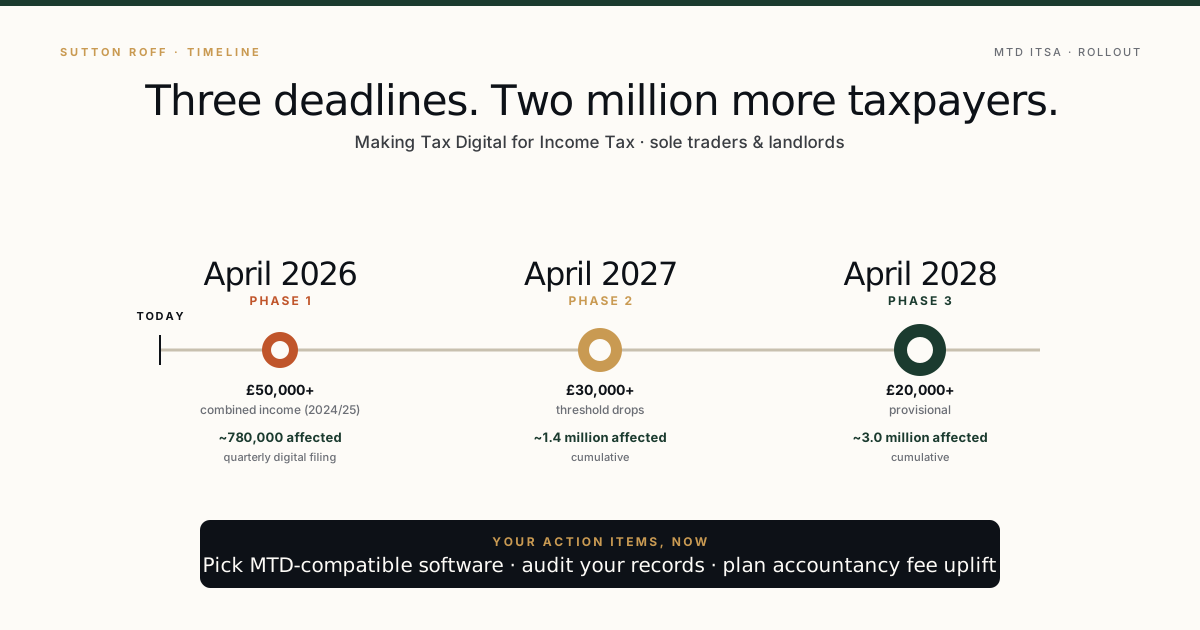
Making Tax Digital for Income Tax Self-Assessment (MTD ITSA) finally goes live on 6 April 2026 after years of delays. If your combined self-employment + property income for the 2024/25 tax year was over £50,000, you’re in scope from day one. From April 2027, the threshold drops to £30,000 — pulling in roughly 2 million more taxpayers. This is the single biggest compliance change for sole traders, landlords and creators in two decades. Here’s what you actually need to do in the next 6 months.
What MTD ITSA actually requires
Three new obligations, in addition to your existing self-assessment return:
- Digital records — every income and expense item must be recorded digitally in MTD-compatible software (HMRC publishes a list). Spreadsheet-only is allowed if it’s connected to “bridging software” that submits via API.
- Quarterly updates — four “quarterly updates” per year, summarising income and expenses for each business. Filed via API, not the .gov.uk portal. Deadlines: 7 August, 7 November, 7 February, 7 May.
- Final declaration — replaces the current self-assessment return. Filed by 31 January as before. Includes any non-business income (employment, dividends, savings) and confirms the figures from the quarterly updates.
One important point: the quarterly updates aren’t a tax payment. You still pay tax on 31 January and 31 July as you do now. The quarterly updates are reporting only.
Who’s in scope from April 2026
You’re mandated from 6 April 2026 if both apply:
- You’re a sole trader or landlord (or both)
- Your combined gross income from those sources for tax year 2024/25 was over £50,000
“Gross income” is turnover, not profit. A landlord with three BTLs grossing £20k each is in scope (£60k gross), even if net profit after Section 24 mortgage costs is much lower.
From 6 April 2027, the threshold drops to £30,000.
From 6 April 2028 (provisional), the threshold drops to £20,000.
Limited companies are not in scope of MTD ITSA — they have their own separate MTD for Corporation Tax framework, currently delayed.
Who’s exempt or excluded
- Partnerships (separately delayed — date not yet confirmed)
- Trusts
- Beneficiaries of trusts (different rules)
- Non-residents with UK property income (in the rules but with concessions for digital exclusion)
- People genuinely unable to use digital tools — case-by-case digital exclusion application
The three things to do in the next 6 months
1. Pick your software now.
HMRC’s approved list includes Xero, QuickBooks, FreeAgent, Sage, Coconut, Untied, Hammock, and several specialist landlord apps. For most:
- Sole traders / general SMEs — Xero or FreeAgent. Xero scales better; FreeAgent is simpler for one-person operations and free with most NatWest/Mettle business accounts.
- Landlords — Hammock (purpose-built for property), or Xero with a property plug-in.
- Creators / influencers — Xero or FreeAgent, depending on volume of platform reconciliation.
Start using your chosen software in the 2025/26 tax year so you have a clean run-in. Going live on 6 April 2026 with software you’ve never used is a recipe for missing the August Q1 deadline.
2. Audit your record-keeping now.
Whatever you do today (shoebox, spreadsheet, app), MTD requires:
- Each transaction recorded with date, amount, and description
- Receipts kept (HMRC accepts photos/scans — don’t need paper)
- Categorised by income/expense type
- Reconciled to your bank statements
If you’ve been doing rough end-of-year reconciliation, that won’t fly. The shift to monthly (or weekly) digital recording is the single biggest change.
3. Plan for the cashflow impact of quarterly visibility.
You won’t pay tax quarterly — but HMRC will see your numbers four times a year. That changes one practical thing: HMRC’s risk-scoring becomes faster. Anomalies (unusually high expense ratios, sudden income drops, late filings) will trigger nudge letters or enquiries faster than before.
For most well-managed businesses this is a non-issue. For businesses that have been running tight or with informal records, the increased visibility shortens the gap between making a mistake and HMRC asking about it.
Penalties — the new points-based system
MTD uses a points-based late-filing penalty system:
- Each missed quarterly update or final declaration = 1 point
- Hit 4 points (in 24 months) = £200 fixed penalty
- Each subsequent missed deadline at the threshold = additional £200
- Points can be cleared by 24 months of full compliance
Plus interest and late-payment penalties on tax due on 31 January (unchanged).
The hidden cost — accountancy fees will go up
For your accountant, MTD changes a one-touch year-end engagement into a five-touch quarterly engagement. Expect fee increases of:
- Sole trader / simple landlord: +£200–£400/year (4 quarterly reviews + final)
- More complex traders or multi-property landlords: +£500–£1,000/year
This is real, structural, and unavoidable. Accountants offering “MTD-included” packages at no price increase are usually skipping the quarterly review (which means errors compound until year-end).
What sole traders / landlords often get wrong
- Trying to use a non-MTD spreadsheet without bridging software. Won’t be accepted. Pick a real solution.
- Leaving software setup to March 2026. Migrating data while running a business is brutal. Start six months early.
- Treating quarterly updates as tax payments. They’re not — they’re reporting. Tax payment dates haven’t changed.
- Forgetting that a single missed deadline = a point. 4 points = £200 penalty, even if your final return is filed on time and tax is paid.
Key takeaways
- MTD ITSA is mandatory from 6 April 2026 for sole traders + landlords with combined income over £50k in 2024/25.
- Threshold drops to £30k in April 2027, £20k in April 2028.
- Quarterly digital updates required: 7 Aug, 7 Nov, 7 Feb, 7 May. Plus final declaration on 31 January.
- Get on MTD-compatible software now — Xero, FreeAgent, Hammock for property, or similar. Use it through 2025/26 to be ready.
- Expect accountancy fees to rise by £200–£1,000 a year. It’s real, structural work.
FAQ
Do I need software, or can I use spreadsheets?
You need MTD-compatible software to submit quarterly updates. Spreadsheets alone don’t work, but “bridging software” lets you keep a spreadsheet for record-keeping and use the bridge to submit to HMRC. Many low-cost options under £10/month.
What if my income drops below the threshold mid-year?
Once you’re in MTD, you stay in unless you have three consecutive years below threshold. So a single dip year doesn’t pull you out — you continue quarterly reporting.
Does MTD apply to my Ltd company?
Not yet for corporation tax. MTD is currently rolling out for VAT (already live), Income Tax (April 2026 / 2027), and eventually corporation tax (timing TBC). Ltds remain on annual CT600 for now.
We’re already onboarding new clients onto MTD-ready workflows. Book a free 20-min review to plan your transition before April 2026 — software selection, data migration, training, ongoing support all in scope. Specialist UK accountants for sole traders, landlords and creators.