
Renting a room of your home to your own Ltd can deduct £2,000-£4,000/year of corporation tax relief beyond what dividends would cost — but the principal-residence-relief trap costs £12,000+ of CGT on home sale if the licence wording is wrong. We see DIY templates compromise PRR on the let proportion, then the homeowner discovers the cost only when they sell their home a decade later.
The mechanics
The structure: you (as homeowner) sign a formal tenancy agreement letting a defined room or suite of rooms to your Ltd company at fair market rent. The company pays you rent monthly. The company gets a corporation-tax deduction for the rent paid. You declare the rent as untaxed property income on your self-assessment return.
Why it works: the rent moves money out of the company at the company’s marginal corporation-tax rate (19% for small profits, 25% headline) and into your personal return at your marginal income-tax rate after deducting your apportioned home-running costs against the rental income.
For a higher-rate-taxpayer director, the personal income-tax cost on the net rental income is lower than the dividend tax (33.75% higher rate) on the same money extracted as a dividend.
What the rent has to look like
The rent must be at fair market value. HMRC will challenge above-market arrangements as “extraction by another name”, recharacterising part as a dividend or BIK. Fair market rent for a room used by a one-person company in a residential setting is typically £200-£500 per month, depending on location and size.
You need a written tenancy agreement (or licence agreement, more commonly for non-exclusive use), drawn up at arm’s length, with the rent reviewed annually and supported by some external benchmark (similar local commercial rentals, valuer’s note, or comparable home-office serviced-office rates).
The agreement must be signed before the rent starts flowing, dated, and kept on file.
Sophia’s setup — £6,000/year rent, higher-rate director
Sophia runs a director-only Ltd. She rents one room of her home to the company at £500/month = £6,000/year.
Company side: £6,000 rent paid is fully deductible against corporation tax. At 19% small profits rate: £1,140 of CT saved.
Personal side — rental income calculation:
- Rental income: £6,000
- Apportioned mortgage interest (1/8 of £24,000 annual interest): £3,000
- Apportioned utilities, council tax, insurance: £1,200
- Net rental profit: £6,000 − £4,200 = £1,800
Tax on £1,800 at 40% higher rate: £720.
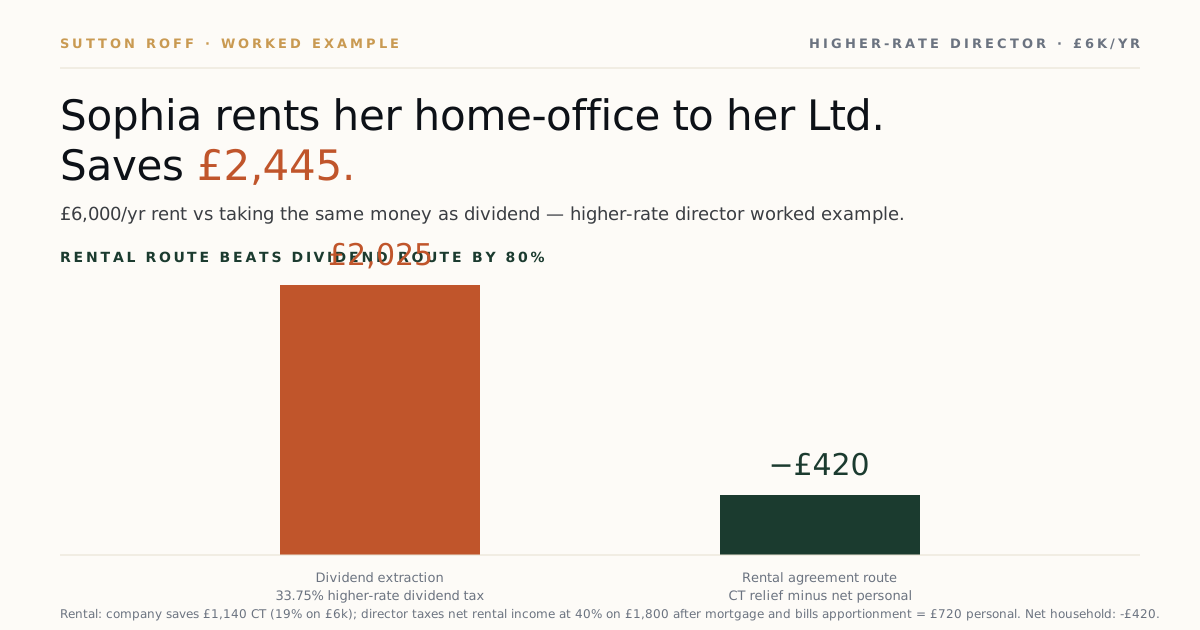
Net household result: Company saved £1,140; director paid £720. Net benefit: £420 on this £6,000.
Compare to extracting £6,000 as a dividend: £6,000 × 33.75% (higher-rate dividend tax) = £2,025 of personal tax, with no CT deduction since dividends aren’t deductible. Net cost: £2,025.
The rental route saves £2,445 versus the dividend route on the same £6,000 movement.
The CGT trap — the £12,000 mistake we see in DIY templates
Principal Private Residence Relief covers the gain on sale of your main home — provided no part is used “exclusively for business”. A formally rented room let to your company can compromise that exclusive-residence claim for the proportion let.
The fix: the licence/tenancy must allow personal use outside business hours. Don’t lock yourself into “exclusive business use” of the room contractually. The room can be a study that you also use for non-business work, family activities, guests. The company has a non-exclusive right to occupy during business hours; you retain general use.
Drafted this way, PRR remains intact. Drafted with “exclusive business use” language, you compromise PRR on (typically) 1/8 of the eventual gain — which on a £400,000 future gain is £50,000 of taxable gain at 24% = £12,000 of CGT. Far more than the £400/year saving was ever worth.
Class 2 NIC and the £6,725 question
Property income is not earned income for NIC purposes. So receiving rental income from your company doesn’t trigger Class 2 or Class 4 NIC — which is part of why it beats salary or dividends extraction at the margin.
It also doesn’t count toward the state-pension qualifying year, so it’s not a substitute for salary at the £6,500 LEL — that needs to come through your director payroll.
What about VAT?
Residential rentals are VAT-exempt by default. Renting your home to your company stays exempt — no VAT considerations. If your company is VAT-registered and the rented space is genuinely commercial (e.g. a separate annex used solely for trade), there’s an “option to tax” lever but it’s rarely beneficial.
Stamp duty? Inheritance tax?
SDLT applies to leases above certain thresholds — for residential leases below £125,000 net present value of rent, no SDLT. A £6,000/year licence at 5 years NPV is well below — no SDLT issue.
For IHT, the home remains your asset. The licence agreement doesn’t transfer ownership — only a contractual right to occupy. So no IHT impact on the structure itself. (We covered IHT on rental properties separately.)
When this is a bad idea
Don’t try to charge above-market rent to extract more — HMRC will challenge, recharacterise, and add back the excess as employment income or dividends, often with penalties for careless behaviour. The line is fair market value evidenced by external comparables.
Don’t use the formal tenancy as a substitute for the simpler £6/week home-office flat rate if the saving is small. We covered the comparison in our home office limited company guide — the rental structure typically only pays back when you’ve got meaningful mortgage interest to offset against the rental income, and a higher-rate marginal income-tax rate.
Don’t draft the agreement yourself from a generic template. The PRR-preserving language (“non-exclusive use”, retained general access) is precise and worth a solicitor or specialist accountant’s hand.
Key takeaways
- Director rents room to company at fair market rent; company gets CT deduction; director declares net rental income personally.
- Higher-rate director extraction saves £2,000-£4,000/year versus dividends on the same amount.
- The agreement must be at fair market value, written, dated, supported by external comparables.
- Use non-exclusive language to preserve Principal Private Residence Relief on home sale.
- No SDLT on small residential licences; no VAT (residential is exempt); no NIC (rental is unearned).
- Best for higher-rate-taxpayer directors with mortgage interest to offset.
FAQ
How much rent should I charge?
Fair market value — typically £200-£500/month for a room used by a one-person company in a residential setting. Benchmark against local serviced-office rates and similar commercial-style residential rentals.
Does this trigger SDLT?
For small residential licences (NPV under £125,000 over the lease term), no SDLT. A typical £6,000/year licence over 5 years has NPV well below the threshold — no SDLT issue.
What if I have a mortgage on the home?
Mortgage interest can be apportioned against the rental income on your personal return — the personal-side calculation. The mortgage itself stays a personal residential mortgage; you don’t need lender consent for a small home-office licence.
Considering renting a home-office to your own Ltd? Book a free 20-min review — we’ll structure the licence with PRR-preserving language, benchmark fair-market rent so HMRC can’t challenge it, and make sure the saving sticks years later. Specialist UK director-extraction accountants.