
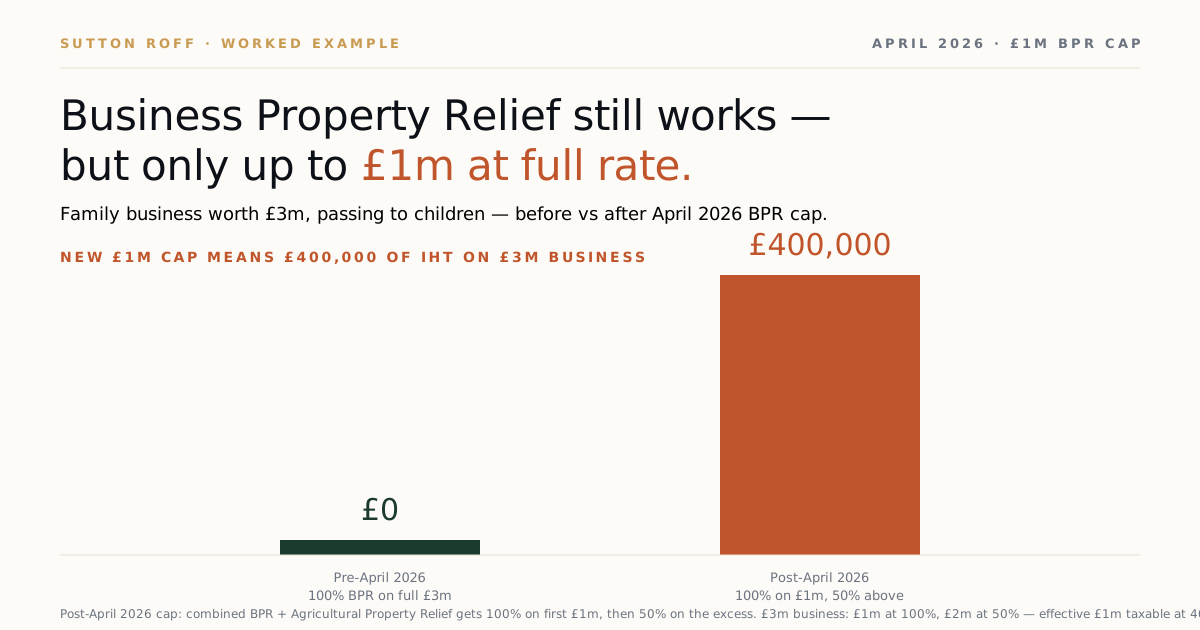
From 6 April 2026, Business Property Relief (and Agricultural Property Relief) gets a £1 million combined cap — above which only 50% relief applies. A £3 million family business that paid £0 IHT under current rules pays £400,000 from April 2026. We see business owners assume “BPR will sort it” and miss the 18-month window before the cap takes effect.
How BPR works (current rules until April 2026)
Business Property Relief reduces the value of qualifying business assets in your estate for IHT purposes:
| Asset type | Relief rate (current) | Relief rate (from 6 April 2026) |
|---|---|---|
| Unquoted trading company shares | 100% | 100% on first £1m, then 50% |
| Sole-trader business / partnership interest | 100% | 100% on first £1m, then 50% |
| Quoted shares (with control) | 50% | 50% |
| Business land/buildings | 50% | 50% |
| AIM-listed shares (qualifying) | 100% | 100% on first £1m, then 50% |
| Investment property (residential rentals) | No relief | No relief |
You must have owned the asset for at least 2 years before death. The business must be “wholly or mainly trading” — investment businesses (e.g. pure rental property businesses) don’t qualify.
What changes from 6 April 2026
The 2024 Autumn Budget capped BPR (and APR — Agricultural Property Relief) at £1 million combined per individual. The mechanics:
- First £1m of qualifying business + agricultural assets: 100% relief (no IHT)
- Above £1m: only 50% relief on the excess
- The £1m cap is per individual, not per business
- Married couples each have their own £1m cap (£2m combined where assets are split)
The Whitfield family business — £3m, £400k of new IHT from April 2026
Mr Whitfield, the family business owner, dies leaving £3m of qualifying trading-company shares to his children.
Pre-April 2026:
- £3m × 100% BPR = £0 taxable
- IHT: £0
Post-April 2026:
- First £1m: 100% relief = £0 taxable
- Remaining £2m: 50% relief = £1m taxable
- £1m × 40% IHT = £400,000
Same business, same family, £400,000 of new IHT just from the rule change. Larger family businesses (£10m, £20m, £50m+) face proportionally bigger gaps.
The structure of the £1m cap
Some specifics that matter:
- Single £1m allowance per person. No transferable nil-rate band for unused BPR portions between spouses.
- 50% relief above cap means 60% IHT effectively — i.e. 40% applied to half the value above £1m = effective 20% IHT rate on excess.
- Combined with NRB and RNRB — those still apply on top of BPR.
- Lifetime gifts of BPR-qualifying assets — also subject to the new cap when computed at death (if death within 7 years).
Who’s most affected
Family business owners with £2m+ businesses. Anyone passing meaningful business value to children faces the new effective 20% rate on the excess.
Farmers. APR works the same way as BPR. A £3m farm passing to children pays £400k IHT under the new rules — versus £0 under the old. Particularly painful for cash-poor, asset-rich farming families.
AIM-share holders. AIM shares with full BPR (held 2+ years in qualifying companies) lose their BPR-led IHT shelter for portfolios above £1m. Many investors used AIM ISAs as IHT-shelter wrappers; the strategy now caps at £1m.
What still works as an IHT planning tool
Lifetime gifts more than 7 years before death. Outright gifts of BPR-qualifying business assets fall out of the estate after 7 years — irrelevant to the £1m cap because the asset isn’t in the estate at death. Gifts within 7 years use the £1m cap when computed.
Spouse-to-spouse transfers. Each spouse has their own £1m cap. So splitting business ownership 50:50 between spouses gives £2m of headroom.
Family Investment Companies. Transferring share ownership of a FIC to children over time, with parent retaining voting control, sits outside the estate over time. Same logic as before, just more important now that BPR is capped.
Trusts. Specific trust structures can hold qualifying business assets for the family’s benefit while sitting outside the deceased’s estate. Significantly more complex than outright gifts.
Insurance. Life insurance written in trust to pay the IHT bill — doesn’t reduce the bill but ensures the family doesn’t have to fire-sale business assets to fund it.
The 2-year ownership requirement
BPR requires 2 years of ownership before death (or before gifting, if PET). New owners of family businesses (e.g. inherited from a parent) need to hold for 2 years before BPR applies on their own death.
Replacement-asset rule: if you sell a BPR-qualifying business and reinvest within 3 years in another qualifying business, the 2-year clock can be aggregated across the two — preventing a planning trap on business transitions.
What the rule doesn’t change
BPR conditions otherwise unchanged:
- Wholly or mainly trading test (50%+ trading activity)
- Excepted assets exclusion (excess cash, investment portfolios held inside the company that aren’t business-needed)
- Quoted vs unquoted distinction (50% vs 100% rate, both subject to new cap)
- Replacement-asset rule for ownership-period aggregation
So owners shouldn’t just plan for the cap — also confirm the underlying business genuinely qualifies. Excess cash sitting on a balance sheet from sale proceeds, or investment property held inside an operating company, can compromise BPR availability entirely.
Pre-April 2026 acceleration
Some business owners are accelerating ownership transitions before April 2026 to lock in the unlimited BPR. Mechanics:
- Lifetime gift of business shares to children — uses pre-April 2026 BPR
- Survives 7 years from gift = no IHT regardless of post-April 2026 rules
- Dies within 7 years of gift but pre-April 2026 = full BPR still applies
- Dies post-April 2026 within 7 years of pre-2026 gift = post-2026 cap applies
So gifting now, surviving 7 years, locks in the unlimited BPR forever. Death in years 1-7 partially undoes the planning, with pro-rated treatment. Imperfect but materially better than waiting until 2026 to start.
When this is a bad idea
Don’t gift business shares to children if you depend on the business for income. Once gifted, you’ve transferred control and economic benefit. Shareholder-employer arrangements can preserve some control but not without trade-offs.
Don’t assume “my business qualifies for BPR” without checking the wholly-or-mainly trading test. Excess cash, investment property, dormant subsidiaries can compromise the relief.
Don’t act on rumours of further changes. Plan based on what’s been legislated.
Key takeaways
- Until 5 April 2026: 100% BPR on qualifying unquoted business shares (no cap).
- From 6 April 2026: combined £1m BPR + APR cap; 50% relief on excess.
- £3m business passed at death post-2026: £400,000 of new IHT.
- Each spouse has their own £1m cap — splitting ownership maximises headroom.
- Lifetime gifts surviving 7 years escape the cap.
- Underlying BPR qualifying conditions otherwise unchanged.
FAQ
What counts as a “trading” company?
HMRC’s “wholly or mainly trading” test — substantially more than 50% of the company’s activities by various measures (turnover, profits, employees, assets). Substantial investment activity (typically >20%) breaks the test.
How does the £1m cap interact between BPR and APR?
From April 2026 the £1m is a combined BPR + APR allowance per individual. So a farmer with £600k of business assets and £600k of agricultural assets only shelters £1m at 100%, not £1.2m.
Can I gift business assets gradually?
Yes — lifetime gifts of qualifying business assets surviving 7 years escape the cap entirely (PETs). Gifts within 7 years of death are caught by the new cap. Gradual gifting starting now maximises the chance of all of it sitting outside the new cap.
Family business worth more than £1m and considering succession? Book a free 20-min review — we’ll model pre- and post-2026 IHT exposure, plan lifetime gifting against the 7-year clock, and structure a Family Investment Company if it works for your situation. Specialist UK estate and succession planning accountants.