
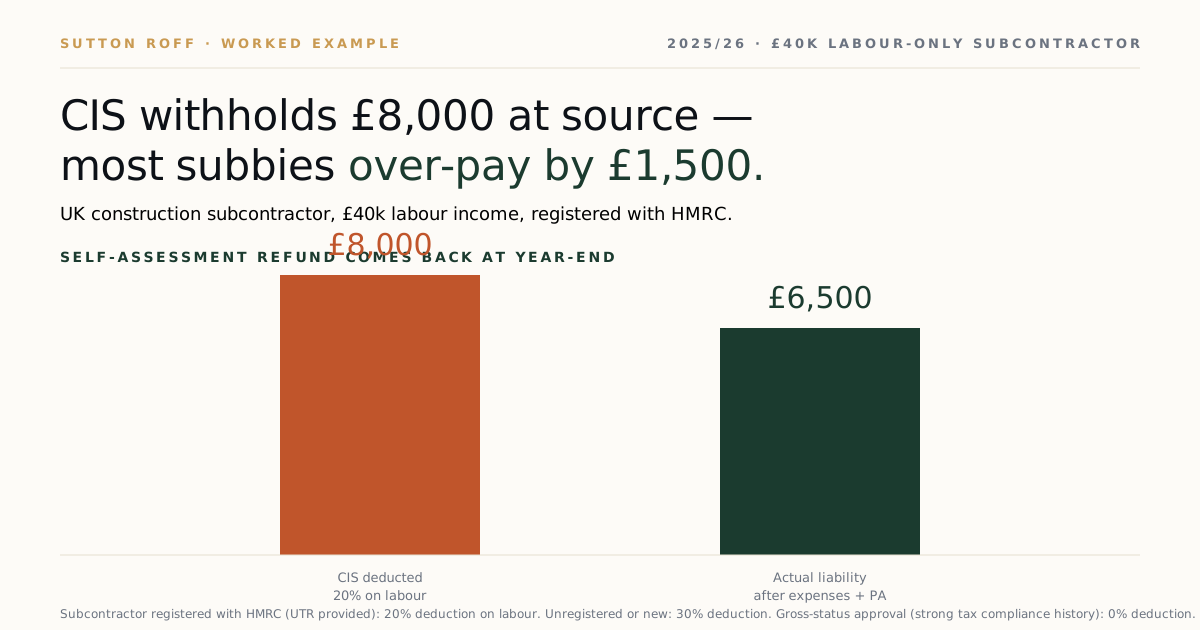
CIS deducts 20% from subcontractor labour invoices at source — a system designed in 1999 and largely unchanged. Most subbies overpay through CIS by £1,000-£2,500/year because their actual tax bill (after expenses and Personal Allowance) is below the deducted amount. We see first-year subbies wait until the next January to claim the refund — a full 18 months after the cash was withheld and could have been working for them.
How the Construction Industry Scheme works
If you’re a subcontractor providing labour to a UK construction main contractor, the contractor must:
- Verify your CIS status via HMRC online
- Deduct CIS tax at 20% (registered) or 30% (unregistered) from your labour invoice
- Pay HMRC the deducted amount
- Issue you a CIS payment statement monthly showing gross/net/deduction
- Pay you the net (after deduction)
The deduction applies only to the labour element of your invoice. Materials and equipment hire are paid gross. So an invoice with £4,000 labour + £1,000 materials gets £800 deducted (20% of labour), leaving you £4,200 paid net.
Three CIS statuses you can have
1. Unregistered: 30% deduction on labour. Penalty rate — register immediately to drop to 20%.
2. Registered (standard): 20% deduction on labour. The default for new subbies.
3. Gross status: 0% deduction. Available to subbies with strong tax history (3+ years of compliance, turnover thresholds met). The Holy Grail of CIS — paid full gross, no upfront tax bite, full cash flow.
Liam, plumber, £40,000 of labour — overpaid through CIS
Liam runs a solo plumbing subcontracting business, all labour-only invoices, registered for CIS at standard 20%. Annual labour income £40,000. £5,000 of allowable expenses (van running costs, tools, insurance, work clothes).
What gets deducted at source:
- £40,000 × 20% = £8,000 CIS deducted by main contractors
- Subbie receives £32,000 net of CIS
Annual self-assessment reconciliation:
- Profit: £40,000 − £5,000 expenses = £35,000
- Less Personal Allowance: £35,000 − £12,570 = £22,430 taxable
- Income tax at 20%: £4,486
- Class 4 NIC at 6%: £1,346
- Total liability: £5,832
- Less CIS already deducted: -£8,000
- Tax refund due: £2,168
This subbie has overpaid by £2,168 through the year — refunded after filing. Some over-pay much more if expenses are higher than typical.
The “Gross Status” route
Subbies can apply to HMRC for gross-status payment, where the contractor pays full gross with no deduction. Conditions:
- Compliance test: filed all returns and paid all tax on time for the past 12 months
- Business test: running a genuine construction business in the UK
- Turnover test: for individuals £30,000+ of labour income; partnerships £30,000 per partner; companies £30,000 per director
For subbies with strong cash flow and good tax compliance, gross status is worth the application. Effects:
- You receive full payment immediately rather than 80%
- Your tax liability is unchanged — same self-assessment reconciliation at year-end
- You get the cash flow advantage of holding the £8,000 CIS amount across the year (rather than HMRC holding it for you)
You apply via gov.uk; review takes 4-8 weeks. Ongoing compliance is monitored — fall behind on a return or payment and gross status can be withdrawn.
What expenses CIS subbies commonly under-claim
- Van running costs (45p/mile or actual)
- Tools and small equipment (AIA on items above £100)
- Power tools and consumables
- Public liability insurance and trade insurance
- Mobile phone (business proportion)
- Protective clothing, boots, hard hats
- Trade memberships (CITB levy, FMB membership, etc.)
- Training (CSCS card, asbestos awareness, etc.)
- Home office for admin (£6/wk simplified or apportioned)
- Accountancy fees
What’s not deductible: ordinary clothing (suits, jeans for non-PPE work), commute from home to a single regular site, personal-use vehicle running costs.
The Domestic Reverse Charge for VAT
From 1 March 2021, VAT-registered subbies in construction must use the Domestic Reverse Charge — the main contractor accounts for VAT on the service rather than the subbie charging it. Subbie’s invoice notes “Reverse charge applies — customer to account for VAT” and shows the rate applicable but no VAT amount.
For VAT-registered CIS subbies this means:
- Don’t charge output VAT on construction invoices
- Continue reclaiming input VAT on costs
- Submit quarterly VAT returns claiming refunds (input exceeds output for most subbies)
The reverse charge is a major cash-flow help — saves the cycle of charging, collecting, paying VAT only to reclaim it later.
Sole trader vs Ltd for CIS subbies
For sub-£40k earners, sole trader is simpler. Above £50k profit, Ltd structure starts to pay back — same pattern as other self-employed trades (covered in our sole trader vs Ltd piece).
For Ltd-company subbies, CIS deductions apply to the company invoices. The 20% gets deducted from labour-element invoices, deposited with HMRC, and offsets against the company’s corporation tax bill at year-end (rather than the director’s personal tax). Ltd subbies often build up CIS receivables that become a meaningful working-capital asset on the balance sheet.
When this is a bad idea
Don’t operate as a CIS subbie unregistered. The 30% deduction wipes out cash flow, and you can register in 24 hours via gov.uk.
Don’t ignore the CIS payment statements your contractors give you. They’re your evidence for the SA reconciliation — without them you can’t claim the deduction back.
Don’t apply for gross status without the compliance track record. A failed application doesn’t disqualify you forever, but it’s a wasted month and contractors may be cautious afterwards.
Key takeaways
- CIS deducts 20% (registered) or 30% (unregistered) on labour-element invoices.
- Materials, equipment hire paid gross — not subject to deduction.
- Self-assessment reconciles annually; refunds typical for first-year subbies.
- Gross status (0% deduction) available for compliant subbies with £30k+ turnover.
- Domestic Reverse Charge applies for VAT-registered subbies from March 2021.
- Sole trader fine sub-£50k profit; Ltd structure starts paying back above.
FAQ
How long does Gross Status take to apply for?
HMRC review: typically 4-8 weeks. Conditions check past 12 months of compliance. Approved status applies from the next month after letter date. Reviewable annually.
Does CIS apply to materials I supply?
Generally no — CIS deduction only applies to the labour element of invoices. Materials, equipment hire, subcontracted-out costs paid through gross. Get the invoice split right at the contractor’s end.
What’s the Domestic Reverse Charge?
From March 2021, VAT-registered subcontractors don’t charge VAT on most B2B construction services. The main contractor accounts for VAT under the reverse-charge mechanism. Subbies invoice with “reverse charge applies” note — helps cash flow.
Self-employed in construction and either new to CIS or chasing a refund? Book a free 20-min review — we’ll reconcile your CIS deductions against actual liability, claim the refund, and apply for gross status if your turnover and compliance history qualifies. Specialist UK CIS subcontractor accountants.