
HMRC counts every Uber, Deliveroo and Amazon Flex driver as self-employed — regardless of how the platform contracts label them. We see drivers default to the 45p-per-mile simplified rate and miss £500-£1,000/year of legitimate deductions because actual costs (commercial insurance, depreciation, finance interest) exceed the flat rate at high mileage. Picking the wrong method for your driving pattern is one of the easier savings in self-employment.
Yes — gig drivers are self-employed for tax
UK platforms (Uber, Deliveroo, Just Eat, Amazon Flex, Bolt) classify drivers as self-employed contractors. The platform takes a commission cut and pays the rest to your account. From HMRC’s perspective:
- You’re trading on your own account
- You declare gross earnings minus expenses on a self-assessment return
- You pay income tax + Class 4 NIC on net profits
- You handle your own insurance, MOT, fuel, vehicle maintenance
The Supreme Court Uber ruling (2021) found Uber drivers are “workers” for employment-rights purposes (entitled to minimum wage and holiday pay during driving time). That’s a labour-law classification — it doesn’t change the tax treatment, which remains self-employed.
The £1,000 trading allowance
If your gross gig earnings across all platforms total under £1,000 in the tax year, you don’t need to register or file. Above £1,000 you can either:
- Use the £1,000 allowance against gross earnings (no expense tracking)
- Deduct actual expenses
For most active gig drivers earning £15-£40k, actual expenses dwarf £1,000 — so deducting actual expenses wins materially.
The 45p/mile mileage rate vs actual costs
Gig drivers can choose between two methods for vehicle costs:
1. HMRC simplified mileage rate — 45p/mile for the first 10,000 business miles, 25p/mile thereafter. This covers fuel, insurance, depreciation, MOT, repairs — a single rate for everything.
2. Actual costs — claim a business proportion of fuel, insurance, repairs, depreciation, finance interest. Requires keeping receipts and a mileage log to apportion costs.
Most gig drivers find the 45p/mile method simpler and roughly equivalent in cash terms. For high-mileage drivers (over 10,000 business miles per year), the rate drops to 25p/mile — at which point actual costs often beat the simplified rate.
What gig drivers can deduct
If using the 45p/mile mileage method, vehicle running costs are inside that rate — don’t claim them separately. But you can still deduct:
- Phone (business proportion of contract)
- Mobile data top-ups
- Cleaning supplies for the vehicle
- Hot bag or insulated container for delivery
- Branded clothing (Deliveroo jacket etc., if you bought it)
- Bike maintenance (for delivery cyclists)
- Accountancy fees for SA
- Bank charges on a dedicated business account
- License and badge renewal fees (PHV, taxi licensing)
If using actual-cost method instead of mileage:
- Business proportion of fuel
- Business proportion of insurance (private hire/courier policy needed for gig work — your standard insurance won’t cover commercial use)
- Business proportion of MOT, repairs, services, tyres
- Capital allowances on the vehicle (generally 18% writing-down allowance per year, or 100% AIA for commercial vehicles like vans)
Karim’s Uber year — 30,000 business miles, two methods modelled
Karim clears £35,000 gross via Uber after their commission. Drives ~30,000 business miles/year.
Mileage method:
- 10,000 miles at 45p = £4,500
- 20,000 miles at 25p = £5,000
- Vehicle costs deduction: £9,500
- Plus phone, cleaning, accountancy, etc.: ~£600
- Total deductions: £10,100
- Net profit: £35,000 − £10,100 = £24,900
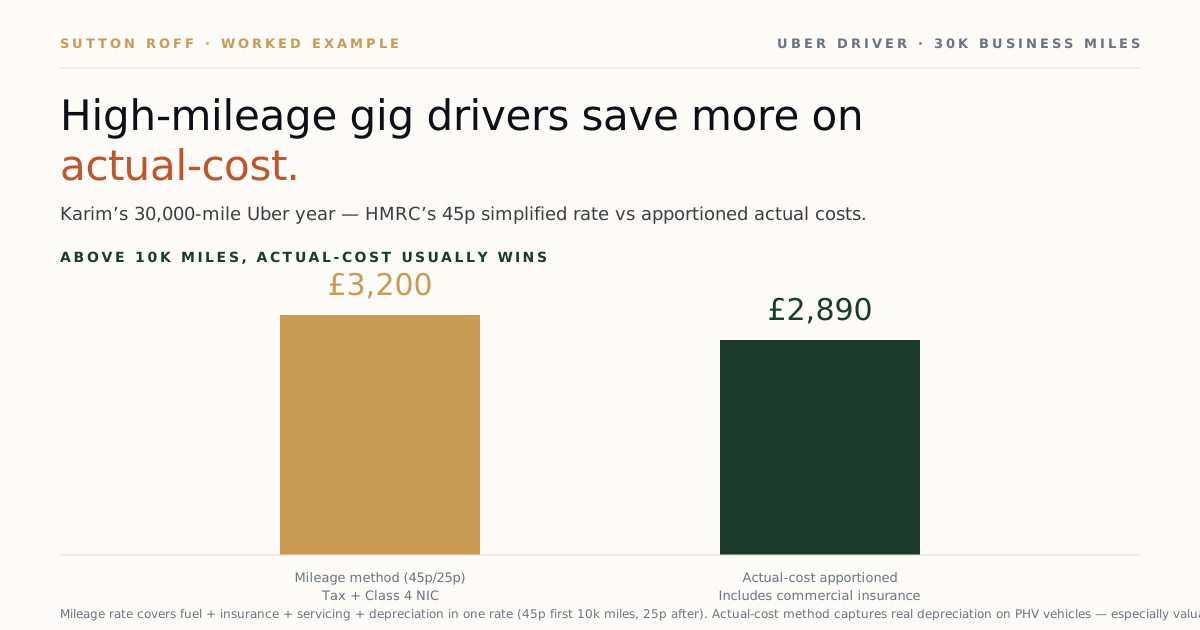
- Tax + Class 4 NIC: roughly £3,200
Actual-cost method:
- Fuel: £6,000 × 90% business = £5,400
- Insurance (commercial): £1,800 × 90% = £1,620
- Servicing/repairs: £900 × 90% = £810
- Depreciation/lease: £3,500 × 90% = £3,150
- Total vehicle costs: £10,980
- Plus phone, etc: £600
- Total deductions: £11,580
- Net profit: £35,000 − £11,580 = £23,420
- Tax + Class 4 NIC: roughly £2,890
For this driver, actual-cost method saves ~£310/year. Slim margin, but worth getting right — and the actual-cost method captures the value of vehicle depreciation more accurately.
Insurance — the legality and tax trap most new drivers miss
Standard car insurance does not cover commercial use. If you’re delivering for Deliveroo on your private-use insurance and have an accident, the insurer will refuse the claim. You need:
- Private Hire Vehicle (PHV) insurance for Uber/Bolt — typically £2,500-£4,000/year, includes commercial use
- Hire and Reward insurance for Deliveroo/Just Eat car deliveries — typically £1,500-£3,000/year
- Courier insurance for cyclists doing food delivery — modest annual cost
The premium is fully deductible. Operating without proper insurance is illegal and removes your tax expense entirely (you can’t claim non-compliant costs).
VAT for gig drivers
If your gross gig earnings exceed £90,000 in any rolling 12 months, you need to register for VAT. This catches some full-time multi-platform drivers and most full-time PHV operators with multiple vehicles.
Once registered, you charge VAT on your supplies (which platforms typically handle for you for ride-share) and reclaim VAT on costs. The mechanics get complex with platform-mediated transactions — proper accounting support matters.
Sole trader vs Ltd for gig drivers
For most gig drivers, sole trader is the right structure — simpler, lower compliance cost, and the tax difference is minimal at typical gig earnings (£15-£40k).
Ltd structure starts to pay for full-time PHV operators or multi-vehicle fleet drivers earning £60k+, where retaining profits in the company at 19% CT vs 40% personal income tax becomes meaningful.
When this is a bad idea
Don’t try to claim “the platform handles my tax”. They don’t — they pay you gross of tax, and HMRC expects you to register and file.
Don’t operate gig work on standard private-use car insurance. Apart from being illegal, it removes a major deductible expense category.
Don’t ignore platform-reporting from 2024. Uber, Deliveroo, Bolt all now report driver earnings directly to HMRC for those crossing reporting thresholds.
Key takeaways
- Gig drivers are self-employed for tax — register for SA above £1,000 trading allowance.
- Two vehicle-cost methods: 45p/mile simplified or actual-cost apportioned.
- High-mileage drivers (10,000+ business miles) often save more on actual-cost method.
- Commercial insurance (PHV / hire-and-reward) required and fully deductible.
- VAT registration mandatory above £90k gross gig earnings.
- Platform reporting active from 2024 — under-declaration is increasingly visible.
FAQ
Can I claim a vehicle bought before I started gig work?
Yes — from the date you started using it for business, you can claim the business proportion of running costs (or 45p/mile). The car’s capital cost can be claimed as Writing Down Allowance from the date business use started.
Do I need to register for VAT?
Only if your gross gig earnings exceed £90,000 in any rolling 12-month period. Most single-platform drivers don’t cross this. Multi-vehicle PHV operators or full-time drivers covering long hours can hit it.
What’s the tax position on bonuses (e.g. peak-time multipliers)?
All gross earnings — base fares, surge multipliers, weekly bonuses, referral bonuses — count as income. The platform reports the full amount; HMRC sees the total. Track separately for accurate SA reporting.
Driving for a platform and never filed self-assessment, or want to confirm the right vehicle-cost method? Book a free 20-min review — we’ll register you for SA, pick the optimal mileage-versus-actual-cost method, and confirm your insurance is properly classified for commercial use. Specialist UK self-employed accountants.