
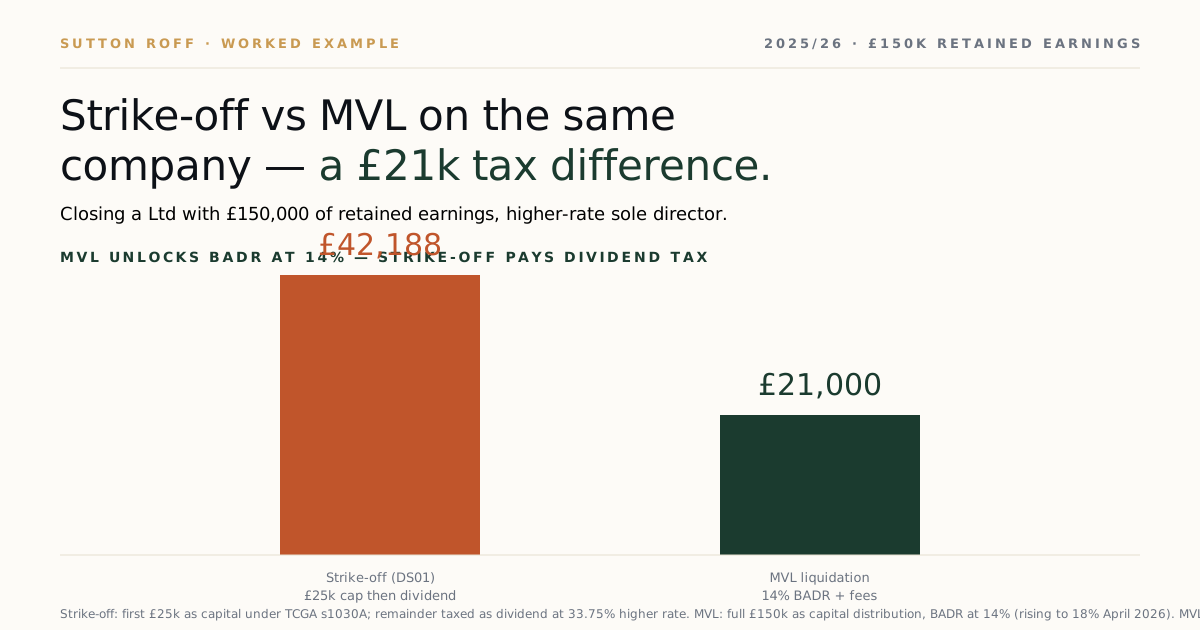
On £150,000 of retained earnings, MVL liquidation costs £21,000 in tax versus £42,188 via strike-off — a £21,188 saving unlocked by BADR at 14%. The Targeted Anti-Avoidance Rule wipes that saving out if you start the same trade again within 2 years. We’ve seen directors take BADR via MVL, then incorporate a “new” Ltd doing identical contracting work — and have HMRC re-categorise the entire distribution as dividend income two years later.
The two routes — strike off vs MVL
Strike off (DS01): File a one-page form at Companies House, wait 2 months for objections, the company is dissolved. Cost: ~£10. The company’s assets at the point of strike-off pass to the Crown unless distributed first.
Members Voluntary Liquidation (MVL): A formal liquidation process led by a licensed insolvency practitioner. Takes 3-12 months. Cost: typically £2,000-£5,000 in liquidator fees. Designed for solvent companies with substantial retained earnings to distribute as capital rather than income.
The £25,000 threshold that decides which
For strike off: HMRC’s “concessional treatment” under TCGA 1992 s1030A allows the first £25,000 of distributions to be treated as capital (taxed at CGT rates with annual exemption and BADR). Anything above £25,000 is treated as income — taxed at dividend rates of 8.75/33.75/39.35%.
For MVL: the entire distribution is capital. Taxed at CGT rates throughout, with BADR available if conditions are met.
So for distributions up to £25,000, strike off is the clear winner — same tax treatment, much lower cost. Above £25,000, MVL starts to pay back.
BADR at 14% (rising to 18%)
Business Asset Disposal Relief (BADR) reduces CGT on qualifying disposals of business assets. For 2025/26 it sits at 14%, up from 10% in October 2024 and rising to 18% from 6 April 2026.
Conditions:
- You owned 5%+ of the company shares throughout the 24 months before disposal
- You were a director or employee throughout the 24 months
- The company was a trading company throughout the period
- Lifetime limit: £1m of qualifying gain
For most owner-managed Ltd directors closing their company, all conditions are met. BADR applies on the gain element of the capital distribution.
Ben’s £150,000 retained earnings — strike-off versus MVL
Ben is a higher-rate director winding down his Ltd with £150,000 of retained earnings. Owned 100% throughout the past 24 months. Trading company.
| Step | Strike-off (DS01) | MVL liquidation |
|---|---|---|
| Treatment of distribution | First £25k as capital, balance as dividend | Full £150k as capital |
| £25k capital portion @ 14% BADR | £3,080 (after £3k allowance) | — |
| £125k dividend portion @ 33.75% | £42,188 | — |
| Full £147k capital @ 14% BADR | — | £20,580 |
| Liquidator fees | ~£10 (Companies House) | ~£3,000 |
| Total cost | £45,268 | £23,580 |
| MVL saves | £21,688 on this closure | |
MVL saves £21,688 on this closure. Stack a few years of contributions into the right year, time the closure correctly, and the saving is huge.
The Targeted Anti-Avoidance Rule (TAAR)
HMRC’s TAAR specifically targets directors who close their Ltd via MVL, take BADR-favoured capital, then start a similar trading activity within 2 years (often via a new Ltd). HMRC re-categorises the original distribution as income, charging dividend tax instead of capital — wiping out the BADR benefit.
Conditions for TAAR to bite:
- The capital distribution is made in connection with winding up the company
- Within 2 years, the director (or anyone connected) is involved in the same or similar trade
- One of the main purposes was a tax advantage
The third condition gives some defence. Genuine retirement, change of career, or distinctly different new trade can survive TAAR. “Same trade in a new Ltd to refresh BADR” doesn’t.
How TAAR caught Riya — and cost her £40,000
Riya, an IT consultant, runs a Ltd company for 6 years. Decides to close it via MVL. £200,000 distributed at 14% BADR = £28,000 tax. Saves £40,000+ versus dividend route.
18 months later, takes a new contracting role and incorporates a new IT consultancy Ltd. TAAR applies. HMRC re-categorises the £200,000 as dividend income. Tax bill jumps to £67,500. The £40,000 saving is lost, plus a back-tax interest bill on top.
The legitimate path: take a 2+ year break from the trade, change to a genuinely different activity, or accept the dividend treatment if the closure is just for refresh.
What needs to be done before MVL
Pre-MVL housekeeping (3-6 months out):
- Settle all debts, including final corporation tax
- Pay all final salaries, dividends and director loans
- Close VAT registration
- Complete final P11D, P60s, P35
- Cancel direct debits, business insurance, professional memberships
- Liquidate any non-cash assets to cash
The MVL itself:
- Director makes statutory declaration of solvency
- Liquidator appointed at general meeting
- Liquidator settles any final liabilities, distributes remaining cash to shareholders
- Final account filed; company struck off Companies House register
The April 2026 BADR rate increase
BADR rate is 14% in 2025/26 and rises to 18% from 6 April 2026. So a £150,000 distribution that pays £20,580 today will pay £26,460 from April 2026 — about £5,880 more.
For directors planning closure, doing it in 2025/26 saves the rate hike. The economic incentive to close in this tax year is real but the closure must be substantive — TAAR still applies regardless of timing.
What if the distribution exceeds £1m?
BADR is capped at a lifetime £1m of qualifying gain. Above £1m, the gain is taxed at the standard CGT rates (24% higher rate). The £1m is per individual, so two-shareholder couples have £2m of headroom between them.
For very large company closures (£1m+ to a single shareholder), part of the distribution falls back to standard CGT — still better than dividend rates, but worth modelling carefully.
When this is a bad idea
Don’t MVL if you’re planning to start the same trade again within 2 years. TAAR will catch you.
Don’t strike-off above £25,000 if you’d qualify for BADR — you’re paying dividend tax on income you could have taken at 14% capital.
Don’t ignore the April 2026 rate change. If you’re already planning closure in 2026, accelerating to before 5 April locks in 14% over 18%.
Key takeaways
- Strike off (DS01): free, fast, £25k capital cap, balance treated as dividend income.
- MVL: liquidator-led, £2-5k cost, full distribution as capital with BADR available.
- BADR rate 14% in 2025/26, rising to 18% from April 2026.
- BADR conditions: 5%+ holding, director/employee, trading company, 24-month qualification.
- TAAR catches re-trading within 2 years — re-categorises capital as dividend income.
- £1m lifetime BADR cap per shareholder.
FAQ
Can I MVL a company with debts?
No — MVL requires a Declaration of Solvency stating all debts can be paid within 12 months. If you can’t make that declaration, you need a different insolvency procedure (CVL — creditors’ voluntary liquidation).
How long does MVL take?
Typically 3-9 months from director declaration to final distribution. Depends on speed of asset realisation and HMRC clearances. Plan accordingly — don’t expect cash distributions on day one.
What’s the cost difference between MVL providers?
Liquidator fees range £2,000-£8,000+ depending on complexity. Online “cheap MVL” providers can be £1,500. Mid-tier traditional firms £3,500-£5,000. Get 2-3 quotes; the saving doesn’t affect tax position, only fees.
Winding down a Ltd with retained earnings? Book a free 20-min review — we’ll compare strike-off and MVL on your specific numbers, assess TAAR exposure if you might trade again, and time the closure for the BADR rate (14% now, 18% from April 2026). Specialist UK Ltd company closure accountants.