
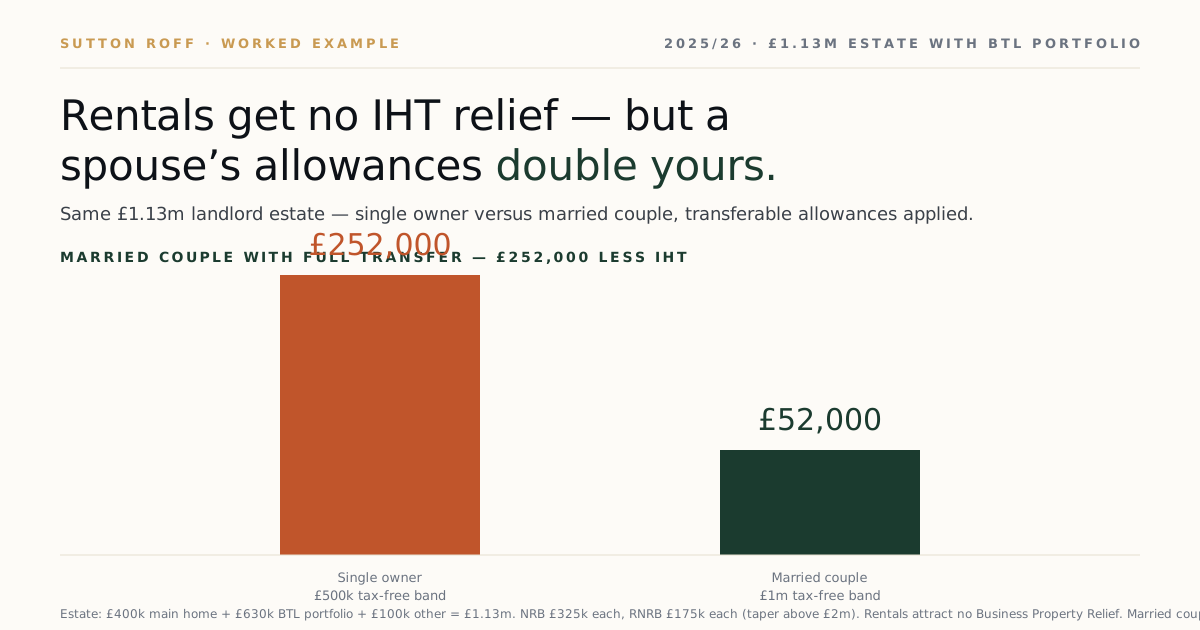
BTLs sit in your estate at probate value and attract no Business Property Relief, no matter how active you’ve been as landlord. We see landlords assume the portfolio “is the business” and discover too late that HMRC treats residential lettings as investment activity, not trade. Combined with the April 2027 pension-IHT change, a typical £1.13m landlord estate pays £252,000 of IHT versus £52,000 if married-couple allowances are used properly.
The default IHT position for landlords
Inheritance tax is charged at 40% on the value of your estate above your nil-rate band. Rental properties form part of the estate at probate value (typically open-market value at date of death), with no relief for the fact they’re income-generating assets.
The two nil-rate bands you have:
- Standard nil-rate band: £325,000 per person — frozen until April 2030.
- Residence nil-rate band: £175,000 per person — applies only to your main home, passed to direct descendants. Tapers to zero on estates above £2m.
So a single landlord can shelter £500,000 (£325k + £175k); a married couple £1,000,000 if both allowances pass to the survivor and then to direct descendants.
Why BTLs get no relief
Business Property Relief (BPR) at 100% wipes out IHT on qualifying business assets — trading companies, AIM-listed shares held 2+ years, partnership interests in trading partnerships. It does not apply to property investment businesses. HMRC’s view since the early 2000s is that holding rental property is “wholly or mainly” investment activity, not a trade.
This is the key difference between, say, a working farm passed to children (BPR-protected) and a 5-flat BTL portfolio passed to children (full IHT). The court tests look at how active the business is — but for almost every standard residential BTL operation, including HMOs, the answer is “investment”, not “trade”. Even Airbnb-style operations rarely meet the trading bar.
Robert’s £1.13m estate — single owner
Robert, a single landlord with no children, dies with:
- Main home: £400,000
- 2 BTL flats: £350,000 + £280,000 = £630,000
- Other assets (savings, ISA, pension on death): £100,000
- Total estate: £1,130,000
Tax-free band: £325,000 NRB + £175,000 RNRB = £500,000.
Taxable estate: £1,130,000 − £500,000 = £630,000.
IHT at 40%: £252,000.
Three-quarters of that bill is driven by the BTL portfolio — and there’s no relief mechanism that applies as-of-right.
The same estate married — £200,000 less IHT
Robert and his wife Margaret, joint estate of £1.13m. First spouse dies and leaves everything to the survivor (spouse exemption — no IHT on death-1). Their unused NRB and RNRB transfer to the survivor.
On second death:
- Survivor’s own NRB: £325,000
- Transferred NRB: £325,000
- Survivor’s RNRB: £175,000 (main home passes to children)
- Transferred RNRB: £175,000
- Total tax-free: £1,000,000
Taxable estate: £1,130,000 − £1,000,000 = £130,000. IHT at 40%: £52,000.
The married-couple structure saves £200,000 versus the same estate held singly — purely from doubling the allowances. This is why getting the will and ownership structure right before death matters more than most landlords appreciate.
The seven-year gift rule
Lifetime gifts of property fall outside your estate completely if you survive 7 years from the gift date. Between 3 and 7 years, taper relief reduces the IHT on a partial scale (20% at 3 years, escalating to 80% at 6+ years).
Critical caveat: gifts must be genuine and outright. A “gift” where you continue to receive the rental income is a “gift with reservation of benefit” — treated for IHT as if you still own the property, regardless of legal title. This catches landlords who try to give the property to children but keep the rent.
Pure outright gifting works. Gifting into a trust (with the right structure) can give the right tax outcome while keeping family-control levers. Gift-and-leaseback arrangements need careful structuring to avoid the GROB rules.
Strategies that actually reduce landlord IHT
1. Use both spouse allowances. First step for any married couple — make sure NRB and RNRB transfer correctly.
2. Lifetime gifts to children — outright, with no reservation, more than 7 years before death.
3. Mortgage the portfolio — debt reduces the taxable estate. Borrowing to invest elsewhere (e.g. pension or BPR-qualifying assets) can create a structural reduction.
4. Move portfolio into a Family Investment Company (FIC). FICs sit outside the estate over time as gifts of share value pass to children, with parent retaining voting control. Modern alternative to discretionary trusts since the 2006 trust changes.
5. Life insurance written in trust to pay the IHT bill — doesn’t reduce the bill but ensures the family doesn’t have to fire-sale property to fund it.
6. Convert to actually-trading activity — if you genuinely run a serviced-accommodation business at scale (multiple properties, employed staff, hotel-like services), BPR may apply. Bar is high but not impossible for the right operators.
Pension-on-death: about to change
Until April 2027, pensions pass outside the estate for IHT — making them the most efficient asset to leave to heirs. From 6 April 2027, most pension funds become part of the estate for IHT.
This is a major shift for landlord-with-pension-and-BTL estates. The gap between “pension cheaper than BTL for IHT” closes, and the planning balance changes. We’ll cover the pension-IHT change in detail in a separate post — for now, factor in that pensions stop being an automatic IHT shelter from April 2027.
When this is a bad idea
Don’t gift property to children while continuing to receive the rent — gift-with-reservation rules undo the IHT effect entirely.
Don’t expect BPR to magically kick in on rental property — it doesn’t, regardless of how active you’ve been as landlord. Investment activity remains investment activity.
Don’t postpone planning until “later” — the 7-year gift clock can’t be backdated. A 60-year-old landlord who plans now has time; an 80-year-old who delays has lost most of the levers.
Key takeaways
- BTLs sit in the estate at probate value with no Business Property Relief.
- NRB £325k + RNRB £175k per person — single owner shelters £500k, married couple £1m.
- Lifetime gifts fall out of the estate after 7 years (taper relief between 3-7 years).
- Gifts with reservation of benefit (keeping the rent) are caught and disallowed.
- Family Investment Companies are the modern lifetime-transfer structure.
- Pensions stop being IHT-free from 6 April 2027 — major rebalance ahead.
FAQ
Can I gift my BTL to my children now?
Yes — outright gift triggers CGT on the implicit gain (24% higher rate on residential), and starts the 7-year clock to fall outside your estate. Deeds of gift, Land Registry update, no SDLT for inter-family gifts without consideration.
How does the 7-year rule work?
Gifts surviving 7 years are completely outside the estate. Between 3 and 7 years, taper relief reduces the IHT proportionally (20% at 3 years, escalating to 80% at 6+ years). Death within 3 years: full IHT on the gift.
What if my BTL has a mortgage at death?
The mortgage debt reduces the taxable estate value (you’re passing the property minus the debt). So a £400k BTL with £200k mortgage is £200k in the estate, not £400k. Document the mortgage at probate value.
Portfolio crossed £750k and never had IHT exposure modelled? Book a free 20-min review — we’ll size the bill, identify gifting capacity, and assess whether a Family Investment Company or lifetime transfers materially help. Specialist UK landlord and estate planning accountants.