
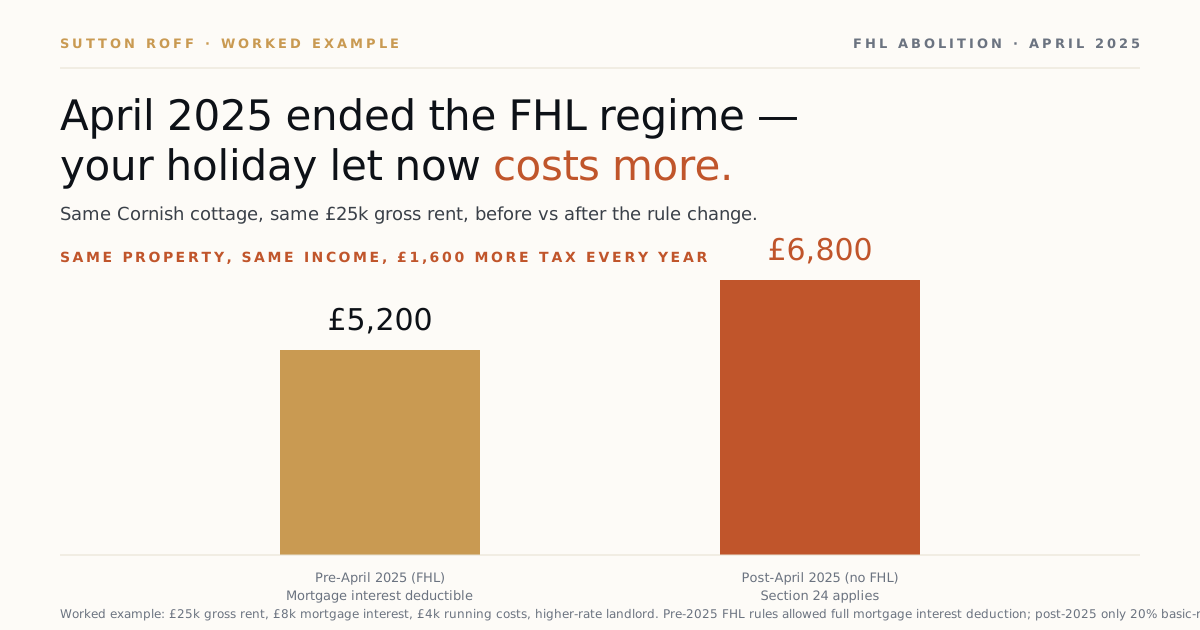
April 2025 ended the Furnished Holiday Let regime — and the same Cornish cottage now costs roughly £1,600/year more in tax for a higher-rate owner, plus a £20,000 BADR loss on eventual sale. We’ve helped a dozen FHL owners model the post-2025 position; about half held, a third sold, and the rest incorporated. The right answer turns on hold horizon and leverage, not headline reaction.
What changed on 6 April 2025
For decades, FHLs occupied a middle ground between rental income and trading income. Properties that met the FHL availability and letting tests got several real tax advantages over standard BTLs:
- Mortgage interest fully deductible (no Section 24 restriction)
- Capital allowances on furniture, fittings and fixtures
- Business Asset Disposal Relief (BADR) on sale at 14% CGT
- Earnings counted for pension contribution purposes
- Profits could be split 50:50 between spouses by election (without Form 17)
From 6 April 2025, the FHL regime is abolished. Holiday lets are now treated as standard property income. All five of those advantages went away in one go.
What it means in cash
For a typical higher-rate-taxpayer FHL owner with mortgage debt: the tax bill on the same property’s same income jumps by roughly 30%. Most of the increase comes from Section 24 starting to apply to your mortgage interest.
The capital-allowances loss matters less in any one year (most furniture-replacement is now small Replacement of Domestic Items relief) but bites on initial fit-out and major refurbs.
The BADR loss is a deferred shock — it only hits when you sell, but the gap is large. A £200k gain on a typical FHL would have paid 14% CGT (£28k); under the new rules it pays 24% CGT for higher-rate (£48k). A £20k difference per typical sale.
The same Cornish cottage — before and after April 2025
Olivia, a higher-rate taxpayer, owns a cottage in St Ives earning £25,000 gross rent. £8,000 mortgage interest. £4,000 of running costs (cleaning, agency, utilities, council tax).
| Calculation step | Pre-April 2025 (FHL) | Post-April 2025 (standard rental) |
|---|---|---|
| Gross rent | £25,000 | £25,000 |
| Mortgage interest deductible from income? | Yes (full) | No (20% credit only) |
| Taxable profit | £13,000 | £21,000 |
| Income tax @ 40% | £5,200 | £8,400 |
| Less 20% basic-rate interest credit | — | −£1,600 |
| Net tax | £5,200 | £6,800 |
| Capital allowances on furniture | Available | Lost |
| BADR @ 14% on sale | Available | Lost (24% standard) |
The same property now costs £1,600 more in annual tax, plus a typical £20k+ BADR loss on eventual sale.
The same property now costs £1,600 more in annual tax. Multiply across 7 years of holding plus the BADR loss on sale and a typical FHL is £35,000-£60,000 worse off post-April 2025.
Four routes if you already own an FHL
Option 1: Hold as standard rental. Accept the new tax position. Most owners do this — selling triggers CGT now plus loss of position; holding lets you ride the income out. Worth running a 5-year forward model before deciding.
Option 2: Incorporate. Move the FHL into a Ltd company to escape Section 24 on the mortgage interest. Same SDLT/CGT trade-off as standard BTL incorporation — covered in our Section 24 incorporation deep-dive. The FHL-to-Ltd math works at smaller scale than standard BTL because the FHL was already operating like a business, not just a rental.
Option 3: Sell. Consider whether the cottage still earns its place in your portfolio at the new tax rate. Many holiday-let owners are selling — not because the cash returns are bad, but because the post-tax returns no longer beat alternatives like ISA-wrapped equities.
Option 4: Reposition as a serviced-accommodation business. Genuinely-trade-like activity (multiple properties, employed cleaning staff, hotel-style operations) can sometimes qualify as a trade rather than property income — gaining most of the old FHL advantages back. Strict tests, not for one-cottage owners.
Council tax vs business rates: the other complication
Holiday lets that were available for short-term let for 140+ days a year (with at least 70 days actually let) historically went onto business rates rather than council tax. Many owners qualified for Small Business Rates Relief — paying nothing.
That hasn’t changed. The FHL tax regime ended; the business-rates classification is separate. So the council-tax-versus-business-rates positioning is still worth getting right and can save £1,500-£3,000 per property per year.
A quirk: 2024/25 was a partial year
For the 2024/25 tax year (ending 5 April 2025), FHL rules still applied for the full year. So your 2024/25 self-assessment (filed by 31 January 2026) is the last one under FHL rules. The 2025/26 return — filed by 31 January 2027 — is the first one under the new regime.
Worth keeping records cleanly for the transition: capital allowances pools at 5 April 2025 are frozen, mortgage interest tracking switches from “expense” to “credit-eligible” on 6 April 2025, and BADR availability ends for any sale completing on or after that date.
When this is a bad idea
Don’t try to keep FHL status by lightly tweaking your operation — the regime is gone, not modified. The legitimate “trade” classification needs scale and substance, not paperwork.
Don’t sell purely to avoid the new tax position without modelling alternatives — incorporation, gifting to a basic-rate spouse, or repositioning ownership often saves more than a panicked sale costs.
Key takeaways
- FHL regime abolished from 6 April 2025; holiday lets now taxed as standard rentals.
- Section 24 mortgage-interest restriction now applies — typically £1,500-£2,500 more annual tax.
- Capital allowances on furniture/fittings ended for FHLs.
- BADR (14% CGT) on sale ended — sale gains now at standard 18%/24% rates.
- Council-tax-versus-business-rates positioning is unchanged.
- 2024/25 returns still under old rules; 2025/26 onwards under new.
FAQ
Does FHL still exist for council tax purposes?
Council tax classification (vs business rates) is unchanged by the FHL tax abolition. Properties available 140+ days/year and let 70+ days can still be on business rates with Small Business Rates Relief — saving £1.5-3k/year per property.
Can I claim mortgage interest fully under any structure?
Yes — inside a Ltd company, mortgage interest is fully deductible (Section 24 doesn’t apply to companies). Personal-name landlords get only the 20% basic-rate credit. Incorporation is the main route to full interest deductibility.
What if I rent through Airbnb but it’s also my main home?
Rent-a-Room scheme covers up to £7,500/year tax-free if it’s genuinely your main residence and Airbnb guests share facilities. Whole-home Airbnb when you’re away on holiday doesn’t qualify for Rent-a-Room.
Own a holiday let and not sure how the FHL abolition hit you? Book a free 20-min review — we’ll model your new annual tax position, the BADR loss on sale, and whether incorporation, sale or hold-and-absorb is the right call for your property. Specialist UK FHL and property tax accountants.