
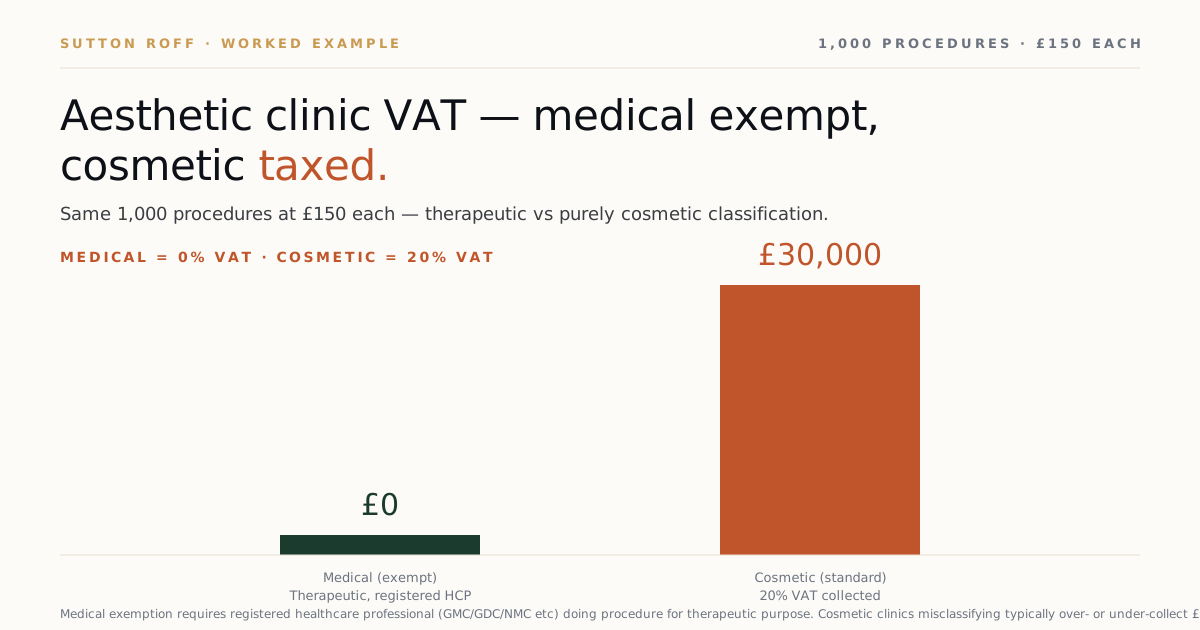
It’s the most expensive line in UK aesthetic medicine: the boundary between exempt medical treatment and standard-rated cosmetic treatment. Get it wrong and you either over-pay 20% VAT on supplies that should be exempt — or under-pay and walk into a five-or-six-figure HMRC assessment with backdated VAT, penalties and interest. Both happen frequently. Here’s the framework we use.
The legal test
VAT exemption for medical treatment (VATA 1994 Sch 9 Group 7) requires two things:
- The supplier is a registered health professional (GMC, NMC, GDC, GPhC, etc., or under direct supervision of one).
- The principal purpose is the protection, maintenance or restoration of the health of the individual.
Both must be met. Either fails — the supply is standard-rated.
The case law that matters: Skin Rich Ltd (2019), Mainpay (2022), Illuminate Skin Clinics (2024). HMRC has been winning. Their position: the second test (“principal purpose health”) requires evidence of a clinical diagnosis — not just a registered prescriber.
The grey middle
Easy cases:
- Treating melasma post-pregnancy with prescribed lasers — exempt. Clinical condition, registered practitioner.
- Lip filler for purely aesthetic enhancement — standard-rated. No medical condition.
Hard cases (where the money lives):
- Botox for migraine — exempt if licensed practitioner with documented clinical history. Standard-rated if the clinic prescribes it for “frown lines” and quietly mentions migraine prevention as a secondary benefit.
- Hyperhidrosis Botox — typically exempt if prescribed for excessive sweating (a clinical condition).
- Mole removal — exempt if there’s a dermatological reason. Standard-rated if it’s purely cosmetic.
- Acne scarring treatment — usually exempt. Acne is a clinical condition, scarring is its sequela.
- Anti-wrinkle injections — the default position is now standard-rated unless there’s clearly documented clinical justification.
What HMRC looks for
If they investigate, the documentation HMRC requests is roughly:
- Patient consultation notes recording the clinical reason for treatment.
- The prescribing clinician’s qualifications and registration.
- Evidence the principal purpose was therapeutic (not aesthetic).
- Consistent treatment of similar cases over time (so they can spot reclassification just to dodge VAT).
If your patient consent form ticks “I want this for cosmetic reasons”, that supply is standard-rated. Full stop.
A worked example
A clinic in West London does £600,000/year of total turnover, split £400k aesthetic (lip filler, anti-wrinkle, dermal fillers) and £200k clinical (acne treatment, melasma, hyperhidrosis Botox, scar revision).
If the clinic correctly applies the medical exemption to the £200k clinical and standard-rates the £400k aesthetic:
- VAT collected on aesthetic: £400k × 20% / 120% = £66,667 output VAT
- VAT recoverable on inputs (mostly standard-rated): roughly £15,000
- Net VAT bill to HMRC: ~£51,667/year
If they incorrectly classify the whole £600k as exempt (a common error), they collect zero VAT, but on review HMRC will assess up to 4 years backdated on the misclassified portion. That’s £200k+ of backdated VAT, plus penalties (15–30%) and interest. Easily £250k+ exposure.
The other direction is also painful: clinics that standard-rate everything voluntarily because “it’s safer” leave £40k+ a year in unclaimed exemption (and lose VAT-registration headroom for input recovery).
Mixed-use overheads — partial exemption
Clinics that make both exempt and standard-rated supplies become partially exempt. Input VAT on overheads (rent, utilities, equipment, software) needs to be apportioned between taxable and exempt activity. The standard method (turnover-based) is often unfavourable for clinics with high-margin aesthetic income; a special method based on treatment-room hours or staff time can recover more — needs HMRC approval first.
Key takeaways
- Medical treatment exemption requires both a registered practitioner and a principal-purpose health justification. Neither alone is enough.
- HMRC’s recent case law (Skin Rich, Illuminate) has tightened the bar — purely cosmetic treatments are now firmly standard-rated, regardless of who delivers them.
- Document the clinical rationale on the consultation form for any treatment you intend to exempt.
- Mixed-supply clinics are partially-exempt. The standard turnover-based input recovery method is often suboptimal — a special method may recover thousands more.
- Risk windows: HMRC can assess up to 4 years backdated on misclassification, plus 15–30% penalties.
FAQ
Who counts as a “registered healthcare professional”?
Doctors (GMC), dentists (GDC), nurses (NMC), pharmacists (GPhC) and certain allied health professionals on regulated registers. Aesthetic practitioners without these registrations can’t access the medical exemption regardless of training.
What documentation do I need?
Patient consultation notes documenting the therapeutic purpose, the medical professional’s assessment, and the planned procedure. Generic before/after photos aren’t enough — HMRC wants documented therapeutic intent specific to that patient.
What if a procedure has both medical and cosmetic intent?
Apportion. The therapeutic-purpose portion is exempt; the cosmetic enhancement portion is standard-rated. HMRC accepts reasonable apportionments backed by clinical notes. Get the documentation right at consultation, not retrospectively.
Running an aesthetic clinic with a mix of clinical and cosmetic treatments? Book a free 20-min review — we’ll spot-check your VAT classification, your partial-exemption method, and any backdated risk before HMRC does. Specialist aesthetic-clinic accountants.