
Section 24 of the Finance (No.2) Act 2015 is the single most expensive piece of UK landlord legislation in a generation. It stops residential landlords offsetting mortgage interest as a normal expense — replacing it with a 20% basic-rate tax credit. For a higher-rate landlord with leveraged BTL properties, it routinely creates “phantom profits” you pay tax on but never see. The fix everyone talks about is incorporation. Here’s when it actually works — and when it doesn’t.
The problem in one number
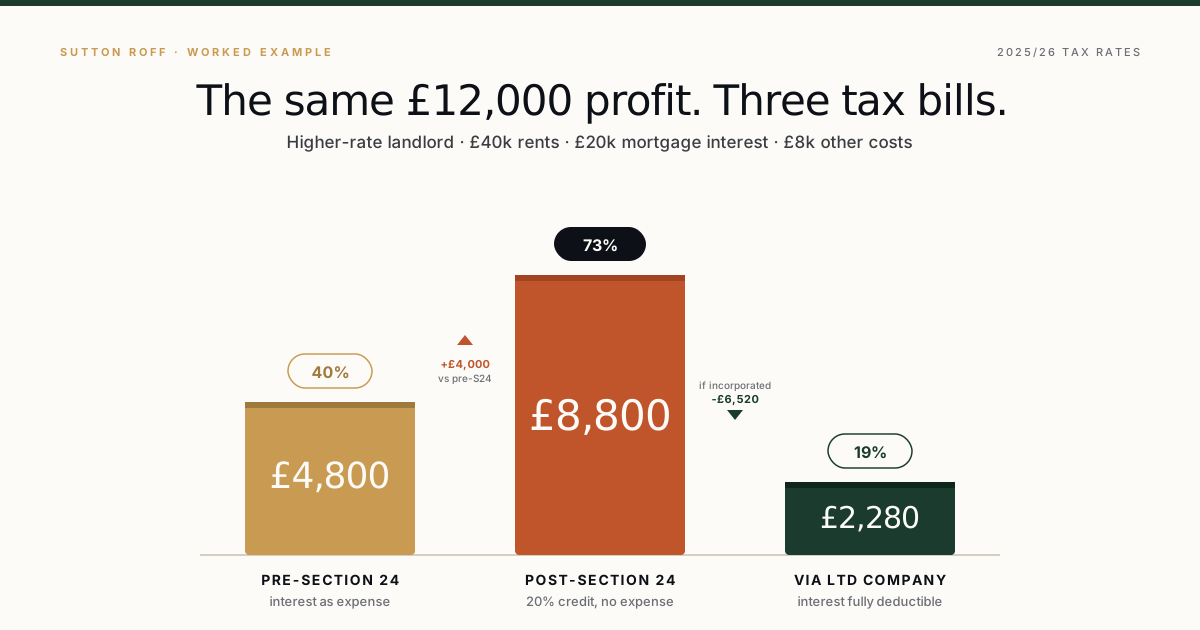
A landlord with £40,000 rental income, £20,000 mortgage interest and £8,000 other expenses pre-Section 24 had taxable rental profit of £12,000 — straightforward.
Post-Section 24, taxable profit is £32,000 (income minus other expenses, ignoring interest). Mortgage interest enters the return as a separate 20% credit: £20,000 × 20% = £4,000 reduction in tax due. For a higher-rate landlord (40%):
- Tax on £32,000 at 40% = £12,800
- Less £4,000 interest credit
- = £8,800 tax on £12,000 of actual cash profit. Effective rate: 73%.
For an additional-rate landlord (45%) with the same numbers, the effective rate is 83%. That’s the Section 24 problem.
Incorporation — why it works (in theory)
A limited company is exempt from Section 24. A Ltd company can deduct mortgage interest as a normal expense. The same numbers inside a company:
- Rental income £40,000 less £20,000 interest less £8,000 other expenses = £12,000 profit
- Corporation tax at 19% (small profits rate, sub-£50k) = £2,280
That’s £6,520/year less tax than the personal-name route — every year, indefinitely. Multiply across a portfolio and the appeal is obvious.
Why it usually doesn’t work — the costs of getting in
The catch is in the transition costs. Moving properties from personal to corporate ownership is treated as a sale at market value:
- Capital Gains Tax — payable on any uplift since you bought the property. 24% (higher rate) or 18% (basic rate) on residential gains as of 2025/26.
- Stamp Duty Land Tax — the company pays SDLT on the deemed acquisition. With the 5% additional-property surcharge (raised from 3% in October 2024), even modest portfolios hit £20k–£60k of SDLT.
- Mortgage redemption + replacement — your personal BTL mortgages need to be repaid and replaced with company-name mortgages, often at higher rates and with arrangement fees.
The total upfront cost on a £600,000 portfolio frequently exceeds £40,000–£70,000. Recovering that takes years.
A worked example
Higher-rate landlord with a portfolio of three properties: total value £800k, total mortgage £500k (interest £25k/yr), gross rents £45k, other costs £8k. Owned for 7 years, total gain since purchase ~£200k.
Status quo (personal): taxable profit £37k, tax at 40% = £14,800, less interest credit £5,000 = £9,800/yr.
If incorporated: taxable profit £12,000, CT at 19% = £2,280/yr. Annual saving ~£7,500.
One-off cost to incorporate:
- SDLT (5% additional on £800k): £40,000
- CGT (24% on £200k after annual exemption): £47,280
- Mortgage refinancing costs (~1.5% of £500k): £7,500
- Legal + accountancy: £6,000
- Total upfront: £100,780
Payback period at £7,500/yr: 13.4 years. For a landlord under 50 with a long-term hold horizon, the maths works. For a landlord planning to sell or downsize within 5–10 years, it doesn’t.
The Section 162 incorporation relief — does it apply?
Section 162 TCGA 1992 lets you defer CGT on incorporation if your property activity counts as a “business” rather than a passive investment. HMRC’s bar is high: it generally requires at least 20 hours/week of personal involvement managing the portfolio, and a portfolio big enough to justify that.
For most landlords with day jobs and a managing agent, S162 doesn’t apply. For full-time landlords with 6+ properties and active hands-on management, it might — and removes one of the biggest barriers (CGT). Talk to a specialist before relying on it.
When incorporation isn’t the answer
- Portfolio held under 5 years — not enough time for tax savings to repay the entry cost.
- Properties planned to be sold soon — incorporation locks you into corporate-CGT rules at exit.
- Basic-rate landlord — Section 24 is largely neutral for you. Incorporation rarely makes sense.
- Single small mortgage — interest deduction value is too low to cover the costs.
- Minimal personal involvement — S162 relief unavailable, full CGT crystallises on transfer.
Alternatives worth modelling first
- Spouse share transfer — if your spouse is a basic-rate taxpayer, transferring 50%+ ownership keeps everything outside Section 24’s worst impact at 0% CGT (no SDLT on transfer of equity into a spouse).
- Refinance at lower LTV — Section 24 hurts proportional to interest. Reducing leverage reduces the bite.
- Sell + redeploy — for landlords approaching retirement, exiting BTL altogether and redeploying into pensions/ISAs avoids the problem cleanly.
Key takeaways
- Section 24 hurts higher- and additional-rate landlords disproportionately — effective tax rates of 70–80% on real cash profits are common with leveraged portfolios.
- Incorporation removes the problem (companies aren’t subject to Section 24) — but the entry costs (SDLT, CGT, mortgage refi) are usually £40k–£100k+.
- Payback periods of 8–15 years are typical. Run the numbers before committing.
- Section 162 incorporation relief can defer CGT but requires genuine business-level activity (~20 hrs/week minimum).
- For many higher-rate landlords, a spouse transfer or refinancing to lower LTV achieves 70% of the benefit at 5% of the cost.
FAQ
Does Section 24 affect commercial property?
No — Section 24 applies only to residential property. Commercial landlords still get full mortgage interest deduction. Mixed-use properties (e.g. shop with flat above) need apportionment between residential and commercial.
What if I refinance during the year?
Refinancing changes the interest amount but not the Section 24 mechanic. The new interest payments still get only 20% basic-rate credit relief, not full deduction. Refinancing to lower LTV reduces the bite.
Can I incorporate just one property at a time?
Yes — you can transfer single properties to a Ltd. But each transfer triggers SDLT (5% surcharge) and CGT. Section 162 incorporation relief requires meaningful business activity (~20 hrs/week), so single-property transfers usually don’t qualify.
We model every Section 24 scenario for new landlord clients — incorporation, spouse transfer, leverage reduction, partial exit. Book a free 20-min review and we’ll show you the breakeven analysis specific to your portfolio. Specialist landlord and property accountants.