
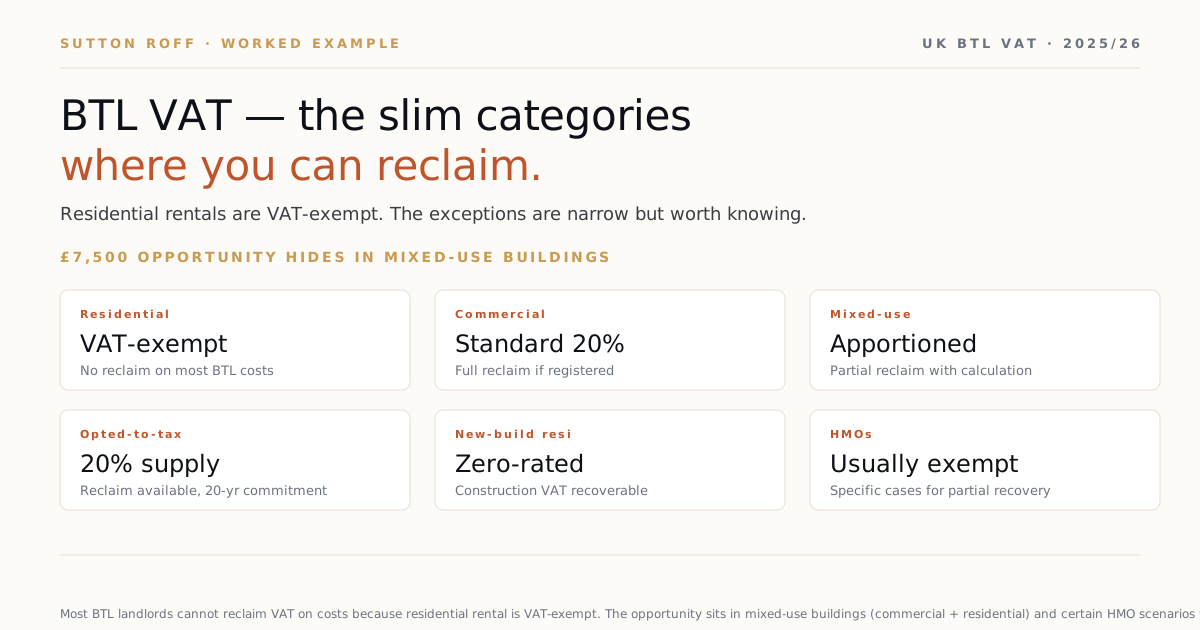
Residential rentals are VAT-exempt. That stops most landlords looking — and almost all generalist accountants miss the next step. If the property is owned by a VAT-registered entity, the partial-exemption de minimis rules quietly allow up to £7,500 a year of input VAT to be reclaimed on rental costs. We see this overlooked at least once a quarter.
The basics
Renting out residential property (other than furnished holiday lets, which the regime has abolished from April 2025) is an exempt supply for VAT purposes. So in principle, no VAT recovery on costs that relate to that activity.
The catch — and the opportunity — sits inside partial exemption. If the same legal entity also makes taxable supplies (i.e. it runs a normal VAT-registered business and owns the rental property), it becomes a partially-exempt trader. And HMRC’s de minimis limit lets a partially-exempt trader recover all of its exempt-related input VAT, provided two conditions are met:
- Total exempt-related input VAT is no more than £625 per month on average (£7,500 a year), and
- It’s no more than 50% of total input VAT being reclaimed.
Hit both, and the VAT on rental costs (plus a fair share of overheads) becomes recoverable. Miss either, and you can’t reclaim any of the exempt VAT.
Who can claim it?
The property must sit in a VAT-registered entity. Two common structures work:
- Sole trader who is VAT-registered for their main business and personally owns the rental property.
- VAT-registered limited company that owns the rental.
If the property is owned by a separate non-VAT-registered SPV, no reclaim is possible — that’s the wrong structure for this strategy.
A worked example
A consultancy company is VAT-registered with annual taxable turnover of £180k. The company also owns a flat let to a long-term tenant generating £18k a year. In a typical year the company incurs:
- £3,200 of input VAT on the rental property (repairs, agent fees, legal costs, gas-safety, insurance with VAT element)
- £1,800 of input VAT on general overheads, of which a fair-use portion (say 20%) relates to the rental
- £14,000 of input VAT on the consultancy business
Exempt-related input VAT = £3,200 + (20% × £1,800) = £3,560. That’s well under the £625-per-month average and under 50% of total input VAT (£3,560 of £19,000 = 18%). De minimis met on both counts — the full £3,560 is recoverable. Without the structure, that’s £3,560 left on the table.
The Flat Rate Scheme trap
If your business is on the Flat Rate Scheme (FRS), this strategy backfires badly. Two problems:
- FRS doesn’t allow input VAT recovery on costs (other than capital purchases over £2,000), so you can’t claim the £3,560 above.
- Worse, FRS captures all turnover including exempt and zero-rated supplies. So your £18k of rental income gets dragged into your flat-rate calculation, and you end up paying VAT on it. The reverse of what you wanted.
If you’re on FRS and own a rental property in the same entity, this is usually a strong argument to leave the scheme.
When this is a bad idea
- You’re on the Flat Rate Scheme (see above) and don’t want to deregister from it.
- Your rental costs are so low that the recovery doesn’t justify the partial-exemption administration.
- The property is held in an SPV for genuine commercial or estate-planning reasons — restructuring just to recover VAT rarely makes sense.
Key takeaways
- Residential rentals are VAT-exempt — but a VAT-registered owner can recover exempt-related input VAT under partial exemption.
- The de minimis ceiling is £625/month average + ≤50% of total input VAT. Hit both and full recovery is allowed.
- Up to £7,500 a year of extra VAT recovery — typically forgotten unless your accountant is genuinely looking.
- Flat Rate Scheme breaks this strategy and adds a flat-rate VAT bill on the rental income. Check before you assume.
FAQ
What about repairs vs improvements for VAT?
VAT on repairs to residential property isn’t reclaimable (residential rentals are exempt). VAT on capital improvements goes into the property’s cost basis but also can’t be reclaimed. Only commercial-property landlords or opted-to-tax buildings recover residential VAT.
Does opting to tax create a CGT issue later?
Opting to tax doesn’t directly trigger CGT. But it makes future supplies VAT-able for 20 years — affecting marketability if you sell to a non-VAT-registered buyer. Not lightly reversed.
Can I reclaim VAT on the original purchase?
Generally no for residential property. New-build commercial property: yes. New-build residential: zero-rated (no VAT to reclaim). Existing residential: VAT-exempt. The reclaim opportunities are narrow and specific.
Own residential property and run a VAT-registered business in the same entity? Book a free 20-min review and we’ll tell you exactly how much you can reclaim — or if FRS is costing you more than it’s saving. Specialist accountants for UK landlords.