
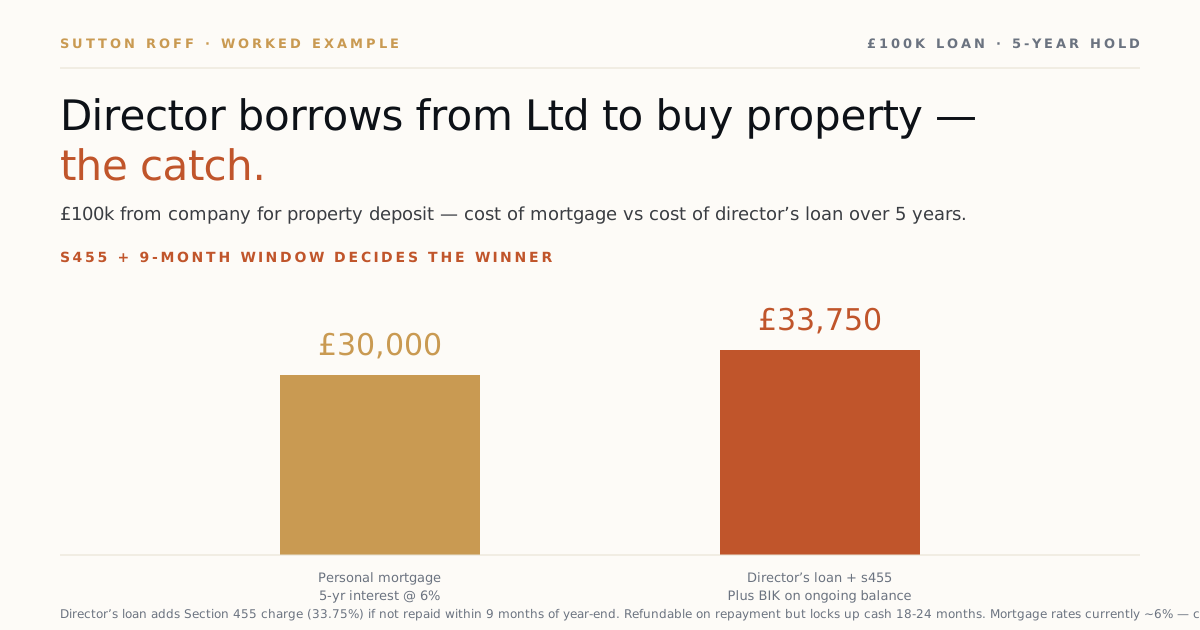
Most directors hear “borrow money from your company” and assume HMRC will come down on them like a tonne of bricks. It’s one of the most persistent myths in small-business tax — and it’s costing people real money.
Borrowing from your limited company to fund a property purchase is legal. It isn’t tax-free, but in the right circumstances it can be meaningfully cheaper than a high-street mortgage (an option for any UK landlord). Here’s how the numbers actually work in 2025/26, and the situations where it’s worth doing.
When this actually makes sense
Three conditions need to line up:
- Your company has surplus cash it doesn’t need for working capital or upcoming tax bills.
- You’re a director and a shareholder — ideally the sole or majority one, so there’s nobody to object.
- You need the money for longer than a few months — otherwise the Section 455 cash-flow hit (below) isn’t worth it.
The classic use case is moving home and needing a deposit bridge, or buying an investment property personally rather than through the company. (If you’re buying a buy-to-let inside the company, that’s a different structure — no director’s loan required.)
The three tax charges to understand
A director’s loan over £10,000 triggers three separate tax consequences. Skip any of them and the numbers don’t work.
1. Benefit in kind (you, personally)
If the company lends you money interest-free — or at a rate below HMRC’s “official rate” — the interest you would have paid is treated as a taxable benefit in kind (BIK). For 2025/26, the official rate is 3.75%.
On a £200,000 loan, that’s a BIK of £7,500 a year, reported on your P11D and taxed at your marginal income-tax rate (20% / 40% / 45%). Pushing yourself into a higher tax band also compresses the basic-rate space for your dividends, so the knock-on cost on dividend tax can be significant.
2. Class 1A NIC (the company)
Your company pays employer’s National Insurance on the value of that BIK. The rate rose to 15% from 6 April 2025 (up from 13.8%), so the company’s NIC bill on a £7,500 BIK is £1,125 a year. This is deductible for Corporation Tax, which softens the blow.
3. Section 455 tax (the company)
This is the one that scares people. If the loan isn’t repaid within nine months and one day of the company’s year end, HMRC charges the company 33.75% of the outstanding balance. On a £200,000 loan that’s £67,500.
The critical thing: Section 455 is not a permanent tax. It’s recoverable. When you repay the loan to the company, HMRC refunds the Section 455 tax. Think of it as a deposit with HMRC, not a cost. The trade-off is pure cash flow — and it’s a big one.
Not sure if a director’s loan is right for your situation?
We’ll model the full cost — BIK, Class 1A NIC, Section 455, personal tax — against your actual numbers in a free 20-minute call. You’ll know whether to proceed before you commit.
A worked example: the £200,000 question
Jeremy is the sole director/shareholder of a profitable Ltd company. He pays himself £12,570 of salary and £37,700 of dividends (the standard tax-efficient split that keeps him just inside the basic-rate band). He wants to borrow £200,000 from the company to help buy a bigger home.
Personal tax cost
- BIK of £7,500 added to earned income → £1,500 income tax at 20%
- Earned income now £20,070; basic-rate space for dividends drops, so £7,000 of dividends gets pushed into the higher-rate band (33.75%) rather than basic (8.75%) — extra £1,750 of dividend tax
- Total personal cost: ~£3,250 a year
Company tax cost
- Class 1A NIC: £1,125, less ~25% CT relief = ~£845 net per year
Section 455 deposit: £67,500 sits with HMRC until Jeremy repays the loan.
Running total: ~£4,095 a year in real tax cost, plus the temporary £67,500 Section 455 deposit.
Is it cheaper than a mortgage?
On an annual basis, the effective rate of the director’s loan is about 2.05% (£4,095 ÷ £200,000). If you’d otherwise be paying a 4.5% mortgage, that’s a material saving.
| Scenario | Annual cost on £200,000 | Over 5 years |
|---|---|---|
| High-street mortgage at 4.5% | £9,000 interest | £45,000 |
| Director’s loan (2025/26 rates) | ~£4,095 tax | ~£20,475 |
| Difference | ~£4,900/year | ~£24,500 |
The break-even is a mortgage rate of around 2.05%. Anything above that, and the director’s loan wins on cost — assuming the company can afford the Section 455 cash-flow hit.
Practical considerations before you do this
- Document it properly. Board minutes, a written loan agreement, and (depending on size and structure) shareholder approval under Companies Act 2006 s.197. Undocumented loans are where HMRC enquiries get nasty.
- Report on the P11D. The BIK must appear on your annual P11D, and Class 1A NIC is due by 22 July following the tax year.
- Disclose in company accounts. Directors’ loans are required disclosures under FRS 102 Section 1A — your accountant needs to pick this up.
- Charge interest at the official rate if you want to avoid the BIK entirely. You’d pay the interest personally to the company; the company then pays Corporation Tax on the received interest (it’s taxable income), but the personal BIK and Class 1A NIC disappear. Sometimes worth running both scenarios.
- Plan the repayment. Ideally repay at least some of the loan within nine months of year-end to avoid the full Section 455 bill, and model when your Section 455 refund will come back.
When this is a bad idea
- Your company needs the cash for trading or upcoming tax liabilities.
- There are other shareholders you’d need to get on board (and you can’t).
- The loan is small (<£20,000) — the admin and cash-flow complexity usually isn’t worth it.
- You can’t realistically repay within a few years — the longer the loan sits, the more the Section 455 cash sits trapped.
- You’re using the money for a business purpose through a different entity — there’s usually a better route via intercompany loans or capital contributions.
FAQ
Can I use a company loan as a mortgage deposit?
Yes — many directors do exactly this. The company loan funds the deposit; a personal mortgage covers the rest. Mortgage lenders typically need to see the company loan documented as a formal arrangement rather than a casual transfer.
Does the property need to be in my personal name?
No — you can use a company loan to buy a property in your personal name (it’s a loan from company to you, used for whatever you choose) or buy in the company’s name (different structure with different tax/SDLT implications).
What if I default on the company loan?
Defaulting on a director’s loan typically means writing it off — which becomes a deemed dividend, taxed at your marginal rate. The s455 charge crystallises but doesn’t refund. Plus potential insolvency considerations if the company can’t bear the write-off.
Key takeaways
- A director’s loan can be a genuine alternative to a mortgage for property purchases — often at a lower effective cost.
- In 2025/26, expect about ~2% effective annual cost on a £200,000 loan, vs typical mortgage rates around 4.5%.
- The Section 455 charge (33.75%) is a cash-flow issue, not a permanent cost — you get it back when the loan is repaid.
- It only makes sense if your company has the surplus cash and the shareholder approvals are in place.
- Document everything, report the BIK on your P11D, and have your accountant price both scenarios (interest-free vs commercial-rate) before you commit.
Thinking about this for a property purchase? We run the numbers for both scenarios in our free 20-minute review — usually takes less than half an hour to know whether it’ll save you money. Book a call.